- Animals
- ›Chordates
- ›Vertebrates
- ›Mammals
- ›Therians
- ›Placental Mammals
- ›Primates, Rodents, and Allies
- ›Primates
- ›Monkeys, Apes, and Tarsiers
- ›Monkeys and Apes
- ›Apes and Old World Monkeys
- ›Old World Monkeys
- ›Cercopithecines
- ›Guenons, Vervet Monkeys, and Talapoins
- ›Cercopithecus
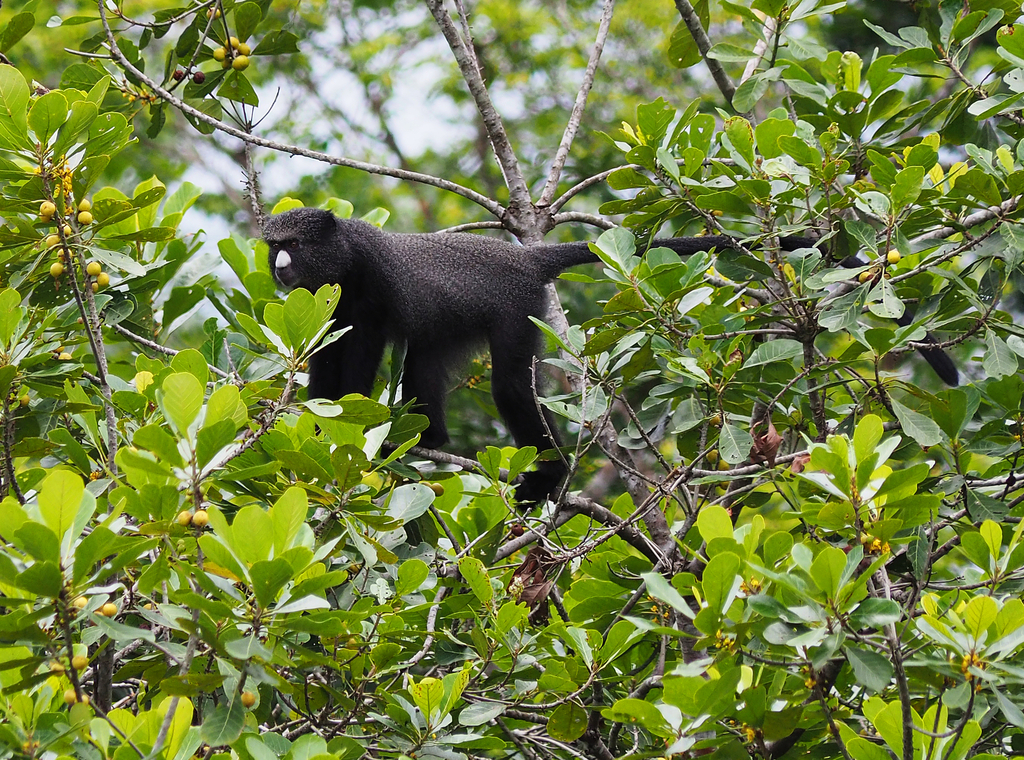
Putty-nosed Monkey
Cercopithecus nictitans
The greater spot-nosed monkey or putty-nosed monkey (Cercopithecus nictitans) is one of the smallest Old World monkeys. It is a guenon of the C. mitis group, native to West Africa and living to some extent in rain forests, but more often in the transition zone between rain forest and savannah. It is primarily arboreal and often associates with monkeys of other species. Both their common names come from the monkeys' prominent white nose.
The greater spot-nosed monkey lives in groups consisting of one adult male, a number of adult females, and their dependent offspring. Little recent research has been conducted into its behaviour, and most has concentrated on its auditory communication. Males use three call types which have been described as 'booms', 'pyows', and 'hacks'. These are used in a number of contexts including as alarm calls.
Listen
Looking for field recordings…
Where it lives
Recorded sightings
—
geo-referenced records in GBIF, from museums, herbaria and field observers.
Drag the globe to turn it. Dots are where records exist, not a range map; darker means more records.
In the stacks
Searching the stacks…
Every page naming Cercopithecus nictitans in the Biodiversity Heritage Library →
This page is assembled live from iNaturalist, GBIF, Wikipedia, the Source Library and the Internet Archive. It is not yet part of the hand-edited codex. iNaturalist taxon 43485.