- Animals
- ›Chordates
- ›Vertebrates
- ›Mammals
- ›Therians
- ›Placental Mammals
- ›Primates, Rodents, and Allies
- ›Primates
- ›Monkeys, Apes, and Tarsiers
- ›Monkeys and Apes
- ›Apes and Old World Monkeys
- ›Old World Monkeys
- ›Cercopithecines
- ›Guenons, Vervet Monkeys, and Talapoins
- ›Cercopithecus
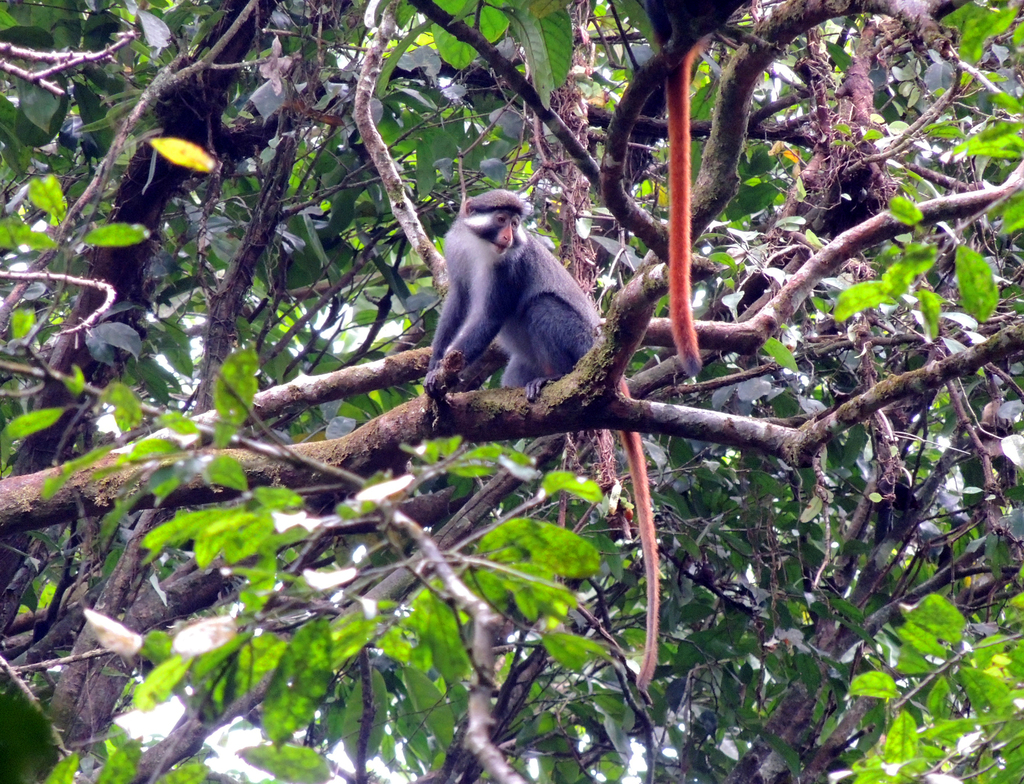
Red-eared Monkey
Cercopithecus erythrotis
The red-eared guenon (Cercopithecus erythrotis), also called red-eared monkey or russet-eared guenon, is a primate species in the family Cercopithecidae. It is native to subtropical and tropical moist lowland forests in Cameroon, Equatorial Guinea and Nigeria. It is listed as Vulnerable on the IUCN Red List and is threatened by habitat loss, illegal bushmeat hunting and pet trade.
From the article Red-eared guenon on Wikipedia (CC BY-SA), quoted section by section
Description
The red-eared guenon is a small, colourful monkey with distinctive facial markings which involve blue fur around its eyes, a brick-red nose and ears, and yellow cheeks. The silky fur on the body consists of banded brown and pale hairs with grey limbs and a long, red tail. The long tails are partially prehensile and are used by infants to cling to the female. The red-eared guenon is an unobtrusive species which produces a quiet trill, unlike the loud long-distance calls made by other guenons. Males average 420 mm head and bodylength, with a 609 mm long tail, females are smaller with a mean head and body length of 384 mm and an average tail length of 553 mm.
Range & habitat
There are two recognised subspecies, which are listed below with their distributions:
Cercopithecus erythrotis camerunensis Hayman, 1940 Cameroon Red-eared Monkey: from the Cross River in south eastern Nigeria and to just north of the Sanaga River in south western Cameroon. Cercopithecus erythrotis erythrotis Waterhouse, 1838 Bioko Red-eared Monkey:Bioko island in Equatorial Guinea.
Wikipedia: “Distribution and subspecies”
What it does
The red-eared guenon is omnivorous and has been recorded eating fruit, leaves, shoots and insects, the latter are important for nutrition, especially for pregnant and lactating females. The red-eared guenon normally forms groups consisting of at least one adult male and around ten females with young which are not as hierarchical as some primate societies. They are territorial but they usually avoid conflict with other groups. The breeding biology of red-eared guenons is little known but similar species give birth to a single infant every one to three years, with pregnancy taking five or six months.
Wikipedia: “Behaviour and ecology”
Listen
Looking for field recordings…
Where it lives
Recorded sightings
—
geo-referenced records in GBIF, from museums, herbaria and field observers.
Drag the globe to turn it. Dots are where records exist, not a range map; darker means more records.
In the stacks
Searching the stacks…
Every page naming Cercopithecus erythrotis in the Biodiversity Heritage Library →
This page is assembled live from iNaturalist, GBIF, Wikipedia, the Source Library and the Internet Archive. It is not yet part of the hand-edited codex. iNaturalist taxon 43484.