- Animals
- ›Chordates
- ›Vertebrates
- ›Mammals
- ›Therians
- ›Placental Mammals
- ›Primates, Rodents, and Allies
- ›Primates
- ›Monkeys, Apes, and Tarsiers
- ›Monkeys and Apes
- ›Apes and Old World Monkeys
- ›Old World Monkeys
- ›Cercopithecines
- ›Baboons, Macaques, and Mangabeys
- ›Cercocebus
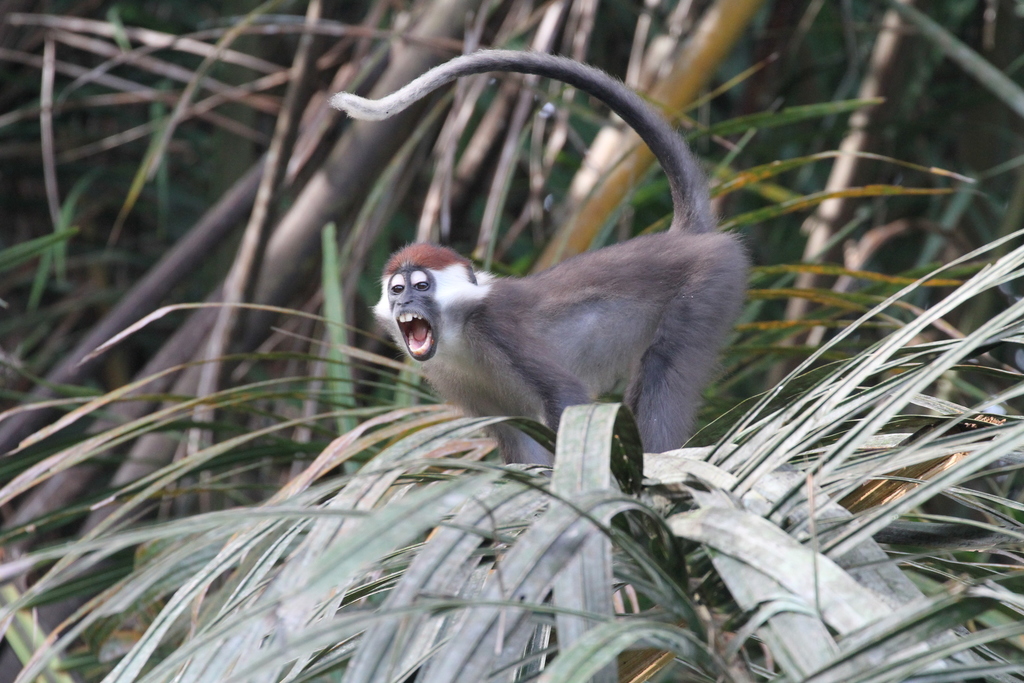
Red-capped Mangabey
Cercocebus torquatus
The collared mangabey (Cercocebus torquatus), also known as the red-capped mangabey, or the white-collared mangabey (leading to easy confusion with Cercocebus atys lunulatus), is a species of primate in the family Cercopithecidae of Old World monkeys. It formerly included the sooty mangabey as a subspecies. As presently defined, the collared mangabey is monotypic.
From the article Collared mangabey on Wikipedia (CC BY-SA), quoted section by section
Description
The collared mangabey has grey fur covering its body, but its common names refer to the colours on its head and neck. Its prominent chestnut-red cap gives it the name red-capped, and its white collar gives it the names collared and white-collared. Its ears are black and it has striking white eyelids, which is why some refer to it as the "four-eyed monkey". It has a dark grey tail that exceeds the length of the body and is often held with the white tip over its head. It has long molars and very large incisors. The average body mass for captive individuals ranges from 9 to 10 kg (20 to 22 lb) for males and 7.5 to 8.6 kg (17 to 19 lb) for females. Head-body length is 47–67 cm (19–26 in) in males and 45–60 cm (18–24 in) in females.
Range & habitat
The collared mangabey is found in coastal, swamp, mangrove, and valley forests, from western Nigeria, east and south into Cameroon, and throughout Equatorial Guinea, and Gabon, and on the Gabon-Congo border by the Atlantic shore.
Wikipedia: “Distribution and habitat”
What it does
The collared mangabey lives in large groups of 10 to 35 individuals including several males. Vocal communication in the form of cackles and barks are used to keep the group in contact and signal their position to other groups. It has a diet of fruits and seeds, but also eats leaves, foliage, flowers, invertebrates, mushrooms, dung, and gum. The collared mangabey has no defined breeding season, it reaches sexual maturity at five to seven years, and has an average gestation period of 170 days.
Wikipedia: “Behavior and ecology”
Listen
Looking for field recordings…
Where it lives
Recorded sightings
—
geo-referenced records in GBIF, from museums, herbaria and field observers.
Drag the globe to turn it. Dots are where records exist, not a range map; darker means more records.
In the stacks
Searching the stacks…
Every page naming Cercocebus torquatus in the Biodiversity Heritage Library →
This page is assembled live from iNaturalist, GBIF, Wikipedia, the Source Library and the Internet Archive. It is not yet part of the hand-edited codex. iNaturalist taxon 43467.