- Animals
- ›Chordates
- ›Vertebrates
- ›Mammals
- ›Therians
- ›Placental Mammals
- ›Primates, Rodents, and Allies
- ›Primates
- ›Monkeys, Apes, and Tarsiers
- ›Monkeys and Apes
- ›Apes and Old World Monkeys
- ›Old World Monkeys
- ›Cercopithecines
- ›Baboons, Macaques, and Mangabeys
- ›Macaca
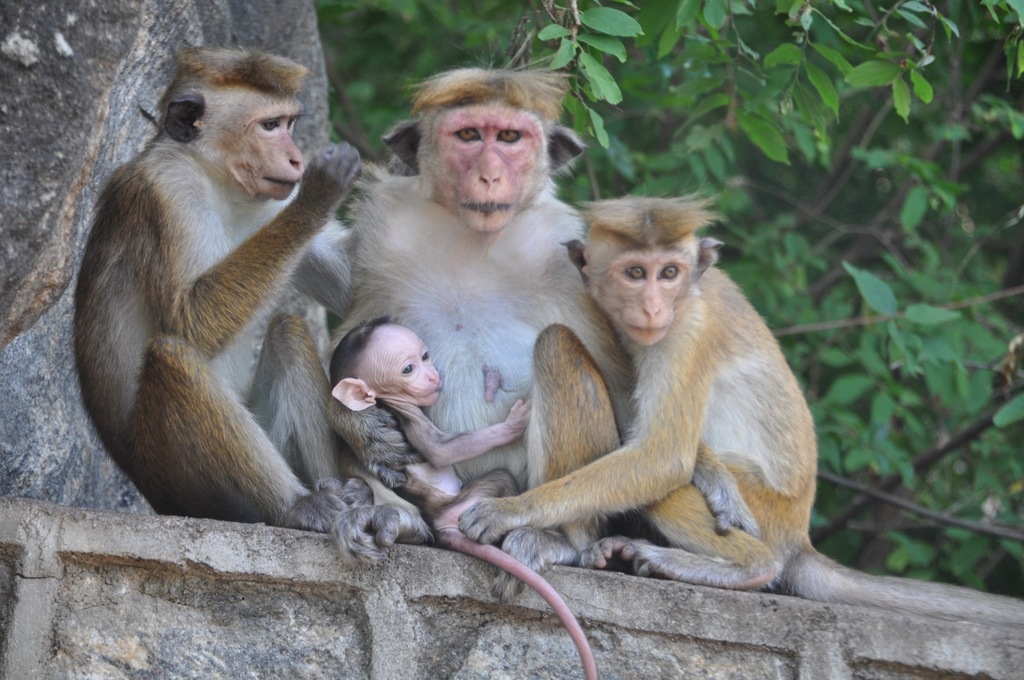
Toque Macaque
Macaca sinica
The toque macaque (; Macaca sinica) is a reddish-brown-coloured Old World monkey endemic to Sri Lanka, where it is known as the riḷawā (Sinhala: රිළවා), (hence the English word rillow). Its name refers to the whorl of hair at the crown of the head, reminiscent of a brimless toque cap.
From the article Toque macaque on Wikipedia (CC BY-SA), quoted section by section
Description
With age, the face of females turns slightly pink. This is especially prominent in the subspecies M. s. sinica.
Range & habitat
M. s. sinica is found from the Vavuniya, Mannar to the lowlands of Anuradhapura, Polonnaruwa, Puttalam, and Kurunegala; and along the arid zone of the Monaragala and Hambantota districts. M. s. aurifrons can be found sympatrically with the subspecies M. s. sinica within intermediate regions of the country in Kegalle and parts of Kurunegala. It is also found in south-western parts of the island in the Galle and Matara districts near Kalu Ganga. M. s. opisthomelas has recently been identified as a separate subspecies. It can be found in the entire south-western region of Ratnapura and in the Nuwara Eliya districts. It is also found around Hakgala Botanical Garden and other cold climatic montane forest patches.
Wikipedia: “Distribution”
What it does
When in estrous, the female's perineum becomes reddish in color and swells. This signals to males that she is ready to mate. There is an average of 18 months between births. After a 5–6 month gestation period, the female will give birth to a single offspring. The baby will hold on to its mother for about 2 months. During this time the infant learns social skills critical for survival. The infant will inherit its social standing from its mother's position in the troop. Young males are forced to abandon their troop when they are about 6–8 years of age. This prevents inbreeding and ensures that the current alpha male maintains his position in the troop. Leaving the troop is the only way a male can change his social standing. If he has good social skills and is strong he may become an alpha male. A single alpha male can father all of the troops' offspring. Birth rarely occurs during the day or on the ground. During labor the female isolates herself from the group (about 100 m). The mother stands bipedally during parturition and assists the delivery with her hands. The infant is usually born 2 minutes after crowning. The infant can vocalize almost immediately after birth; it is important for the mother and infant to recognize each other's voices. Vocalization will be used to alert the mother of imminent danger, and can assist in finding each other if separated. …
Wikipedia: “Reproduction”
Listen
Looking for field recordings…
Where it lives
Recorded sightings
—
geo-referenced records in GBIF, from museums, herbaria and field observers.
Drag the globe to turn it. Dots are where records exist, not a range map; darker means more records.
In the stacks
Searching the stacks…
Every page naming Macaca sinica in the Biodiversity Heritage Library →
This page is assembled live from iNaturalist, GBIF, Wikipedia, the Source Library and the Internet Archive. It is not yet part of the hand-edited codex. iNaturalist taxon 43456.