- Animals
- ›Chordates
- ›Vertebrates
- ›Mammals
- ›Therians
- ›Placental Mammals
- ›Primates, Rodents, and Allies
- ›Primates
- ›Monkeys, Apes, and Tarsiers
- ›Monkeys and Apes
- ›Apes and Old World Monkeys
- ›Old World Monkeys
- ›Cercopithecines
- ›Baboons, Macaques, and Mangabeys
- ›Macaca
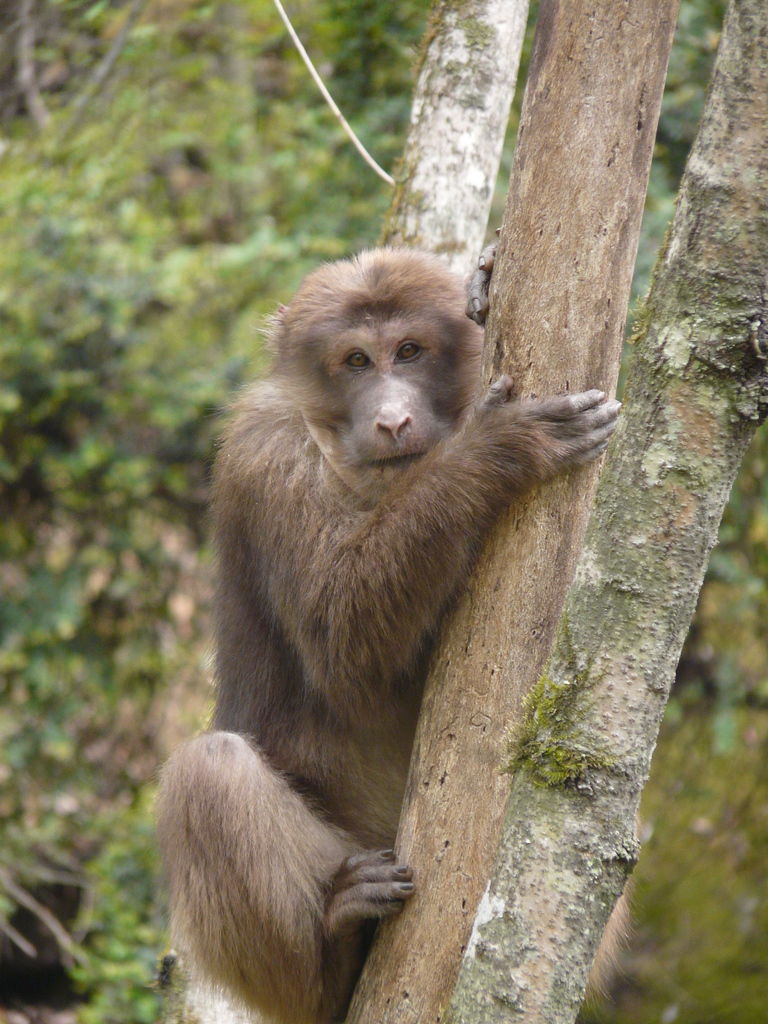
Tibetan Macaque
Macaca thibetana
The Tibetan macaque (Macaca thibetana), also known as Père David's Macaque, the Chinese stump-tailed macaque or Milne-Edwards' macaque, is a macaque species found from eastern Tibet east to Guangdong and north to Shaanxi in China. It has also been reported in northeastern India. This species lives in subtropical forests (mixed deciduous to evergreen) at elevations from 800 to 2,500 m (2,600 to 8,200 ft) above sea level.
From the article Tibetan macaque on Wikipedia (CC BY-SA), quoted section by section
What it does
The Tibetan macaque lives in mixed sex groups. In their complex social system, females remain for life in their natal group, but males disperse shortly after their adolescence (at about 8 years old). Macaque societies are hierarchical, with higher-ranking males getting better access to the resources, namely food and sexually-receptive females. Alpha males dominate the group, being those that are typically large, strong and newly mature. As they age, males tend to gradually lose their social standing and are frequently subject to challenges for dominance from other males. Such conflicts are frequently quite violent and males may kill each other in battle. Studies of Tibetan macaques at Mount Emei and Huangshan Mountains, found the average tenure for an alpha male only lasted about one year. When troop size becomes quite large (in the 40 to 50 range) and competition grows over increasingly stretched resources, some individuals (males, females and juveniles) split from the main group to form a new, smaller group, known as 'fissioning', and move on to a different home range. Usually, it is the lowest-ranking individuals that will split from the main group. Females first breed at around five years of age. The gestation period is six months with a single offspring being produced at each pregnancy. Most infants being born in January and February. …
Wikipedia: “Behaviour”
In human culture
Xing Xing, a free-ranging, one-armed Tibetan macaque, has garnered considerable online fame for her visits to Yanghu Temple in Ninghai County, China, where she is cared for by an elder nun named Ye Liannu.
Wikipedia: “Popular culture”
Listen
Looking for field recordings…
Where it lives
Recorded sightings
—
geo-referenced records in GBIF, from museums, herbaria and field observers.
Drag the globe to turn it. Dots are where records exist, not a range map; darker means more records.
In the stacks
Searching the stacks…
Every page naming Macaca thibetana in the Biodiversity Heritage Library →
This page is assembled live from iNaturalist, GBIF, Wikipedia, the Source Library and the Internet Archive. It is not yet part of the hand-edited codex. iNaturalist taxon 43451.