- Animals
- ›Chordates
- ›Vertebrates
- ›Mammals
- ›Therians
- ›Placental Mammals
- ›Primates, Rodents, and Allies
- ›Primates
- ›Monkeys, Apes, and Tarsiers
- ›Monkeys and Apes
- ›New World Monkeys
- ›Cebid Monkeys
- ›Squirrel Monkeys
- ›Saimiri
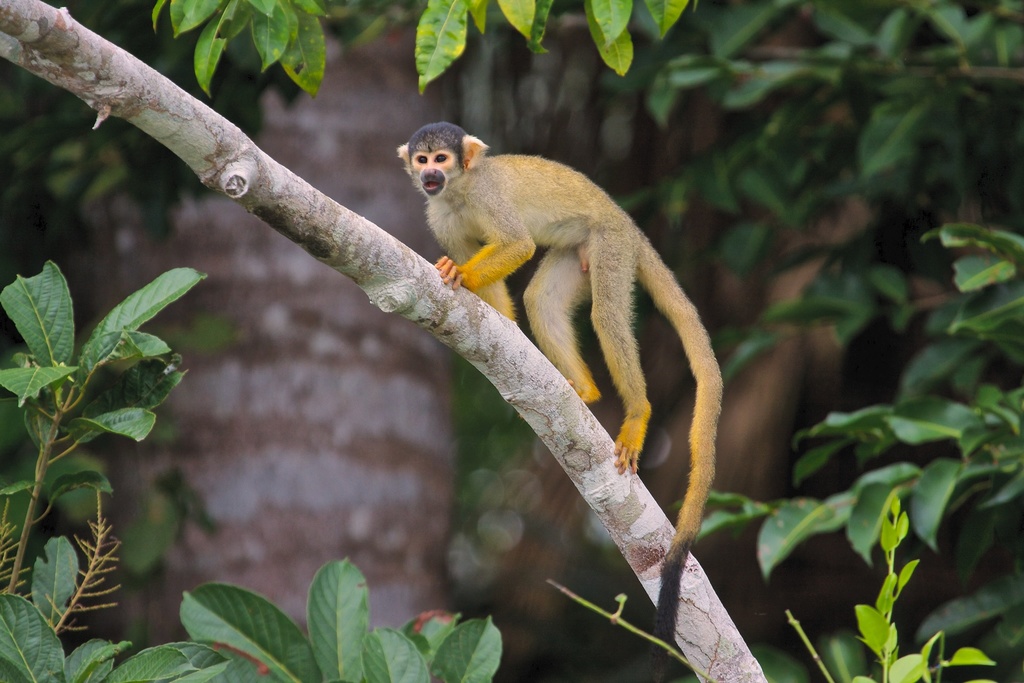
Black-capped Squirrel Monkey
Saimiri boliviensis
The black-capped squirrel monkey (Saimiri boliviensis) is a species of New-World monkey native to the upper Amazon basin in Bolivia, western Brazil and eastern Peru. They weigh between 365 and 1,135 g (13 and 40 oz) and measure, from the head to the base of the tail, between 225 and 370 mm (9 and 15 in). The black-capped squirrel monkey is primarily tree-dwelling and is found in both native and plantation forests as well as some farmed areas near running water. Its diet is omnivorous and mostly consists of flowers, fruit, leaves, nuts, seeds, insects, arachnids, eggs and small vertebrates. It mostly lives in female-dominated troops of around 40 to 75 monkeys, with males having been observed to disperse to live in all-male troops after reaching sexual maturation. Its current conservation status according to the International Union for Conservation of Nature (IUCN) is 'Least Concern'. The species belongs to the genus Saimiri and has two subspecies, S. b. boliviensis (the Bolivian squirrel monkey) and S. b. peruviensis (the Peruvian squirrel monkey).
From the article Black-capped squirrel monkey on Wikipedia (CC BY-SA), quoted section by section
Description
The black-capped squirrel monkey displays sexual dimorphism, with males normally weighing between 550 and 1,135 g (19.4 and 40.0 oz) and females weighing between 365 and 750 g (12.9 and 26.5 oz). Infants typically weigh between 80 and 140 g (2.8 and 4.9 oz) when they are born. Adults of the species measure in length (from the head to the base of the tail) between 250 and 370 mm (9.8 and 14.6 in) for males and 225 and 295 mm (8.9 and 11.6 in) for females. The coat of the monkey is short, soft and dense, and the majority of the fur covering the back of the monkey is a grey to olive-brown hue, while the undersides are typically white, yellow or ochre. The head is characteristically black with white arches over the eyes. The tail is the same colour as the body with a black tufted tip and is not prehensile; it usually measures around 350 to 425 mm (13.8 to 16.7 in). Physically, the black-capped squirrel monkey is very similar to a number of other species of squirrel monkey, but is distinguishable from other species by a number of features. The most noticeable of these are the dark black cap and the white 'Roman type' arch pattern over the monkey's eyes, which is more narrow and rounded than the 'Gothic type' arch pattern over the eyes of the other species. The tail of the 'Roman type' species is also narrower than that of the 'Gothic type'.
Range & habitat
Saimiri displaying the characteristic 'Roman arch' facial pattern of the black-capped squirrel monkey have been documented throughout most of Bolivia, northern Peru, and between the Jurua and Purus Rivers in Brazil. The species is found in lowland tropical rainforests near water in densely forested and swampy regions. It is predominantly arboreal, and while it utilises all levels of the forests, it has been observed to keep mostly to the lower canopies for the purposes of travel and foraging. It has been proposed that matrilineal troops of Saimiri boliviensis are formed due to an abundance of fruit and insects present in their habitat, which is not present in the habitats of other species of the Saimiri genus.
Wikipedia: “Distribution and habitat”
What it does
A Black-capped squirrel monkey will typically reach sexual maturation at around 3 years of age for females and 5 years of age for males. The yearly reproductive cycle of mature Saimiri has been observed by several researchers to be affected by a number of environmental factors, including the cycles of rainfall and levels of illumination in their habitat. The mating season coincides with the dry season, and will typically result in a single infant being born to each mother. It has been suggested that adult female monkeys are more receptive to environmental cues for the mating season to begin, and the response in males is in part attributed to behavioural and scent cues from the females. During the mating season, males of the species will gain a large amount of subcutaneous upper body fat, leading to what is known as a 'fatted' appearance. It has also been observed that the testosterone levels of monkeys of the Bolivian and Peruvian species are noticeably higher during the mating season than those of other species of male Saimiri from Guayana. Males will become more irritable and aggressive, fight more frequently for the purpose of achieving dominance within the troop, and engage in genital display towards less dominant males. …
Wikipedia: “Reproduction”
At the table
Black-capped squirrel monkeys are omnivorous. A typical squirrel monkey diet includes fruits, insects, eggs, small vertebrates, arachnids, leaves, flowers, nuts, seeds, and rarely fungi; however it has been observed that they prefer insects to fruit. Mature Saimiri spend most of the day foraging. They will begin foraging at around 60 to 40 minutes before sunrise and will spend the first part of the day actively feeding on fruits and any insects they are able to hunt while foraging for fruit. They will then adopt more sedate feeding behaviors and spend the rest of the day resting and hunting for more insects. Often, when food is not scarce, they will stop and rest for an hour or two in the middle of the day when it is too hot to continue. When fruits are scarce, squirrel monkeys have been reported to consume Ascopolyporus, a fungus that is parasitic on scale insects which are parasitic to local bamboo species. Researchers formulate that this is done as an alternative food source during dry seasons.
Wikipedia: “Food and foraging”
Listen
Looking for field recordings…
Where it lives
Recorded sightings
—
geo-referenced records in GBIF, from museums, herbaria and field observers.
Drag the globe to turn it. Dots are where records exist, not a range map; darker means more records.
In the stacks
Searching the stacks…
Every page naming Saimiri boliviensis in the Biodiversity Heritage Library →
This page is assembled live from iNaturalist, GBIF, Wikipedia, the Source Library and the Internet Archive. It is not yet part of the hand-edited codex. iNaturalist taxon 43426.