- Animals
- ›Chordates
- ›Vertebrates
- ›Mammals
- ›Therians
- ›Placental Mammals
- ›Primates, Rodents, and Allies
- ›Primates
- ›Monkeys, Apes, and Tarsiers
- ›Monkeys and Apes
- ›New World Monkeys
- ›Marmosets and Tamarins
- ›Leontopithecus
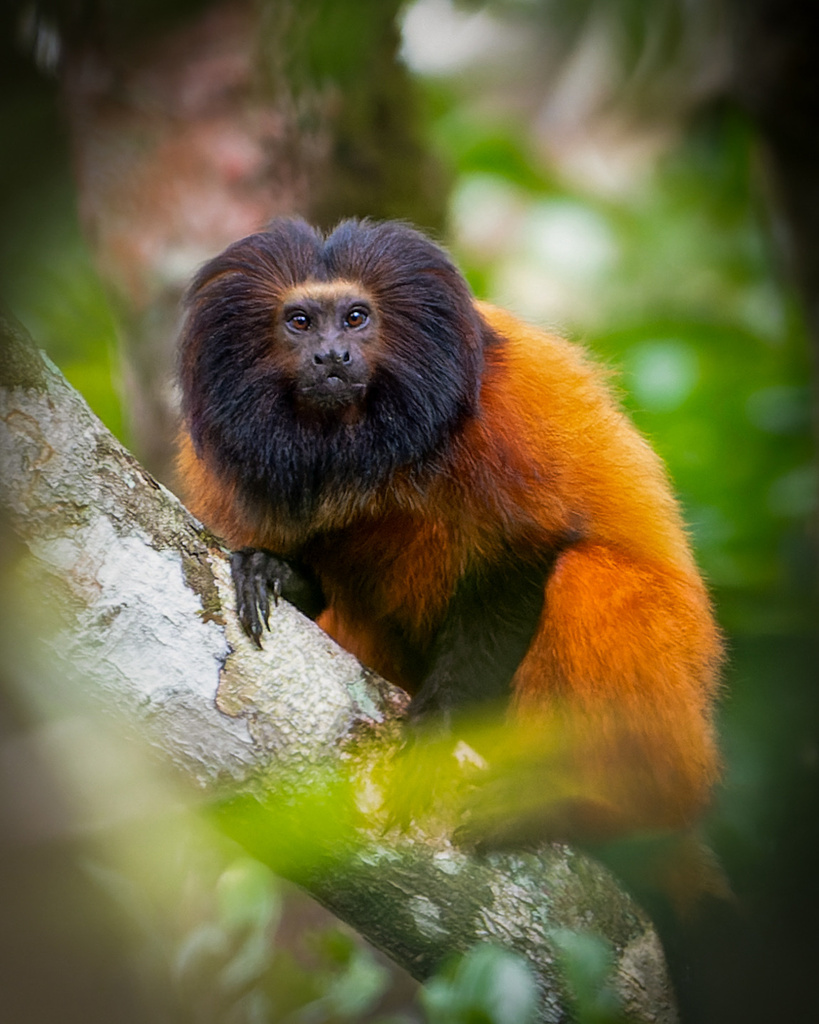
Black-faced Lion Tamarin
Leontopithecus caissara
The black-faced lion tamarin or Superagüi lion tamarin (Leontopithecus caissara) is a small New World monkey of the family Callitrichidae. It is endangered and endemic to coastal forests in southeastern Brazil. There are several conservation projects and the total populations is unlikely to exceed 400 individuals. It is overall golden-orange with contrasting black head, legs and tail.
The black-faced lion tamarin was not recognized until 1990 when two Brazilian researchers, Maria Lucia Lorini and Vanessa Persson, described it based on individuals from the island of Superagui in the Brazilian state of Paraná. Shortly after additional populations were discovered on the adjacent mainland in Paraná and in the far southern São Paulo. The specific name caissara is a reference to the caicaras, the local people of Superagui Island.
From the article Superagüi lion tamarin on Wikipedia (CC BY-SA), quoted section by section
What it does
The black-faced lion tamarin is an arboreal species and primarily eats small fruits and invertebrates such as insect, spiders and snails. They are also known to drink nectar, eat the young leaves of bromeliads and consume mushrooms. They are thought to supplement parts of their diet with mushrooms during the dry season. The black-faced lion tamarin lives in extended family groups with 2-8 members. Within these families there is normally only one breeding female per season. Births typically occur from September to March and females normally give birth to twins. Social interaction is a key component in maintaining a reproductive system such as this. Grooming is the most common form of affiliative behavior seen by the species specifically between the breeding pair.
Wikipedia: “Behavior”
Listen
Looking for field recordings…
Where it lives
Recorded sightings
—
geo-referenced records in GBIF, from museums, herbaria and field observers.
Drag the globe to turn it. Dots are where records exist, not a range map; darker means more records.
In the stacks
Searching the stacks…
Every page naming Leontopithecus caissara in the Biodiversity Heritage Library →
This page is assembled live from iNaturalist, GBIF, Wikipedia, the Source Library and the Internet Archive. It is not yet part of the hand-edited codex. iNaturalist taxon 43393.