- Animals
- ›Chordates
- ›Vertebrates
- ›Mammals
- ›Therians
- ›Placental Mammals
- ›Ungulates, Carnivorans, and Allies
- ›Odd-toed Ungulates
- ›Equines
- ›Equus
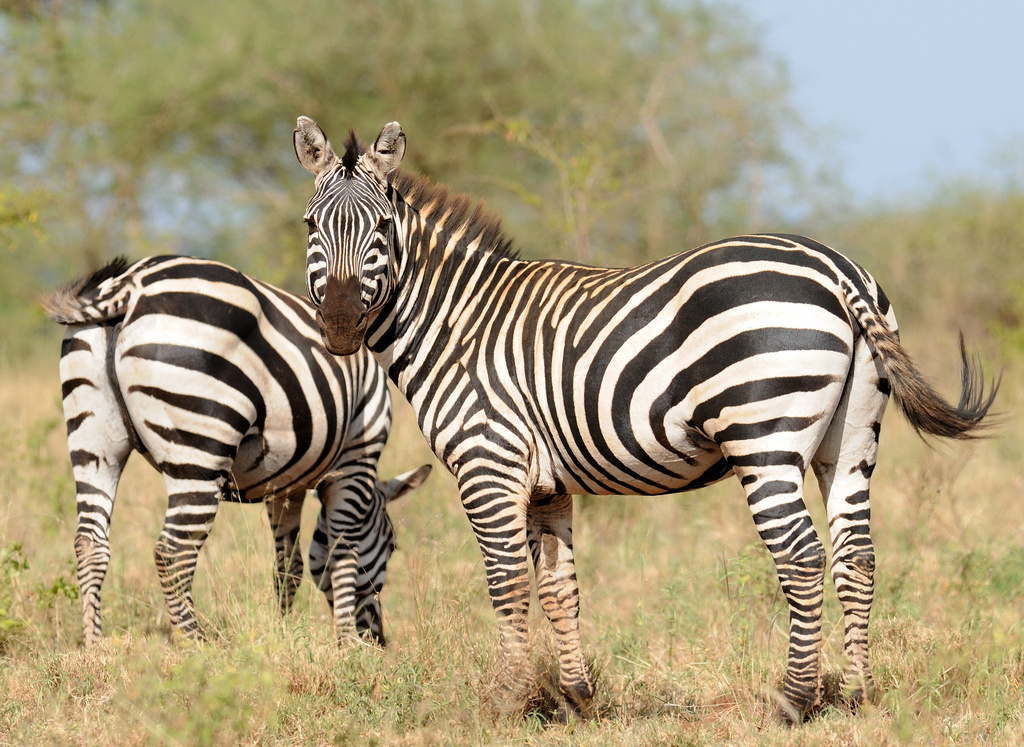
Plains Zebra
Equus quagga
The plains zebra (Equus quagga, formerly Equus burchellii) is the most common and geographically widespread species of zebra. Its range is fragmented, but spans much of southern and eastern Africa south of the Sahara. Six or seven subspecies have been recognised, including the quagga which was thought to be a separate species. More recent research supports variations in zebra populations being clines rather than subspecies.
Plains zebras are intermediate in size between the larger Grévy's zebra and the smaller mountain zebra and tend to have broader stripes than both. Great variation in coat patterns exists between clines and individuals. The plains zebra's habitat is generally, but not exclusively, treeless grasslands and savanna woodlands, both tropical and temperate. They generally avoid desert, dense rainforest and permanent wetlands. Zebras are preyed upon by lions and spotted hyenas, Nile crocodiles and, to a lesser extent, leopards, cheetahs and African wild dogs.
From the article Plains zebra on Wikipedia (CC BY-SA), quoted section by section
Range & habitat
The plains zebra's range stops short of the Sahara from South Sudan and southern Ethiopia extending south along eastern Africa, as far as Zambia, Mozambique, and Malawi, before spreading into most southern African countries. They may have lived in Algeria in the Neolithic era. Plains zebras generally live in treeless grasslands and savanna woodlands, but can be found in a variety of habitats, both tropical and temperate. However, they are generally absent from deserts, dense rainforests, and permanent wetlands. They generally prefer Acacieae woodlands over Commiphora. They are water-dependent and live in more mesic environments than other African equids. They seldom wander 10–12 km (6.2–7.5 mi) from a water source. Zebras also live in elevations from sea level to 4,300 feet (1,300 m) on Mount Kenya. Depending on the population, zebra herds may be sedentary, being highly dense with small ranges, or migratory, being less populated with separate, extensive dry and wet home ranges. When migrating, zebras appear to rely on some memory of the locations where foraging conditions were best and may predict conditions months before their arrival. The loss of open grasslands due to woody plant encroachment increases predation risk and therewith habitat.
Wikipedia: “Range and habitat”
What it does
Plains zebras primarily feed on grass; preferred species being Themeda triandra, Cynodon dactylon, Eragrostis superba and Cenchrus ciliaris. Zebra sometimes browse on herbs, leaves and twigs or dig for corms and rhizomes during the dry season. They appear to partial to eating scorched Colophospermum mopane and Pterocarpus rotundifolius, consuming both the leaves and twigs. Plains zebras are adapted for grazing on both long, tough grass stems and newly emerging short grass (stems and sheaths). In some areas, it rarely feeds below 100–150 mm (3.9–5.9 in) to ground level. It ranges more widely than many other species, even into woodlands, and it is often the first grazing species to appear in a well-vegetated area. The flexible upper lip allows them to push plant material between the incisors to cut. Zebras have a less efficient digestive system than ruminants but food passage is twice as fast. Thus, zebras are less selective in foraging, but they do spend much time eating. The zebra is a pioneer grazer and prepares the way for more specialised grazers such as blue wildebeests and Thomson's gazelles.
The plains zebra's major predators are lions and spotted hyenas. Lions are most successful when targeting lone individuals, usually an old male while hyenas chase and isolate an individual from the group, usually a female or foal. …
Wikipedia: “Diet and predation”
In human culture
Zebras have been featured in African art and culture for millennia. They have been depicted in rock art in Southern Africa (modern Botswana, Namibia and South Africa) dating from 20,000–28,000 years ago, though not as commonly as antelope species like eland. How the zebra got its stripes has been the subject of folk tales, some of which involve it being scorched by fire. The San people associated zebra stripes with water, rain and lighting due to its dazzling pattern. The zebra has also been associated with beauty and the women of various societies would paint much of their bodies in stripes. For the Shona people of Zimbabwe, the zebra is a totem animal, along with the eland, buffalo, lion and monkey. The zebra is praised in a poem as an "iridescent and glittering creature". Its stripes have symbolised the joining of male and female and at Great Zimbabwe, zebra stripes decorate what is believed to be a domba, a premarital school meant to initiate women into adulthood. In the Shona language, the name "madhuve" means "woman/women of the zebra totem" and is a given name for girls in Zimbabwe. Zebras have also been represented in Western culture. They have been thought of as a more exotic alternative to horse; the comic book character Sheena, Queen of the Jungle is depicted riding a zebra. …
Wikipedia: “In popular culture”
Listen
Looking for field recordings…
Where it lives
Recorded sightings
—
geo-referenced records in GBIF, from museums, herbaria and field observers.
Drag the globe to turn it. Dots are where records exist, not a range map; darker means more records.
In the stacks
Searching the stacks…
Every page naming Equus quagga in the Biodiversity Heritage Library →
This page is assembled live from iNaturalist, GBIF, Wikipedia, the Source Library and the Internet Archive. It is not yet part of the hand-edited codex. iNaturalist taxon 43335.