 NL·0737
Herbarium of the Nature Library
- Name
- Tachyglossus aculeatus
- Family
- Tachyglossidae
- Native to
- Australia (all states including Tasmania and Kangaroo Island) and lowland southern New Guinea
- Habitat
- Forest, Woodland, Desert, Alpine, Grassland
Short-beaked echidna
Tachyglossus aculeatus
Also calledSpiny anteater · Equidna (Spanish/Portuguese) · Échidné à nez court (French)
One of only five living monotremes, the egg-laying mammals. A spine-covered ant- and termite-eater with a sticky tongue, it is found across almost all of Australia and in New Guinea. Females lay a single leathery egg into a temporary pouch and suckle the hatchling from milk patches, without nipples.
The short-beaked echidna, also known as the common echidna, or short-nosed echidna, is one of four living species of echidna, and the only member of the genus Tachyglossus, from Ancient Greek ταχύς, meaning "fast", and γλῶσσα, meaning "tongue". It is covered in fur and spines and has a distinctive snout and a specialised tongue, which it uses to catch its insect prey at a great speed. Like the other extant monotremes, the short-beaked echidna lays eggs; the monotremes are the only living group of mammals to do so. Wikipedia
What it can do
- iLays eggs; the young ('puggle') hatches in the pouch after about 10 days
- iiSnout carries electroreceptors that may detect insects in moist soil
- iiiDigs straight down into soil within minutes to escape predators, leaving only spines exposed
- ivEnters torpor and hibernation, dropping its body temperature to a few degrees above the surroundings
In the field
Field marks
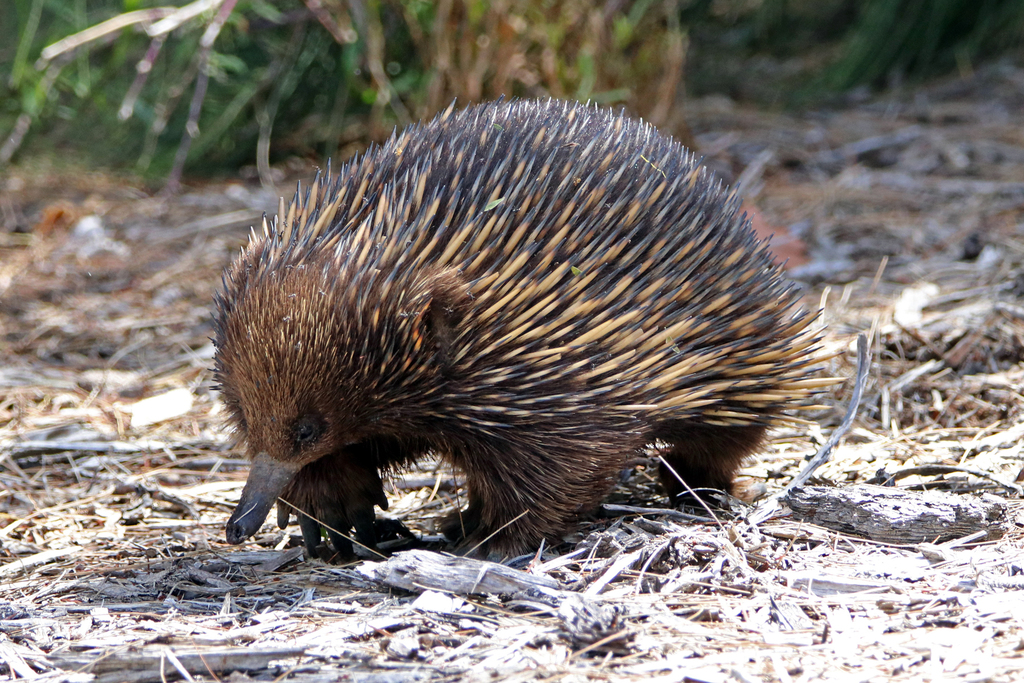
- aRound, spine-covered body with cream, black-tipped spines among brown fur
- bSlim, tube-like hairless snout (beak)
- cShort legs with powerful digging claws; hind feet point backwards
- dSigns: snout-sized holes in soil, torn open termite mounds and ant nests, scats full of ant remains and soil; tracks show backward-pointing hind claws
- Not to be confused with
- No other Australian mammal has spines. Introduced hedgehogs do not occur in Australia. Long-beaked echidnas (New Guinea highlands) are larger with longer, downcurved snouts.
- Where to see it
- Kangaroo Island (South Australia); Tasmania, e.g. Freycinet and Cradle Mountain; Wilsons Promontory (Victoria); Royal National Park (New South Wales); widespread in bushland
- When
- Resident; most active on mild days in spring; echidna trains June–September
Listen
Looking for field recordings…
Life & habits
- Diet
- Ants, termites, beetle larvae and earthworms
- Habitat
- Almost every terrestrial habitat in Australia, from snowfields to deserts
- Size
- 30–45 cm; 2–7 kg
- Lifespan
- Up to about 45 years in the wild
Solitary. In winter, 'echidna trains' form, with up to 10 or more males following a female nose-to-tail for days.
Where it lives
Recorded sightings
—
geo-referenced records in GBIF, from museums, herbaria and field observers.
Native range
Australia (all states including Tasmania and Kangaroo Island) and lowland southern New Guinea
Drag the globe to turn it. Dots are where records exist, not a range map; darker means more records.
In the stacks
Searching the stacks…
Every page naming Tachyglossus aculeatus in the Biodiversity Heritage Library →
Marginalia
An echidna appears on the Australian five-cent coin. In many Aboriginal traditions stories explain how the echidna got its spines, often through a fight or punishment involving spears.
Curiosity
When first described in 1792 it was thought to be a type of anteater; its egg-laying was confirmed only in 1884.
Kinship





Photographs: iNaturalist contributors under the licences shown. Records: GBIF.org. Historical plates: Source Library (CC BY-SA 4.0; originals public domain). Summary text: Nature Library editors and Wikipedia (CC BY-SA). Medicinal and edibility notes are historical and educational, not advice. iNaturalist taxon 43239.