- Plants
- ›Vascular Plants
- ›flowering plants
- ›Dicots
- ›Soapberries, Cashews, Mahoganies, and Allies
- ›soapberry family
- ›Paullinia
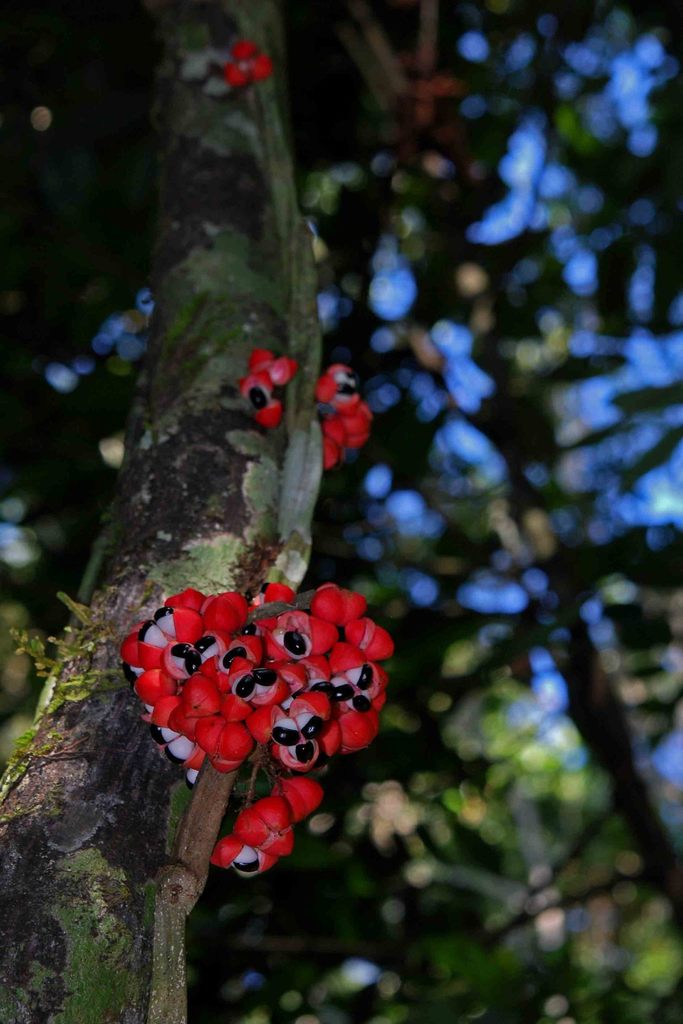
Guarana
Paullinia cupana
Guaraná ( from the Portuguese guaraná [ɡʷaɾɐˈna]; Paullinia cupana, syns. P. crysan, P. sorbilis) is a climbing plant in the family Sapindaceae, native to the Amazon basin and especially common in Brazil. Guaraná has large leaves and clusters of flowers, and is best known for the seeds from its beans, which are about the size of a coffee bean.
Guaraná is common in soft drinks in Brazil, and is a major source of caffeine for many South Americans. Products containing guaraná can be effective stimulants: the seeds can be up to about 6% caffeine. For comparison, green coffee beans are about 1–3% caffeine. As an additive, it has gained notoriety for being used in energy drinks. As with other plants producing caffeine, the high concentration of caffeine is a defensive toxin that repels insects from the berry and seeds.
From the article Guarana on Wikipedia (CC BY-SA), quoted section by section
In human culture
The word guaraná has its origins in the Sateré-Maué word for the plant, warana. Guaraná plays an important role in Tupi and Guarani culture. According to a myth attributed to the Sateré-Maué tribe, guaraná's domestication originated with a deity killing a beloved village child. To console the villagers, a more benevolent god plucked the left eye from the child and planted it in the forest, resulting in the wild variety of guaraná. The god then plucked the right eye from the child and planted it in the village, giving rise to domesticated guaraná. The Guaranis make an herbal tea called cupana by shelling, washing and drying the seeds, followed by pounding them into a fine powder. The powder is kneaded into a dough and then shaped into cylinders. This product is known as guaraná bread, which is grated and then immersed into hot water along with sugar. This plant was introduced to European colonizers and to Europe in the 16th century by Felip Betendorf, Oviedo, Hernández, Cobo and other Spaniard chroniclers. It has since been used, refined, adapted and commercialized by settlers, folklorists, food scientists, and marketers.
Wikipedia: “History and culture”
Where it lives
Recorded sightings
—
geo-referenced records in GBIF, from museums, herbaria and field observers.
Drag the globe to turn it. Dots are where records exist, not a range map; darker means more records.
In the stacks
Searching the stacks…
Every page naming Paullinia cupana in the Biodiversity Heritage Library →
This page is assembled live from iNaturalist, GBIF, Wikipedia, the Source Library and the Internet Archive. It is not yet part of the hand-edited codex. iNaturalist taxon 431412.