- Animals
- ›Chordates
- ›Vertebrates
- ›Mammals
- ›Therians
- ›Placental Mammals
- ›Primates, Rodents, and Allies
- ›Lagomorphs
- ›Hares and Rabbits
- ›Lepus
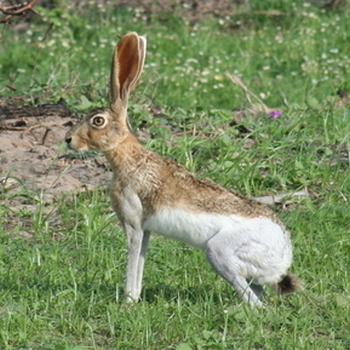
Tehuantepec jackrabbit
Lepus flavigularis
The Tehuantepec jackrabbit (Lepus flavigularis) (Spanish: liebre de Tehuantepec) is a medium-sized species of hare in the family Leporidae that is endemic to eastern Oaxaca, Mexico. It exists in three separated populations, living on grassy dunes and savannas, and is herbivorous, mainly eating grasses. It is not territorial. Most active at night, it will feed for most of the time and occasionally groom or socialize with other hares, spending the daytime resting on beds of grass or shrubs, or under nopales. They are polygynous and breed for most of the year, from February to December, producing one to four young per breeding season. Predators include snakes, dogs, cats, coyotes, and gray foxes.
The Tehuantepec jackrabbit is the most endangered of the hares, with less than 300 mature individuals estimated as of 2019, and is threatened by various factors in its small distribution, including poaching, habitat loss and fragmentation, a small population size, and genetic isolation. Changing agricultural practices, loss of diversity in flora, and competition for food are also factors in the species' decline. It is recognized as endangered both by the International Union for the Conservation of Nature (IUCN) and local authorities in Mexico through the Official Journal of the Federation, and efforts to monitor and implement conservation actions have been ongoing.
From the article Tehuantepec jackrabbit on Wikipedia (CC BY-SA), quoted section by section
Description
Lepus flavigularis is a medium-sized hare, ranging in length from 22.2 to 24.0 inches (56.5 to 61 cm). The chest and neck are yellowish in color, and it can be distinguished from other species by two black stripes that run from the base of the ears to the nape, and by its white flanks. This same coloration of the nape is also noted in several subspecies of the black-tailed jackrabbit. The tail measures from 2.6 to 3.7 inches (65 to 95 mm) and is black above and white underneath. Adults weigh from 3.7 to 6.4 pounds (1.7 to 2.9 kg). The ears range in size from 4.3 to 4.7 inches (110 to 120 mm) and the hind foot from 4.5 to 5.3 inches (115 to 134 mm). Its skull is elongated, and among the Mexican hares, its tympanic bullae (bone structures that enclose the middle and inner ear) are the smallest.
Wikipedia: “Characteristics”
Range & habitat
The Tehuantepec jackrabbit resides in tropical dry savannas dominated by native grasses in the genera Bouteloua and Paspalum with an overstory of sparse bushes of nanche (Byrsonima crassifolia), and scattered trees of morro (genus Crescentia). Generally, it tends towards habitats without dense vegetation, but can be flexible depending on the available resources. It is also found in coastal grassy dunes alongside the plants Opuntia decumbens, Opuntia tehuantepecana, and Sabal mexicana. It occurs from sea level up to an elevation of c. 2,185 feet (666 m). It is endemic to Oaxaca, Mexico, and is only found along savannas and grassy dunes on the shores of the salt water lagoons known as Laguna Inferior and Laguna Superior connected to the Gulf of Tehuantepec in the Istmo de Tehuantepec region. Three small populations persist isolated from each other. It is not sympatric with any other hares. The former distribution of the Tehuantepec jackrabbit is estimated to have extended along the Mexican Pacific Coast on the Isthmus of Tehuantepec from Salina Cruz in Oaxaca to Tonalá in Chiapas, an area of perhaps only 190 square miles (500 km2). As of 2024, it is probably locally extinct in the Chiapas region.
Wikipedia: “Distribution and habitat”
What it does
Home ranges of Lepus flavigularis overlap with one or more individuals regardless of sex and age, and the home range size is about 50 ha with core areas of 9 ha for adult jackrabbits. The Tehuantepec jackrabbit is nocturnal and crepuscular, and spends much of its time feeding. It is not territorial, and while not grazing on plants, it grooms itself and socializes. During the day, it rests among grasses, shrubs, and under nopales either alone or in groups of up to 12 individuals. The Tehuantepec jackrabbit shares its habitat with several other mammals, including the eastern cottontail, the nine-banded armadillo, hooded and western hog-nosed skunks, the Virginia opossum, the gray mouse opossum, and the common raccoon. Predators of the Tehuantepec jackrabbit and its young are domestic dogs, snakes (particularly Neotropical whip and western lyre snakes), domestic cats, coyotes, and gray foxes. There is little to no competition between the jackrabbit and the Eastern cottontail in regions where the two species are sympatric. The nematode Pelecitus meridionaleporinus (family Onchocercidae) is known to parasitize the Tehuantepec jackrabbit by infecting subcutaneous tissue at the base of the ears.
Diet. Lepus flavigularis prefers different plant species depending on whether it is the wet or dry season. …
Wikipedia: “Behavior and ecology”
Listen
Looking for field recordings…
Where it lives
Recorded sightings
—
geo-referenced records in GBIF, from museums, herbaria and field observers.
Drag the globe to turn it. Dots are where records exist, not a range map; darker means more records.
In the stacks
Searching the stacks…
Every page naming Lepus flavigularis in the Biodiversity Heritage Library →
This page is assembled live from iNaturalist, GBIF, Wikipedia, the Source Library and the Internet Archive. It is not yet part of the hand-edited codex. iNaturalist taxon 43136.