- Animals
- ›Chordates
- ›Vertebrates
- ›Mammals
- ›Therians
- ›Placental Mammals
- ›Primates, Rodents, and Allies
- ›Lagomorphs
- ›Hares and Rabbits
- ›Lepus
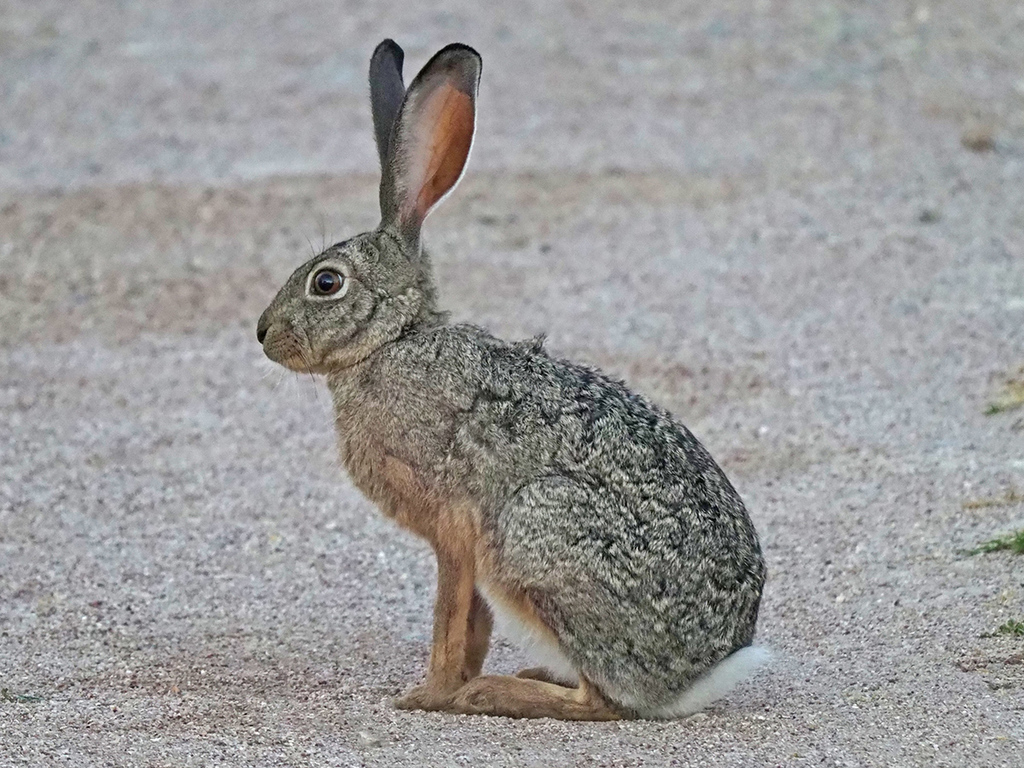
Scrub Hare
Lepus saxatilis
The Cape scrub hare (Lepus saxatilis) (Afrikaans: ribbokhaas) is a species of hare found in South Africa and Namibia. It is a medium to large-sized hare with coarse grizzled-gray fur along most of its body, white undersides, a black and white tail, and black-tipped ears. The hare's eyes are ringed with white. It is similar in appearance to the smaller African savanna hare, a species found in a broader range across Africa. The Cape scrub hare is largely restricted to savanna, woodland, and scrubland habitats, though it is found at the borders or ecotones of some forest and mountain habitats. It is fairly adaptable, able to inhabit regions where agriculture has modified the land.
The International Union for Conservation of Nature considers the Cape scrub hare to be a least-concern species, as it is fairly common and appears in several protected areas. However, its population has been declining, and is expected to decrease by 20% over the next 100 years, according to a 2004 report. Some populations are becoming fragmented due to agricultural development; the hare is also threatened by hunting for food and use in traditional medicine.
From the article Cape scrub hare on Wikipedia (CC BY-SA), quoted section by section
Description
The Cape scrub hare is a medium to large-sized hare with long, broad ears measuring from 10 to 15 centimetres (3.9 to 5.9 inches). It has an adult head and body length of 45 to 63 cm (18 to 25 in). Similar to the African savanna hare though somewhat larger, the Cape scrub hare is a grizzled gray coarse-furred hare. Its undersides are gray, and the inside of the limbs, the chin, and chest are white. Fur becomes sparse along the ears, which are black at the tips. Its tail is black on top and white below, and measures 13 to 15 centimetres (5.1 to 5.9 in) in length. An off-white ring encircles the Cape scrub hare's eyes. Adults weigh from 3.2 to 4 kilograms (7.1 to 8.8 lb), with females being generally heavier than males. There are two notable diagnostic features of the Cape scrub hare's skeleton. One is the ratio of its hard palate length to the total length of its skull, referred to as the mesopterygoid space. This ratio is used to distinguish specimens of the Cape scrub hare from the Cape hare and other nearby African hares. The other is a simple groove in the enamel of its incisors, which is not present in the African savannah hare. …
Range & habitat
The Cape scrub hare is endemic to southern Africa, and lives in southwestern Namibia and the Western Cape and Northern Cape provinces of South Africa. Its presence in Namibia and absence in southeastern parts of Africa is based on taxonomic restrictions imposed on the species in 2018. This hare prefers savanna woodland and scrub habitats, residing in areas with grassy vegetation that it uses for shelter. It can adapt to regions where agricultural development has encroached on its habitat. It is not seen in forests, deserts, or open grasslands, but it may be found at the ecotones of forests and mountainous regions.
Wikipedia: “Habitat and distribution”
What it does
The Cape scrub hare is solitary and herbivorous. It is sometimes found in male-female pairs, particularly while the female is in estrus. There is no defined breeding season in this hare, though females typically produce three young every summer. Gestation takes 5 to 6 weeks. The average newborn weighs 98 grams (0.216 pounds). The species' reproduction has not been studied, and much information is known from casual observation. The Cape scrub hare is a herbivore and eats mostly green grasses, consuming their leaves, stems, and rhizomes. Green grass is preferred over dry grass. Peanuts are sometimes consumed. It is nocturnal, and forages from dusk through the rest of the night. Some ixodid ticks are known to affect Cape scrub hares. Predators of South African hares include martial eagles, Verraux's eagles, black-backed jackals, and Cape foxes.
Wikipedia: “Ecology and behavior”
Listen
Looking for field recordings…
Where it lives
Recorded sightings
—
geo-referenced records in GBIF, from museums, herbaria and field observers.
Drag the globe to turn it. Dots are where records exist, not a range map; darker means more records.
In the stacks
Searching the stacks…
Every page naming Lepus saxatilis in the Biodiversity Heritage Library →
This page is assembled live from iNaturalist, GBIF, Wikipedia, the Source Library and the Internet Archive. It is not yet part of the hand-edited codex. iNaturalist taxon 43125.