- Animals
- ›Chordates
- ›Vertebrates
- ›Mammals
- ›Therians
- ›Placental Mammals
- ›Ungulates, Carnivorans, and Allies
- ›Shrews, Moles, Hedgehogs, and Allies
- ›Shrews, Moles, and Hedgehogs
- ›Hedgehogs and Gymnures
- ›Hedgehogs
- ›Paraechinus
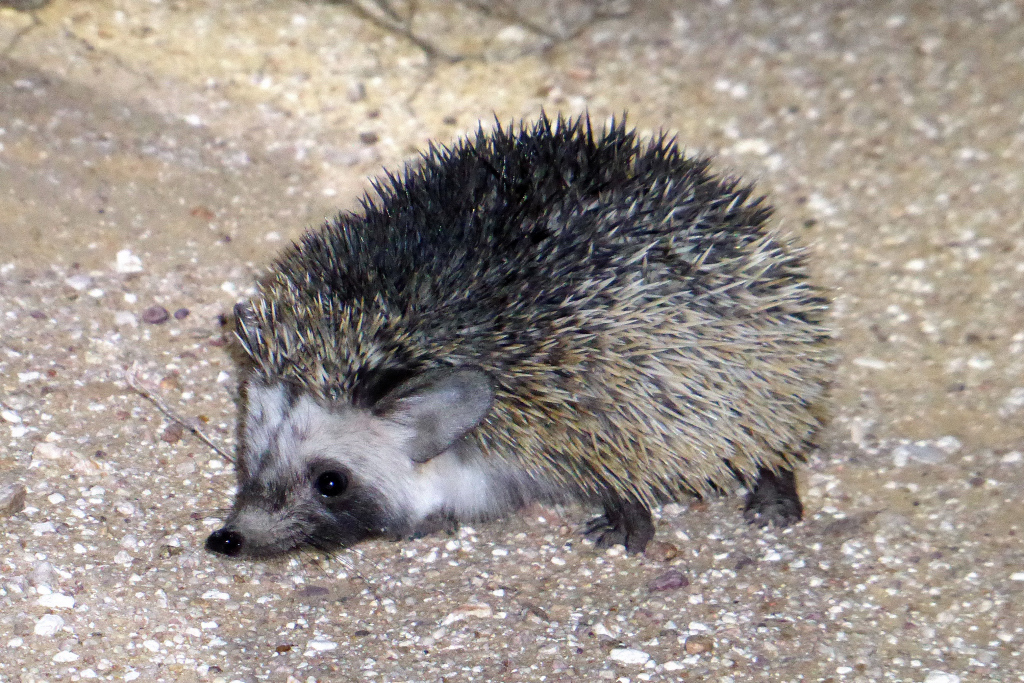
Desert Hedgehog
Paraechinus aethiopicus
The desert hedgehog (Paraechinus aethiopicus) is a species of mammal in the family Erinaceidae.
From the article Desert hedgehog on Wikipedia (CC BY-SA), quoted section by section
Description
The desert hedgehog is one of the smallest hedgehogs. It is 140 to 280 mm (5.5 to 11 in) long and weighs about 280 to 510 g (10 to 18 oz). The spines on its back can be banded with coloring similar to the four-toed hedgehog. It is usually identified by its dark muzzle. If desert hedgehogs are threatened, their muscles go tight and pull the outer layer of skin around the body, making their quills stick out in all directions. The spines have been theorized to aid in defense, but research has shown that this is likely incidental. Rather, the spines do not break in the manner of porcupine quills, but instead bend. The spines are also able to absorb mechanical energy, providing protection from fall damage.
Range & habitat
The desert hedgehog occurs in Bahrain, Algeria, Chad, Djibouti, Egypt, Eritrea, Iran, Iraq, Israel, Jordan, Kuwait, Libya, Mali, Mauritania, Morocco, Niger, Oman, Saudi Arabia, Somalia, Sudan, Syria, Tunisia, United Arab Emirates, Yemen, and possibly Ethiopia.
Wikipedia: “Distribution”
What it does
Breeding begins in March, after hibernation has ended. The female desert hedgehog gives birth to up to six young, in a burrow or concealed nest, after a gestation period of around 30 to 40 days. The young are born deaf and blind, and with the quills located just under the skin, to prevent damage to the female during birth. The quills emerge within a few hours, and the eyes open after around 21 days. The young desert hedgehogs are weaned after about 40 days. There is thought to be a single litter each year.
Health. The desert hedgehog is a host of the Acanthocephalan intestinal parasite Moniliformis saudi.
Wikipedia: “Behaviour and ecology”
Listen
Looking for field recordings…
Where it lives
Recorded sightings
—
geo-referenced records in GBIF, from museums, herbaria and field observers.
Drag the globe to turn it. Dots are where records exist, not a range map; darker means more records.
In the stacks
Searching the stacks…
Every page naming Paraechinus aethiopicus in the Biodiversity Heritage Library →
This page is assembled live from iNaturalist, GBIF, Wikipedia, the Source Library and the Internet Archive. It is not yet part of the hand-edited codex. iNaturalist taxon 43073.