- Plants
- ›Vascular Plants
- ›flowering plants
- ›Dicots
- ›proteas, lotuses, planes, and allies
- ›Protea family
- ›Singlet Proteas
- ›Nutseed Proteoid Clade
- ›Cape Nutseed Proteoids
- ›Mimetes
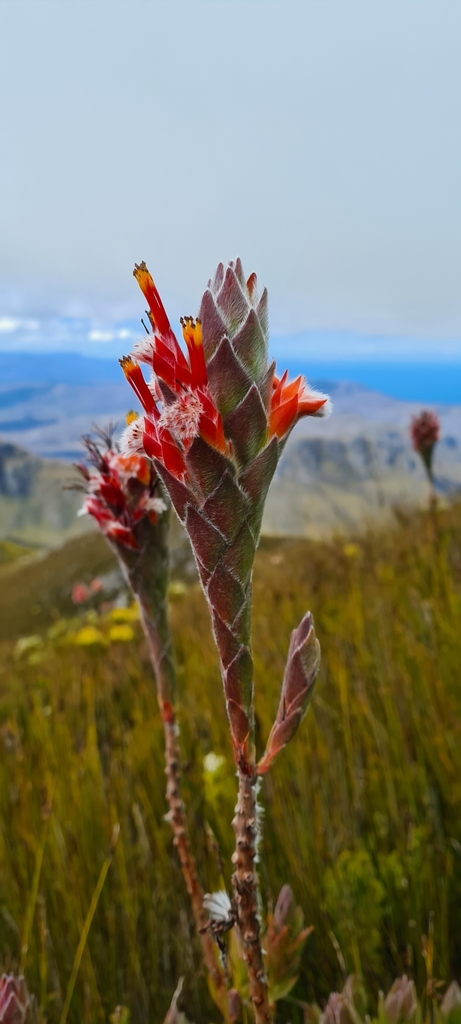
Conical Pagoda
Mimetes capitulatus
Mimetes capitulatus is an evergreen, upright, rounded shrub of about 2 m (7 ft) high, from the family Proteaceae. It has greyish green, lance- to egg-shaped leaves ending in a thickened tip. The flower heads and subtending leaves form a cylindric inflorescence, topped by ordinary, more or less upright leaves. Each primarily orange flowerhead contains 10–13 flowers with conspicuously scarlet styles, yellow under the narrow hourglass-like pollen presenter at its tip. Flowers can usually be found from mid-June till December, peaking in August. It is called conical pagoda in English and skraalstompie in Afrikaans.
From the article Mimetes capitulatus on Wikipedia (CC BY-SA), quoted section by section
Description
Mimetes capitulatus is an evergreen, rounded shrub of about 2 m (7 ft) high that develops from a single trunk, and has a densely branched crown. Older specimens also develop several, usually unbranched straggling shoots. The branches are 5–8 mm (0.20–0.32 in) thick and are initially covered with greyish felty hairs that wear off later on. The leaves are set alternately along the branches, slightly overlapping at an upward angle. They lack stipules and leaf stalks, are lance- to egg-shaped in outline, 2–3.5 cm (0.8–1.4 in) long and ¾–2 cm (0.3–0.8 in) wide, with an entire margin ending sharply pointy in one thickened tip. The surface is initially covered in rough felty hairs, which eventually are lost. The inflorescence is broadly cylinder-shaped, 6–10 cm (2.3–4 in) long and 6–8 cm (2.3-3.3 in) in diameter, topped by more or less upright leaves not unlike all other leaves. In the axils of the higher leaves are flower heads each containing ten to thirteen (most frequently eleven) flowers, the subtending leaves broadly oval, 2.5–4 cm (1–1¾ in) long and 1.5–2 (0.7–0.8 in) broad, set with rough hairs, and with a row of rough hairs along the margin, sometimes flushed reddish. …
Range & habitat
The five known populations of the conical pagoda can be found in the Kogelberg, Kleinrivier and Groenland Mountains, ranges adjacent or at least near the sea, at 600–1200 m (2000–4000 ft) altitude. The average annual precipitation is about 1500 mm (60 in) mostly falling during the southern winter. Here, it grows on permanently moist, sometimes outright swampy peaty soils, near the ridge or peak on the cool, southeastern slope in a vegetation that also contains the Restionid Elegia mucronata, Klattia partita, and the Bruniaceae species Berzelia ecklonii and Brunia alopecuroides. In these locations clouds condensate and cause precipitation during the otherwise dry summer months. The species is pollinated by birds, mostly the malachite sunbird Nectarinia famosa, southern double-collared sunbird Cinnyris chalybeus and orange-breasted sunbird Anthobaphes violacea. It flowers from mid June to November, with a peak in August, and produces copious amounts of nectar. The fruits ripen one at a time, two to six months after flowering and fall to the ground. They are collected by native ants that carry the fruits to their underground nest, where the ants bread is eaten and the seeds remain protected. The seeds germinate after an overhead fieldfire. Plants do not survive fires.
Wikipedia: “Distribution, habitat and ecology”
Where it lives
Recorded sightings
—
geo-referenced records in GBIF, from museums, herbaria and field observers.
Drag the globe to turn it. Dots are where records exist, not a range map; darker means more records.
In the stacks
Searching the stacks…
Every page naming Mimetes capitulatus in the Biodiversity Heritage Library →
This page is assembled live from iNaturalist, GBIF, Wikipedia, the Source Library and the Internet Archive. It is not yet part of the hand-edited codex. iNaturalist taxon 429909.