 NL·0603
Herbarium of the Nature Library
- Name
- Phascolarctos cinereus
- Family
- Phascolarctidae
- Native to
- Eastern and south-eastern Australia (Queensland, New South Wales, Victoria, South Australia)
- Habitat
- Eucalyptus woodland, Temperate forest
Koala
Phascolarctos cinereus
Also calledGula (Dharug) · Kǎolā 考拉 / Shùdàixióng 树袋熊 (Chinese) · Koala (Spanish/French)
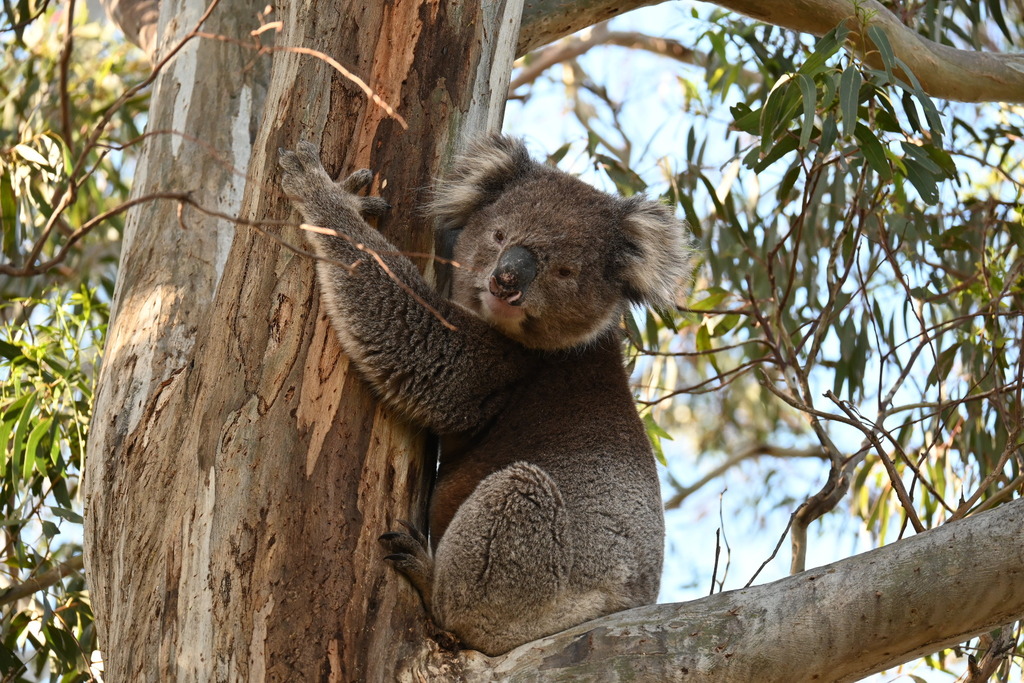
A tree-dwelling marsupial that lives almost entirely on eucalyptus leaves, which are tough, low in energy and toxic to most animals. Koalas sleep or rest for up to 20 hours a day to save energy.
The koala, sometimes inaccurately called the koala bear, is an arboreal herbivorous marsupial native to Australia. It is the only extant representative of the family Phascolarctidae. Its closest living relatives are the wombats. The koala is found in coastal areas of the continent's eastern and southern regions, inhabiting Queensland, New South Wales, Victoria, and South Australia. It is easily recognisable by its stout, tailless body and large head with round, fluffy ears and large, dark nose. The koala has a body length of 60–85 cm (24–33 in) and weighs 4–15 kg (8.8–33.1 lb). Its fur colour ranges from silver grey to chocolate brown. Koalas from the northern populations are typically smaller and lighter in colour than their counterparts further south. These populations are possibly separate subspecies, but not all researchers accept this. Wikipedia
What it can do
- iDetoxifies eucalyptus oils with liver enzymes and gut microbes
- iiFerments leaves in a caecum up to ~2 m long, the longest relative to body size of any mammal
- iiiMales bellow at a very low pitch using a pair of extra vocal folds above the larynx
- ivHas fingerprints that closely resemble human ones
In the field
Field marks
- aStocky grey marsupial with a big black nose
- bLarge furry ears
- cNo visible tail
- dSits in eucalyptus forks, often asleep
- Voice
- Males give loud, deep snoring bellows, mostly in the breeding season
- Not to be confused with
- Unmistakable.
- Where to see it
- Great Otway National Park (Kennett River) and Phillip Island's Koala Conservation Reserve (Victoria); Magnetic Island (Queensland)
- When
- Resident; bellowing Sep–Jan
Listen
Looking for field recordings…
Life & habits
- Diet
- Eucalyptus leaves, from a few dozen preferred species; little need to drink
- Habitat
- Eucalyptus forests and woodlands
- Size
- 4–15 kg (southern koalas larger); 60–85 cm
- Lifespan
- 13–18 years
Mothers feed joeys a special soft dropping called 'pap', which passes on the gut microbes needed to digest eucalyptus.
Where it lives
Recorded sightings
—
geo-referenced records in GBIF, from museums, herbaria and field observers.
Native range
Eastern and south-eastern Australia (Queensland, New South Wales, Victoria, South Australia)
Drag the globe to turn it. Dots are where records exist, not a range map; darker means more records.
In the stacks
Searching the stacks…
Every page naming Phascolarctos cinereus in the Biodiversity Heritage Library →
Marginalia
The name is usually traced to Dharug gula. Millions of koalas were killed for fur in the early 20th century; public outrage at Queensland's 1927 open season led the Commonwealth to stop issuing export permits for koala skins, effectively ending the trade.
Curiosity
The koala is not a bear; its closest living relatives are wombats.
Kinship





Fact-checked: 1 correction made to this sheet. Photographs: iNaturalist contributors under the licences shown. Records: GBIF.org. Historical plates: Source Library (CC BY-SA 4.0; originals public domain). Summary text: Nature Library editors and Wikipedia (CC BY-SA). Medicinal and edibility notes are historical and educational, not advice. iNaturalist taxon 42983.