- Animals
- ›Chordates
- ›Vertebrates
- ›Mammals
- ›Therians
- ›Marsupials
- ›Kangaroos, Possums, Wombats, and Allies
- ›Macropods
- ›Kangaroos, Wallabies and Allies
- ›Banded Hare Wallabies
- ›Lagostrophus
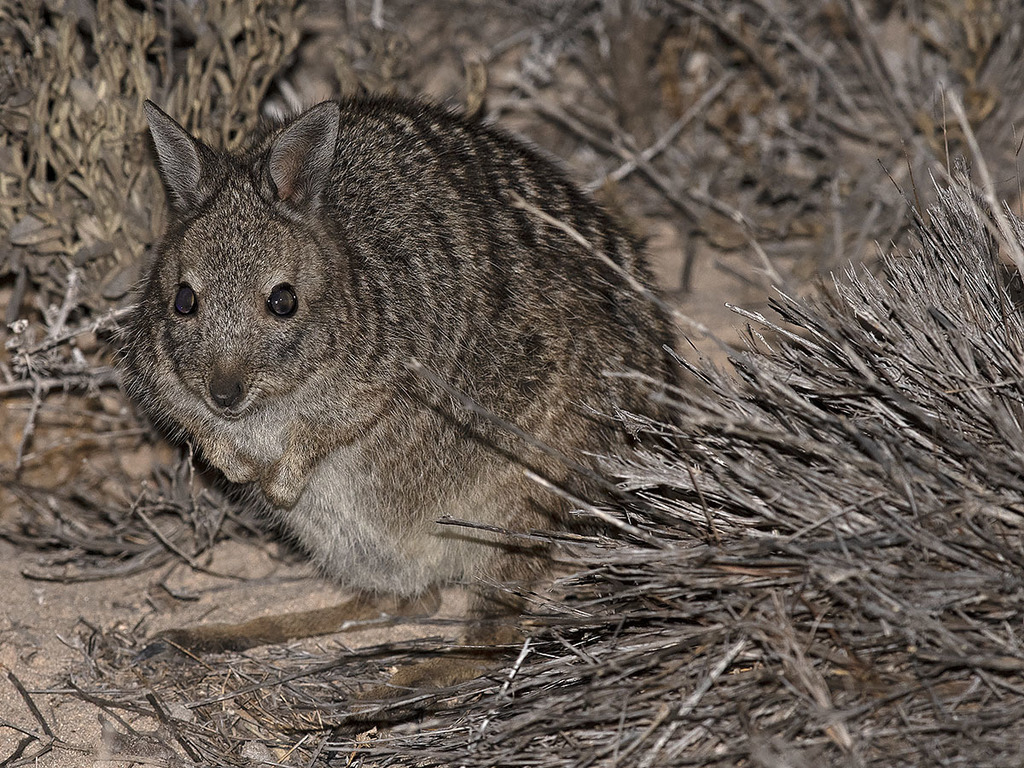
Banded Hare Wallaby
Lagostrophus fasciatus
The banded hare-wallaby or munning (Lagostrophus fasciatus) is a marsupial that is currently found on the Islands of Bernier and Dorre off western Australia. A small population has recently been established on Faure Island and it appears to have been successful. It has also been reintroduced to Wadderin Sanctuary, near Narembeen in the central wheatbelt, in 2013. Evidence suggested that the mernine was the only living member of the sthenurine subfamily, and a recent osteology-based phylogeny...
From the article Banded hare-wallaby on Wikipedia (CC BY-SA), quoted section by section
Description
The average banded hare-wallaby weighs 1.7 kg (3.7 lb); females weigh more than the males. It measures about 800 mm (31 in) from the head to the end of the tail, with the tail almost the same length (averaging 375 mm) as the body. It has a short nose; its long, grey fur is speckled with yellow and silver and fades into a light grey on the underbelly. No colour variation is seen on the face or head, and its colouring is solid grey. Dark, horizontal stripes of fur start at the middle of the back and stop at the base of the tail.
Range & habitat
The species was once found on the mainland, in the southwest of Western Australia and South Australia, but its only surviving natural populations are now restricted to Bernier Island and Dorre Island off Western Australia. The species has been successfully reintroduced to Faure Island and Dirk Hartog Island in Shark Bay, and to a large fenced reserve at Mount Gibson Sanctuary in Western Australia. Although the banded hare-wallaby was once found across the south-western portion of Australia, it is believed to have been extinct on the mainland since 1963, and the last recorded evidence of the banded hare-wallaby on the Australian mainland was in 1906. The devastation of the species possibly can be attributed to the loss of habitat to the clearing of vegetation, the loss of food (due to competition with other animals), and predators.
Fossil record. Fossils of the banded hare-wallaby from the Pleistocene epoch are known from the Pilbara region.
Wikipedia: “Distribution”
What it does
The banded hare-wallaby is nocturnal and tends to live in groups at nesting sites; this species is quite social. Nesting occurs in thickets under very dense brush. This macropod prefers to live in Acacia ligulata scrub. Males are extremely aggressive.
Wikipedia: “Behavior”
Listen
Looking for field recordings…
Where it lives
Recorded sightings
—
geo-referenced records in GBIF, from museums, herbaria and field observers.
Drag the globe to turn it. Dots are where records exist, not a range map; darker means more records.
In the stacks
Searching the stacks…
Every page naming Lagostrophus fasciatus in the Biodiversity Heritage Library →
This page is assembled live from iNaturalist, GBIF, Wikipedia, the Source Library and the Internet Archive. It is not yet part of the hand-edited codex. iNaturalist taxon 42975.