- Plants
- ›Vascular Plants
- ›flowering plants
- ›Dicots
- ›sandalwoods, mistletoes, and allies
- ›schoepfia family
- ›Quinchamalium
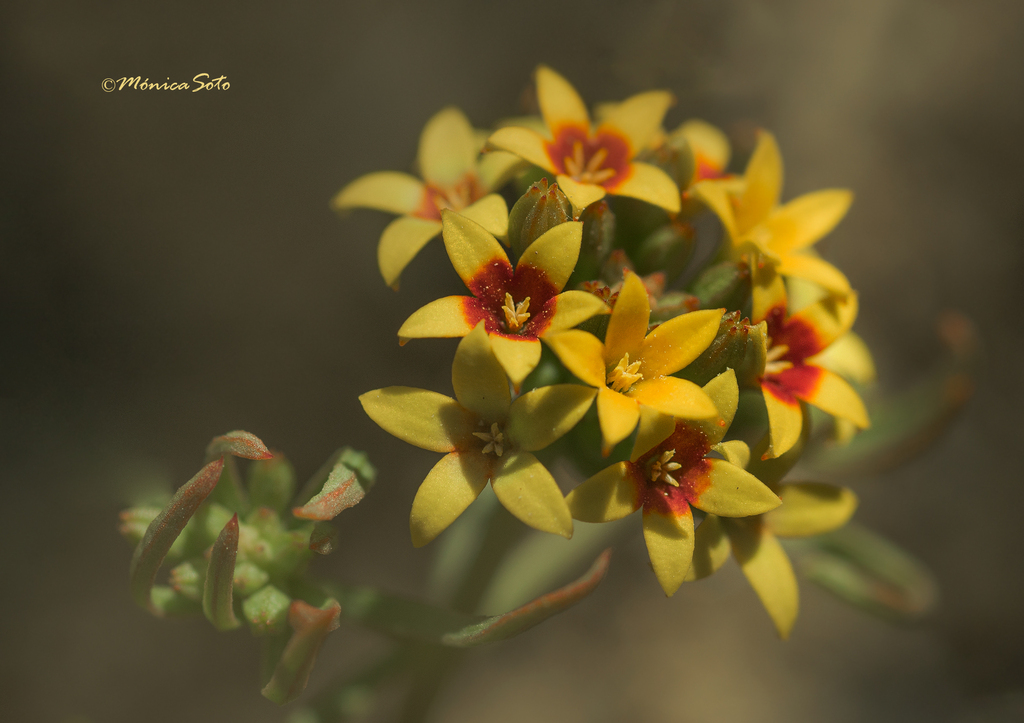
Quinchamali
Quinchamalium chilense
Quinchamalium is a genus of flowering plant in the family Schoepfiaceae, with a single species Quinchamalium chilense, native to Chile, Argentina, Peru and Bolivia. Depending on the latitude, it can be found from sea level to 3,800 m in elevation.
From the article Quinchamalium on Wikipedia (CC BY-SA), quoted section by section
Description
Quinchamalium chilense is a herbaceous, hemiparasitic, perennial plant with a rhizome, from which smaller rootlets with haustoria grow. From the rhizome a number of rarely-branching stems grow each year. These can be decumbent (creeping over the ground) or rise to over 2 metres in height. The flowers are produced in a cluster at the end of the stems, they are pentamerous and usually orangey-yellow in colour. It is extremely variable in height and flower size and colour, so much so that at one time 21 species were recognised, but in 2015 these were all reduced to synonymy with Q. chilense. It is heterostylous; some individuals bear 'thrum flowers', flowers which have short styles. This is somewhat correlated with elevation and cold. The leaves are also variable among individuals, they can be narrow or broader, the plants with more narrow leaves correlated with higher temperatures. The size of the plant appears correlated with annual precipitation. This species has rather bizarre embryos, which appear to be parasitic upon their mother plant before even being pollinated. As the embryo develops in the ovule, the two synergid cells elongate into tubes which penetrate through the micropyle and grow about a third up the length of the style where they form haustoria, organs for sucking nutrients from a host. …
What it does
Quinchamalium chilense is a dominant plant species, along with Festuca scabriuscula, Poa obvalata and Adesmia emarginata in a type of Patagonian steppe habitat with scattered trees of Araucaria araucana found along the upper course of the Biobío River in the Araucanía Region of Chile. This is a cold region at 1,500 m altitude, with a dry season of one to two months, sometimes heavy rains, and temperatures which can fall below freezing. The fly Mitrodetus dentitarsis is known to visit the flowers in Chile.
Wikipedia: “Ecology”
In human culture
It is locally called quinchamalí. The word kincha translates from Quechua as 'hedge of sticks', as often made from dead old quinoa plants (see quincha).
Wikipedia: “Etymology”
Where it lives
Recorded sightings
—
geo-referenced records in GBIF, from museums, herbaria and field observers.
Drag the globe to turn it. Dots are where records exist, not a range map; darker means more records.
In the stacks
Searching the stacks…
Every page naming Quinchamalium chilense in the Biodiversity Heritage Library →
This page is assembled live from iNaturalist, GBIF, Wikipedia, the Source Library and the Internet Archive. It is not yet part of the hand-edited codex. iNaturalist taxon 428962.