- Plants
- ›Vascular Plants
- ›flowering plants
- ›Dicots
- ›Soapberries, Cashews, Mahoganies, and Allies
- ›Torchwoods
- ›Canarium
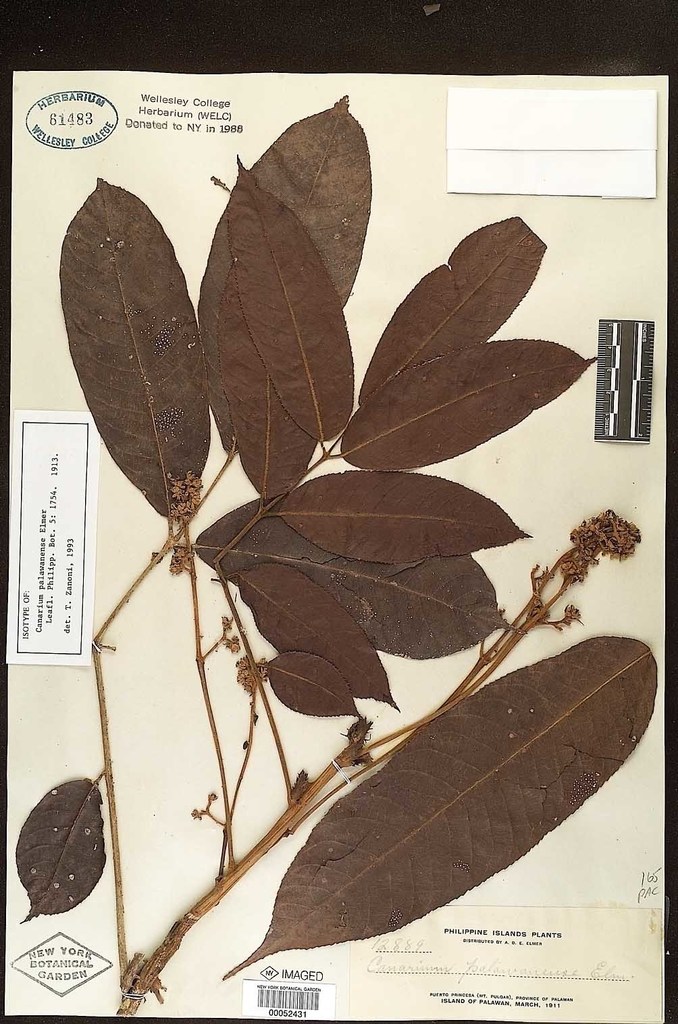
Canarium odontophyllum
Canarium odontophyllum (Malay: buah dabai) is a fruit-bearing tree of the genus Canarium in the family Burseraceae. It is a native of Sarawak. It grows up to a height of 40 to 50 meters. Its fruit is a prized seasonal delicacy in Sarawak. The outer skin is glossy black colour while the flesh is yellow with an elongated seed. The fruit is hard and inedible when ripe and must be soaked in warm water before eating....
From the article Canarium odontophyllum on Wikipedia (CC BY-SA), quoted section by section
Description
The tree grows up to a height of 40 to 50 meters. The fruit outer skin is glossy black colour while the flesh is yellow with an elongated seed. Being in the same genus as the Pili nut (Canarium ovatum) the seeds are also edible, and similar to almonds or pistachios.
Cultivation. The tree is dioecious – the seedlings can be male, or hermaphrodite. Successful cultivation can be achieved through budding or grafting. Mr Harry Munjan, a former senior assistant Agriculture Department officer was the first to have been successful in cultivating the tree through budding back in the 2000s. He also introduced the new clones, ‘Laja’ and ‘Lulong’, in his own farm in Sri Aman, Sarawak.
At the table
Canarium odontophyllum fruit is colloquially known as "Sarawak olive" and can be eaten raw or blanched, eaten with sugar, salt or soy sauce upon serving. In Sarawak, the fruit has become an added ingredient in sauces and fried rice recipes. Besides being eaten in its original form, the fruit can be made into a paste, and can also be dried and milled into powder form for use in foods and drinks. Under commercialization, the fruit can be incorporated in pizzas, desserts, juices, and even mayonnaise.
== References ==
Wikipedia: “Culinary”
Where it lives
Recorded sightings
—
geo-referenced records in GBIF, from museums, herbaria and field observers.
Drag the globe to turn it. Dots are where records exist, not a range map; darker means more records.
In the stacks
Searching the stacks…
Every page naming Canarium odontophyllum in the Biodiversity Heritage Library →
This page is assembled live from iNaturalist, GBIF, Wikipedia, the Source Library and the Internet Archive. It is not yet part of the hand-edited codex. iNaturalist taxon 428107.