- Plants
- ›Vascular Plants
- ›flowering plants
- ›Dicots
- ›Soapberries, Cashews, Mahoganies, and Allies
- ›Torchwoods
- ›Canarium
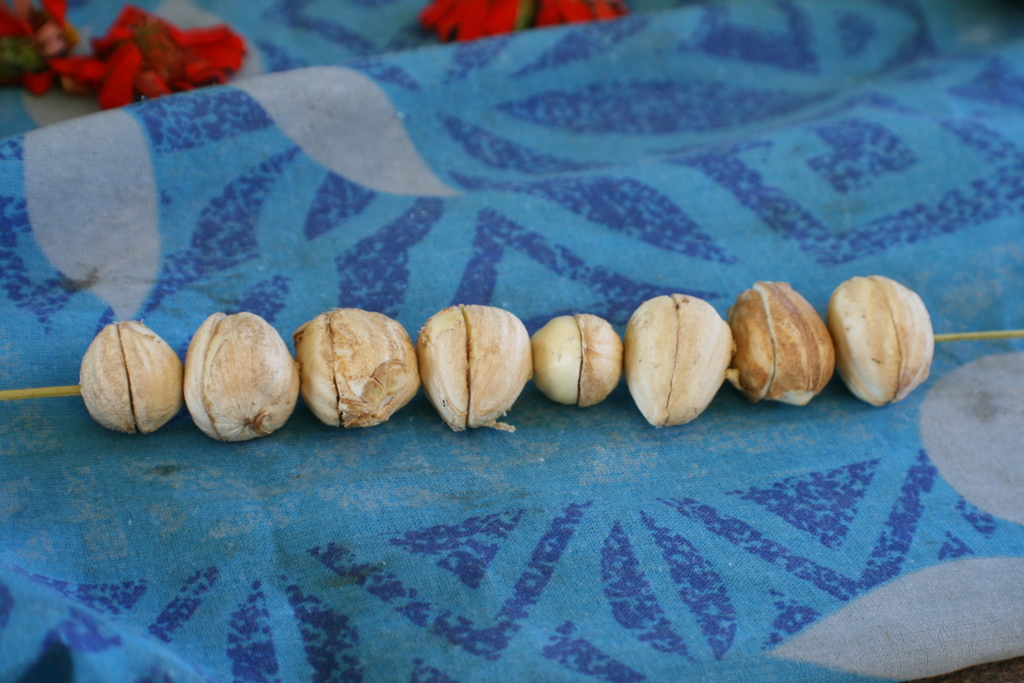
Canarium indicum
Canarium indicum, known as galip nut, is a mainly dioecious tree native in eastern Melanesia. It is usually found in rainforests, secondary forests, old garden areas, around villages and settlements. It is also used as a shade tree, as a windbreak and in agroforestry. Canarium is important in the world food system as it can be used as a food and timber source, in traditional medicine, intercropping and agroforestry.
From the article Canarium indicum on Wikipedia (CC BY-SA), quoted section by section
At the table
Many parts of the tree can be used. In Melanesia, except for Fiji, kernels are important in the local diet as fat and protein suppliers. Kernels are eaten raw, baked or roasted, used as a snack or added to other food, such as staple root crops, soups or even crushed and used as ice-cream toppings. Depending on the regions, they can also be used in different ways, like added to megapode eggs in the Solomon Islands or mixed with tuber puddings in Vanuatu. However, taste can vary from unpalatable bitter to a soft delicate coconut butter taste and is sensible to the processing technique. Kernel oil is mainly used for cooking as a substitute to coconut oil or blended with other oils. It also serves as a medicinal product. It can be used in cosmetic and skin care products, in which anti-aging and anti-inflammatory agents of Canarium oil can stimulate tensin 1 expression and are thus effective against wrinkles and loss of skin firmness. In the past, the kernel oil was used as a lighter and to prevent and treat arthritis. The testa can be added in animal feed. The mesocarp (flesh) is used as a fertilizer. Shells can be used as bedding for horticultural crops and for carving into jewellery. Furthermore, they can also be burned in kilns to produce clean, dense and high-grade charcoal fuel, which can be refined to "activated carbon" for pharmaceutical uses. …
Wikipedia: “Products uses and processing technology”
How it is grown
Canarium is native in eastern Indonesia, Papua New Guinea, the Solomon Islands, and Vanuatu. Besides Melanesia, it is also cultivated in Fiji, in the north of Australia, Taiwan, Hawaii, Honduras and Trinidad. Usually, it is found in rainforests, secondary forests, old garden areas, around villages and settlements and is also used as a shade tree, as a windbreak and in agroforestry. Nuts have been important in the diet in Papua New Guinea for about 6,000 years. In 2007, approximately one third of the household grew Canarium. In the Solomon Islands, they are important in traditional society, with the ownership of trees being a measure of wealth.
Wikipedia: “Origin and regions of cultivation”
Where it lives
Recorded sightings
—
geo-referenced records in GBIF, from museums, herbaria and field observers.
Drag the globe to turn it. Dots are where records exist, not a range map; darker means more records.
In the stacks
Searching the stacks…
Every page naming Canarium indicum in the Biodiversity Heritage Library →
This page is assembled live from iNaturalist, GBIF, Wikipedia, the Source Library and the Internet Archive. It is not yet part of the hand-edited codex. iNaturalist taxon 428104.