- Animals
- ›Chordates
- ›Vertebrates
- ›Mammals
- ›Therians
- ›Marsupials
- ›Kangaroos, Possums, Wombats, and Allies
- ›Cuscuses, Brush-tailed Possums, and Pygmy Possums
- ›Cuscuses and Brush-tailed Possums
- ›Brush-tailed and Scaly-tailed Possums
- ›Trichosurus
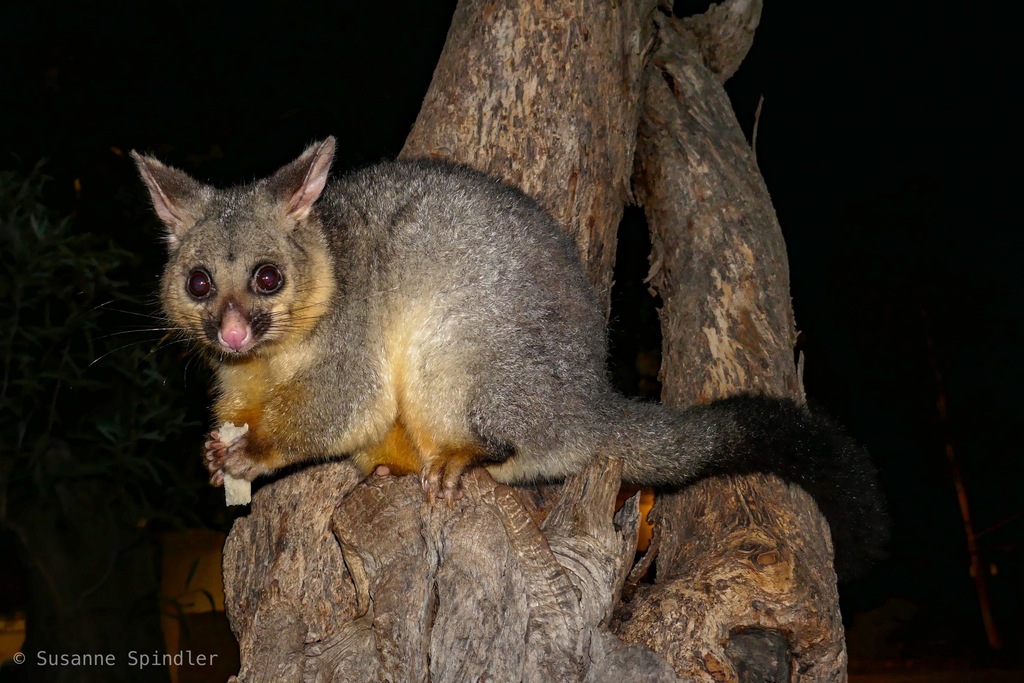
Common Brushtail Possum
Trichosurus vulpecula
The common brushtail possum (Trichosurus vulpecula, from the Greek for "furry tailed" and the Latin for "little fox", previously in the genus Phalangista) is a nocturnal, semiarboreal marsupial of the family Phalangeridae, native to Australia and invasive in New Zealand, and the second-largest of the Australasian possums.
Like most possums, the common brushtail possum is nocturnal. It is mainly a folivore, but has been known to eat small mammals such as rats. In most Australian habitats, eucalyptus leaves are a significant part of the diet, but rarely the sole item eaten. Its tail is prehensile and naked on its lower underside. The four colour variations are silver-grey, brown, black, and gold.
From the article Common brushtail possum on Wikipedia (CC BY-SA), quoted section by section
Description
The common brushtail possum has large and pointed ears. Its bushy tail (hence its name) is adapted to grasping branches, prehensile at the end with a hairless ventral patch. Its fore feet have sharp claws and the first toe of each hind foot is clawless, but has a strong grasp. The possum grooms itself with the third and fourth toes which are fused together. It has a thick and woolly pelage that varies in colour depending on the subspecies. Colour patterns tend to be silver-grey, brown, black, red, or cream. The ventral areas are typically lighter and the tail is usually brown or black. The muzzle is marked with dark patches. The common brushtail possum has a head and body length of 32–58 cm (13–23 in) with a tail length of 24–40 cm (9.4–16 in). It weighs 1.2–4.5 kg (2.6–9.9 lb). Males are generally larger than females. In addition, the coat of the male tends to be reddish at the shoulders. As with most marsupials, the female brushtail possum has a forward-opening, well-developed pouch. The chest of both sexes has a scent gland that emits a reddish secretion which stains that fur around it. It marks its territory with these secretions.
Range & habitat
The common brushtail possum is one of the most widespread marsupials of Australia. It is found throughout the eastern and northern parts of the continent, as well as some western regions, Tasmania and a number of offshore islands, such as Kangaroo Island and Barrow Island. Western Australia alone has several scattered population groups locally distinguished with given indigenous names: nunguin in Kimberley, walambari in Pilbara, wayurta in the desert areas, and bilda in Nullarbor Plain shared with South Australia among many others. It is also widespread in New Zealand since its introduction in 1850. The common brushtail possum can be found in a variety of habitats, such as forests, semi-arid areas and even cultivated or urban areas. It is mostly a forest inhabiting species, however it is also found in treeless areas. In New Zealand, possums favour broadleaf-podocarp near farmland pastures. In southern beech forests and pine plantations, possums are less common. Overall, brushtail possums are more densely populated in New Zealand than in their native Australia. This may be because Australia has more fragmented eucalypt forests and more predators. In Australia, brushtail possums are threatened by humans, tiger quolls, dogs, foxes, cats, goannas, carpet snakes, and powerful owls. In New Zealand, brushtail possums are threatened only by humans and cats. …
Wikipedia: “Range and habitat”
What it does
The common brushtail possum is largely arboreal and nocturnal. It has a mostly solitary lifestyle, and individuals keep their distance with scent markings (urinating) and vocalisations. They usually make their dens in natural places such as tree hollows and caves, but also use spaces in the roofs of houses. While they sometimes share dens, brushtails normally sleep in separate dens. Individuals from New Zealand use many more den sites than those from Australia. Brushtail possums compete with each other and other animals for den spaces, and this contributes to their mortality. This is likely another reason why brushtail possum population densities are smaller in Australia than in New Zealand. Brushtail possums are usually not aggressive towards each other and usually just stare with erect ears. They vocalise with clicks, grunts, hisses, alarm chatters, guttural coughs, and screeching.
Wikipedia: “Behaviour”
At the table
The common brushtail possum can adapt to numerous kinds of vegetation but it is largely omnivorous. It prefers Eucalyptus leaves, but also eats flowers, shoots, fruits, and seeds. It may also consume animal matter such as insects, birds' eggs and chicks, and other small vertebrates. Brushtail possums may eat three or four different plant species during a foraging trip, unlike some other arboreal marsupials, such as the koala and the greater glider, which focus on single species. The brushtail possum's rounded molars cannot cut Eucalyptus leaves as finely as more specialised feeders. They are more adapted to crushing their food, which enables them to chew fruit or herbs more effectively. The brushtail possums' caecum lacks internal ridges and cannot separate coarse and fine particles as efficiently as some other arboreal marsupials. The brushtail possum cannot rely on Eucalyptus alone to provide sufficient protein. Its more generalised and mixed diet, however, does provide adequate nitrogen.
Wikipedia: “Food and foraging”
In human culture
The common brushtail possum can breed at any time of the year, but breeding tends to peak in spring, from September to November, and in autumn, from March to May, in some areas. Mating is promiscuous and random; some males can sire several young in a season, while over half sire none. In one Queensland population, males apparently need a month of consorting with females before they can mate with them. Females have a gestation period of 16–18 days, after which they give birth to single young. A newborn brushtail possum is only 1.5 cm (0.6 in) long and weighs only 2 g (0.07 oz). As usual for marsupials, the newborn may climb, unaided, through the female's fur and into the pouch and attach to a teat. The young develops and remains inside the mother's pouch for another 4–5 months. A preliminary study inducing ovulation through exposure of hormones resulted in changes to the appearance of mammary glands in females suggesting that mammary glands provide immunological protection to neonates through milk secretions. When older, the young is left in the den or rides on its mother's back until it is 7–9 months old. Females reach sexual maturity when they are a year old, and males do so at the end of their second year. …
Wikipedia: “Reproduction and life history”
Listen
Looking for field recordings…
Where it lives
Recorded sightings
—
geo-referenced records in GBIF, from museums, herbaria and field observers.
Drag the globe to turn it. Dots are where records exist, not a range map; darker means more records.
In the stacks
Searching the stacks…
Every page naming Trichosurus vulpecula in the Biodiversity Heritage Library →
This page is assembled live from iNaturalist, GBIF, Wikipedia, the Source Library and the Internet Archive. It is not yet part of the hand-edited codex. iNaturalist taxon 42808.