- Plants
- ›Vascular Plants
- ›flowering plants
- ›Dicots
- ›Mallows, Rock Roses, and Allies
- ›Mallow and Hibiscus Family
- ›Helicteroideae
- ›Durioneae
- ›Durio
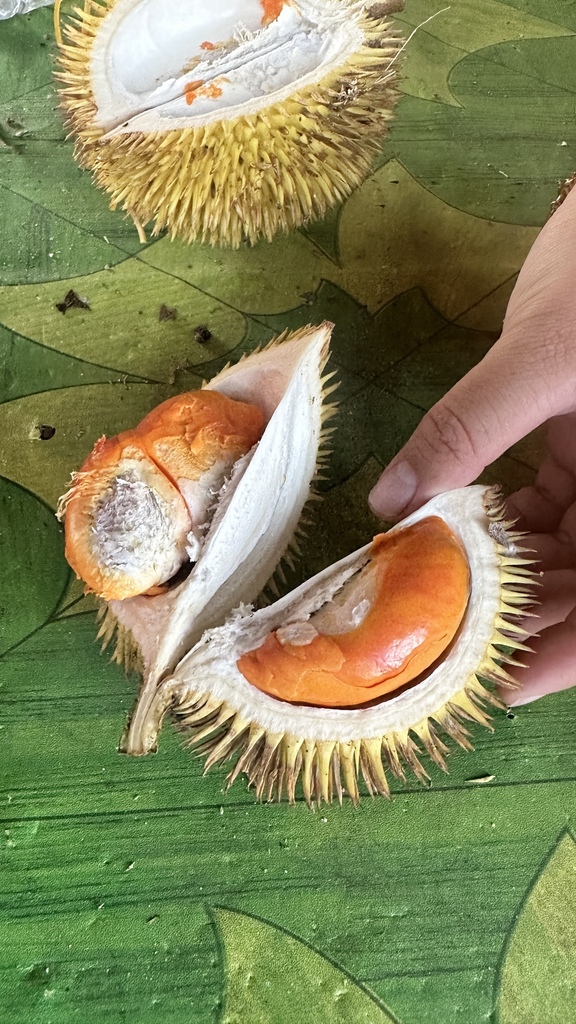
Durio graveolens
Durio graveolens, sometimes called the red-fleshed durian, orange-fleshed durian, or yellow durian, is a species of tree in the family Malvaceae. It is one of six species of durian named by Italian naturalist Odoardo Beccari. The specific epithet graveolens ('strong smelling' or 'rank') is due to the odor. Although most species of Durio (most notably Durio dulcis) have a strong scent, the red-fleshed type of D. graveolens has a mild scent. It is native to Southeast Asia.
D. graveolens is an edible durian, perhaps the most popular 'wild' species of durian, and it is sold commercially regionally.
From the article Durio graveolens on Wikipedia (CC BY-SA), quoted section by section
Description
D. graveolens is a large, up to 50 m (160 ft) tall upper canopy tree. The trunk is 85–100 cm (33–39 in) in diameter and can have no branches until about 25 m (82 ft) high. The trunk is smooth or flaky, grey/mauve to ruddy brown with steep buttress roots. The buttresses reach 3 m (9.8 ft) and extend out 1.5 m (4 ft 11 in). The oblong leaves are 10–26 cm (3.9–10.2 in) long without the petiole (leaf stalk), and 4–10 cm (1.6–3.9 in) wide. They are perfectly rounded on both ends, rigid, and slightly coriaceous (leather-like in feel or texture). On the top, they are glabrous (smooth and hairless) and crisp, almost vernicose (varnished). Underneath, the leaves are copper-brown and lepidote (scaly), with large scales of up to 2 mm (0.079 in) in diameter, which are not very noticeable, at least when dry. The leaf scales are peltate (shield-shaped), ciliate-radiated (fringed), and deeply-lobed in three to five parts. In addition to the scales, long strands of stellate hairs and other trichomes of varying size form a soft tomentose (fuzzy) surface. The leaf midrib is very prominent on the underside and forms a crease on top. The leaf stipules are caducous (drop early). Leaves have 10–12 lateral veins per side (with some smaller ones intermixed), which are tiny and superficial above and more distinct, but still barely visible. …
Range & habitat
Wild D. graveolens grows in Peninsular Malaysia (states of Johor, Kedah, Kelantan, Malacca, Penang, Perak, Selangor, and Terengganu), Indonesian Islands of Borneo and Sumatra, Palawan, and Southern Thailand. It is cultivated in Brunei, Sarawak, Sabah, and the Northern Territory of Australia. In Brunei, its popularity outshines D. zibethinus, which is not cultivated in the country. It is occasionally grown outside the tropics. In Florida, it has been seen to survive two consecutive nights at 0 °C (32 °F), albeit shrouded in cloth.
Wikipedia: “Distribution and habitat”
What it does
D. graveolens is a tropical plant species that needs high heat and humidity. Typically, it is found on clay-rich soils in wet lowland dipterocarp forests, frequently along riverbanks and swamps. Because of its tolerance for wet habitats, it is possibly resistant to infection by the oomycete Phytophthora palmivora. It can also be found on hillsides and shale ridges up to 1,000 m (3,300 ft) in elevation. It is pollinated by bats. As it is one of the only species to naturally hybridize with D. zibethinus, they are thought to share a pollinator, likely the cave nectar bat (Eonycteris spelaea). Pollen from both of these durian species has been found in cave nectar bat feces, and possibly in that of the long-tongued fruit bat (Macroglossus sobrinus). After harvest, fruit can be set upon by fungi such as Lasiodiplodia theobromae, Glomerella cingulata, Geotrichum candidum, Calonectria kyotensis, and occasionally Gliocephalotrichum bulbilium. Secondary or opportunistic fungal infection can be from species such as Aspergillus niger and other Aspergillus spp., Candida spp., Gibberella intricans, and Penicillium spp. The fruit is fed on by Bornean orangutans (Pongo pygmaeus), Prevost's squirrels (Callosciurus prevostii), crab-eating macaques (Macaca fascicularis), black hornbills (Anthracoceros malayanus), possibly viverrids and sun bears (Helarctos malayanus). …
Wikipedia: “Ecology”
At the table
The fruit's pulp is typically eaten raw and has the fragrance of roasted almonds or burnt caramel. The taste is described as sweet and cheesy or similar to eating an avocado or pimento cheese. Sometimes, it is fermented into the condiment tempoyak. The red-fleshed type is used with freshwater fish to make a type of sayur (a traditional Indonesian vegetable stew). The seeds can also be ground into flour (tepung biji durian dalit), which then can be used to make, for example, fish crackers. The tree is also harvested for lumber in Sarawak. The Iban people there also bathe day-old infants (especially for preterm birth) in a tisane of mature bark, as they believe it strengthens the skin.
Wikipedia: “Uses”
In human culture
The specific epithet graveolens means strong smelling, although it has been described as having a "mild" or "slight" odor or even, in a book published by the US National Research Council, as "odorless". In Malay, the fruit is called durian burong, durian burung (literally 'bird durian'), durian rimba ('jungle durian'), durian kuning ('yellow durian'), durian merah ('red durian'), or durian otak udang galah ('crayfish brain durian'). In Iban, it is durian isu. The Bidayuh call it durian umot. Among the Kenyah and Dayak peoples, it is known as durian anggang ('hornbill durian'), durian ajan, pesang, tabela or ta-bela, tabelak, taula, tuala, tuwala. On Sumatra, the Batak call it tinambela. In Karo, it is called meraan. In Thailand, it is referred to as thurian rak kha (Thai: ทุเรียนรากขา) or thurian khua tit (ทุเรียนขั้วติด; sources differ on which name refers to this species, with the other being attributed to D. kutejensis). In Aceh Tamiang Regency, it can be called durian batu ('stone durian'), and elsewhere in Sumatra, it known as durian adjan. Other regional names include durian dalit (but this can apply also to Durio oxleyanus) alau, dujen, durian alau, durian daun dungoh, durian hutan ('forest durian'), durian pipit, lai bengang, merang kunyit, pasang, and tongkai.
Wikipedia: “Etymology”
Where it lives
Recorded sightings
—
geo-referenced records in GBIF, from museums, herbaria and field observers.
Drag the globe to turn it. Dots are where records exist, not a range map; darker means more records.
In the stacks
Searching the stacks…
Every page naming Durio graveolens in the Biodiversity Heritage Library →
This page is assembled live from iNaturalist, GBIF, Wikipedia, the Source Library and the Internet Archive. It is not yet part of the hand-edited codex. iNaturalist taxon 427561.