- Plants
- ›Vascular Plants
- ›flowering plants
- ›monocots
- ›gingers, bananas, and allies
- ›Spiral Gingers and Allies
- ›Costus
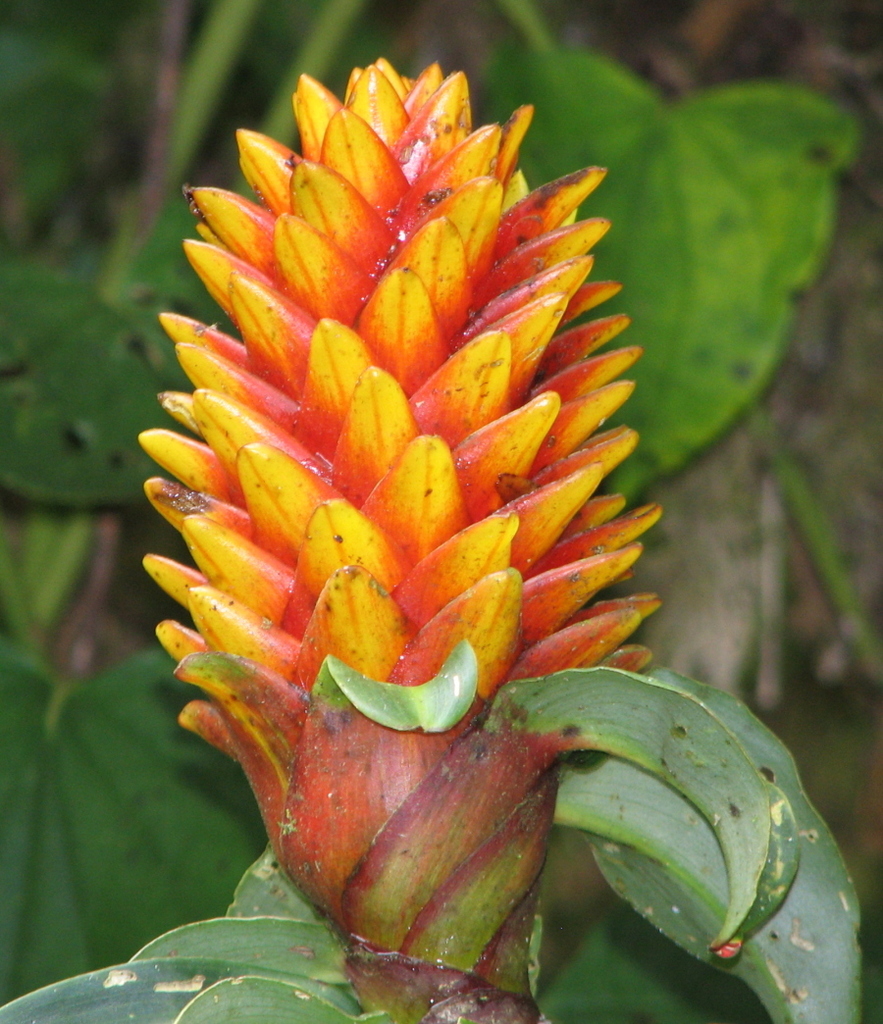
Costus curvibracteatus
Costus curvibracteatus is a tropical rhizomatous perennial native to Costa Rica and Panama. A member of the spiral ginger family of plants, its common name is orange tulip ginger. It is also sometimes referred to as spiral ginger; however, this common name is better associated with Costus barbatus, a more widely cultivated and very similar species. Despite the name and its relation to the ginger family (Zingiberaceae), the rhizomes of the orange tulip ginger are not...
From the article Costus curvibracteatus on Wikipedia (CC BY-SA), quoted section by section
Range & habitat
Costus curvibracteatus is native to Costa Rica and Panama, where it usually grows in the understory of forested montane areas between 700 and 1,900 metres (2,300 and 6,200 ft). The plant can sometimes be found growing as low as 50 m (160 ft). One record exists of the plant being found in the Chocó region of Colombia. The plant is not uncommon in its native habitat and has been classified by the International Union for Conservation of Nature as being of least concern.
Wikipedia: “Distribution and habitat”
What it does
Costus curvibracteatus produces abundant nectar in its tubular florets and is pollinated by hummingbirds. Its seeds, by which it reproduces, are contained within glabrous, ellipsoid capsules, 10 to 17 mm long. Only occasionally cultivated as an ornamental, it can nevertheless be grown successfully in milder climates if kept warm and sheltered in a shady location, with well-watered soil. It also grows well when potted and indoors. The plant can be grown from seeds, by first soaking them, or from cuttings of a mature plant. Costus productus is more common in the ornamental plant trade, but is often incorrectly labelled as C. curvibracteatus.
Wikipedia: “Reproduction and cultivation”
Where it lives
Recorded sightings
—
geo-referenced records in GBIF, from museums, herbaria and field observers.
Drag the globe to turn it. Dots are where records exist, not a range map; darker means more records.
In the stacks
Searching the stacks…
Every page naming Costus curvibracteatus in the Biodiversity Heritage Library →
This page is assembled live from iNaturalist, GBIF, Wikipedia, the Source Library and the Internet Archive. It is not yet part of the hand-edited codex. iNaturalist taxon 427387.