- Plants
- ›Vascular Plants
- ›flowering plants
- ›Dicots
- ›myrtles, evening primroses, and allies
- ›myrtle family
- ›Myrtoideae
- ›Leptospermeae
- ›Leptospermum
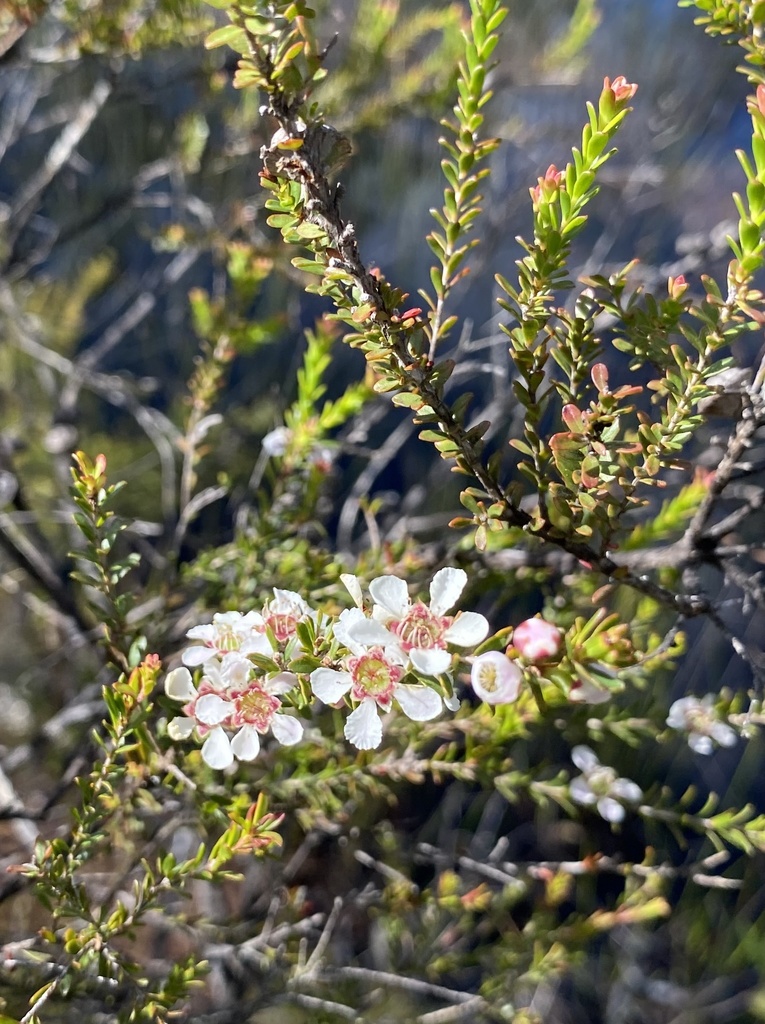
Lemon-scented Tea-tree
Leptospermum liversidgei
Leptospermum liversidgei, commonly known as lemon-scented tea-tree, swamp may, olive teatree, or lemon teatree, is a shrub to 4 m found naturally growing in wet coastal heath in Eastern Australia. Leaves are 5–7 mm long, with a distinctive lemony aroma. The white or pink flowers are solitary, followed by a woody capsule.
From the article Leptospermum liversidgei on Wikipedia (CC BY-SA), quoted section by section
Description
Leptospermum liversidgei is a shrub that typically grows to a height of 4 m (13 ft) and has thin, rough bark on the main branches and hairy young stems. The leaves are crowded, narrow egg-shaped and lemon-scented, mostly 5–7 mm (0.20–0.28 in) long and 1–2 mm (0.039–0.079 in) wide on a very short petiole. The flowers are white or pink, 10–12 mm (0.39–0.47 in) wide on a pedicel 1–1.5 mm (0.039–0.059 in) long, arranged singly on the ends of short, leafless side branches. The floral cup is dark coloured, about 2.5 mm (0.098 in) long, the sepals hemispherical to triangular, about 2 mm (0.079 in) long, the petals about 5 mm (0.20 in) long and the stamens 1.5–2.5 mm (0.059–0.098 in) long. Flowering mainly occurs in January and the fruit is a woody capsule 7–10 mm (0.28–0.39 in) wide and that is not shed when mature.
Range & habitat
Olive tea-tree occurs in coastal swamps between the Bundaberg region of Queensland and Tomago in New South Wales where it grows in heath.
Wikipedia: “Distribution and habitat”
How it is grown
The size of this tea-tree makes it suitable for smaller gardens where it will tolerate poorly-drained soil and at least moderate frost. The leaves contain the essential oil citronellal and the plant is sometimes alleged to repel mosquitoes.
Wikipedia: “Use in horticulture”
Where it lives
Recorded sightings
—
geo-referenced records in GBIF, from museums, herbaria and field observers.
Drag the globe to turn it. Dots are where records exist, not a range map; darker means more records.
In the stacks
Searching the stacks…
Every page naming Leptospermum liversidgei in the Biodiversity Heritage Library →
This page is assembled live from iNaturalist, GBIF, Wikipedia, the Source Library and the Internet Archive. It is not yet part of the hand-edited codex. iNaturalist taxon 427009.