- Plants
- ›Vascular Plants
- ›flowering plants
- ›Dicots
- ›Roses, Elms, Figs, and Allies
- ›rose family
- ›Amygdaloideae
- ›Amygdaleae
- ›Prunus
- ›Padus
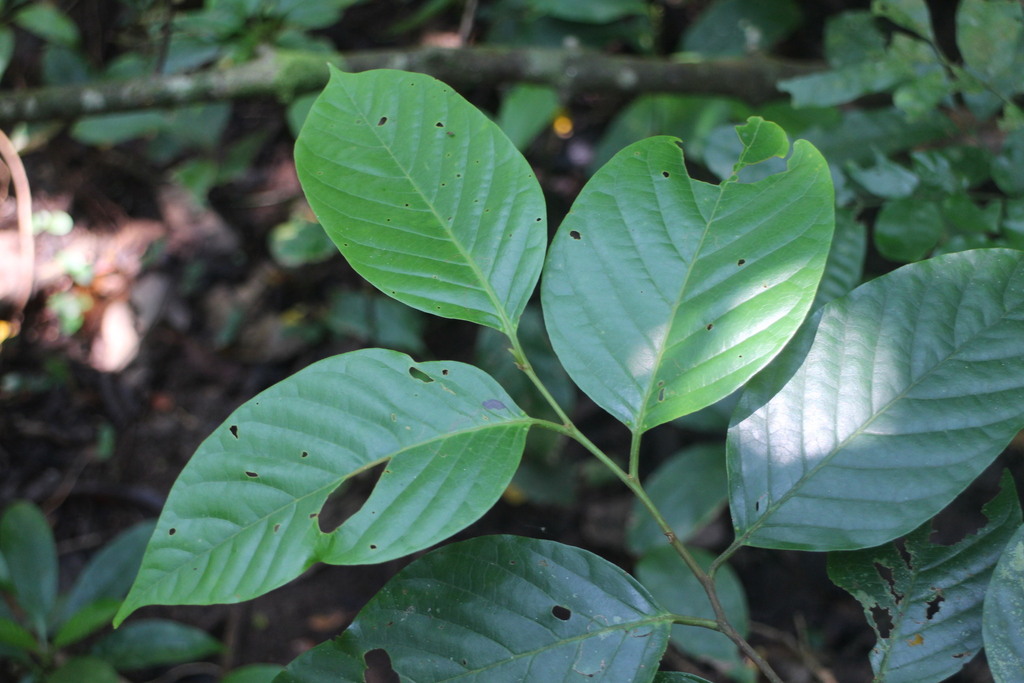
Prunus grisea
Prunus grisea, most commonly known as lago, is a species of flowering plant in the family Rosaceae, and is endemically distributed throughout East, South, and Southeast Asia, as well as parts of Melanesia, spanning over many countries.
From the article Prunus grisea on Wikipedia (CC BY-SA), quoted section by section
Description
Prunus grisea is a versatile tree or shrub, reaching heights of up to 35 m (115 ft), with a crooked or straight cylindrical bole that can remain branchless for up to 15 m (49 ft) and reach diameters of 1 m (3 ft 3 in), occasionally displaying small buttresses. The twigs are initially pubescent to puberulous, quickly becoming glabrous. The leaves vary in shape, predominantly elliptic to oblong but sometimes ovate or lanceolate, ranging from 2–20 cm (0.79–7.87 in) in length and 1–9 cm (0.39–3.54 in) in width, with a rounded or acute base and typically an acuminate apex, though it can occasionally be obtuse. They exhibit 5–9 pairs of venation, which is inconspicuous to invisible, and are sparsely pubescent to glabrous on both surfaces. Basal glands, typically two but occasionally absent or numbering up to 4, are flat, with additional glands often present. The petiole measures between 0.2–2 cm (0.079–0.787 in) and transitions from pubescent to glabrous. Stipules, linear and deciduous, range from 1.5–8 mm (0.059–0.315 in) in length, typically glabrous inside but occasionally glandular-serrate on the margins. The solitary axillary racemes measure between 0.5–6.5 cm (0.20–2.56 in), with a peduncle up to 1 cm (0.39 in) and a sparsely pubescent rachis. Pedicels are very short, between 0–7 mm (0.00–0.28 in). …
Range & habitat
Prunus grisea is found across a very wide range, encompassing many regions. In Malesia, it is present throughout its near entirety, where it occurs most notably in Bohol, Borneo, Cebu, Java, the Kangean and Lesser Sunda Islands, Leyte, Luzon, the Maluku Islands, Mindanao, Mindoro, New Guinea, Palawan, Sibuyan, Sulawesi, and Sumatra. The presence of Prunus grisea within Indochina extends to Cambodia, Myanmar, Peninsular Malaysia, Singapore, Thailand, and Vietnam. Other countries in Asia include Afghanistan, China, where it occurs in Guangdong and Yunnan, along with India, Japan, and Taiwan. Outside of Asia, the plant has been introduced to Guinea, the Hawaiian Islands, Queensland, and the United Kingdom. Prunus grisea was inferred to have dispersed from the Sunda Shelf to the Philippines in the early Miocene, having dispersed from Sahul to the Sunda shelf during the late Oligocene and early Miocene, suggesting historical movement across these biogeographic zones. Collections of Prunus grisea from various localities did not form a distinct clade, indicating unresolved phylogenetic relationships within the section Mesopygeum.
Wikipedia: “Distribution”
What it does
Prunus grisea is primarily found in the wet tropical biome, thriving across a broad elevational range from 0–3,700 m (0–12,139 ft). In its native habitat, it occupies primary and secondary lowland to montane forests, with distinct elevational preferences among its varieties, being a plant that engages in zoochory. In Hawaii, the plant has been naturalized, having been observed forming dense seedling carpets and thickets of scattered saplings around planted trees, the seedlings exceeding 100/m2, predominantly within a concentrated 400 m2 (1,300 ft2) area surrounding the original plantings.
Wikipedia: “Ecology”
At the table
Studies on Prunus grisea indicate that its bark and leaves possess antioxidant and cytotoxic properties, with traditional uses including bark applications for skin irritation and leaves for rheumatism relief. Research evaluating its leaf decoction and various extracts has shown potent antioxidant activity, particularly in the decoction, which exhibited a 92.85% antiradical activity at 500 ppm, along with high total antioxidant capacity and phenolic content. Toxicity assessments using the brine shrimp lethality assay revealed that the chloroform extract had the highest toxicity, with an LC50 value of <10 ppm, while bioassay-guided fractionation of air-dried leaf hexane extracts identified PGH13 as the most bioactive fraction, demonstrating 56.67% mortality against Artemia salina. The wood of Prunus grisea is legally unrestricted for use. It exhibits moderate durability but is generally perishable, making it susceptible to decay and insect damage. Drying is slow and can be challenging, with risks of distortion during the process. In veneer applications, Prunus grisea performs well, demonstrating good lamination properties in both rotary and sliced veneer cutting. Machining characteristics range from easy to fair. This wood is wild-crafted and is primarily used for indoor construction, cabinetry, general housing applications, furniture, plywood, and packing cases.
Wikipedia: “Uses”
Where it lives
Recorded sightings
—
geo-referenced records in GBIF, from museums, herbaria and field observers.
Drag the globe to turn it. Dots are where records exist, not a range map; darker means more records.
In the stacks
Searching the stacks…
Every page naming Prunus grisea in the Biodiversity Heritage Library →
This page is assembled live from iNaturalist, GBIF, Wikipedia, the Source Library and the Internet Archive. It is not yet part of the hand-edited codex. iNaturalist taxon 426496.