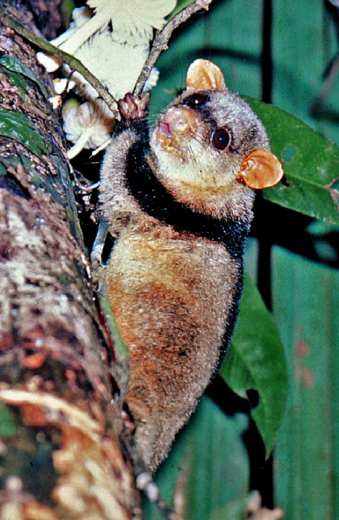
Black-shouldered Opossums
Caluromysiops
The black-shouldered opossum (Caluromysiops irrupta), also known as the white-eared opossum, is an opossum known from western Brazil and southeastern Peru. It was first described by Colin Campbell Sanborn, curator of Field Museum of Natural History, in 1951. The black-shouldered opossum is characterized by a gray coat, gray underbelly, and broad black stripes that extend from the forefeet, meet on the shoulders, run along the midline of the back and then split into parallel stripes that run down the hind feet. Little is known of the behavior of the black-shouldered opossum. It is nocturnal and arboreal. It is known to feed on fruits and rodents. The opossum inhabits humid forests. The IUCN classifies it as least concern.
1 branches of this genus, most-observed first · about 1 known species
See this branch on the Wheel of Life →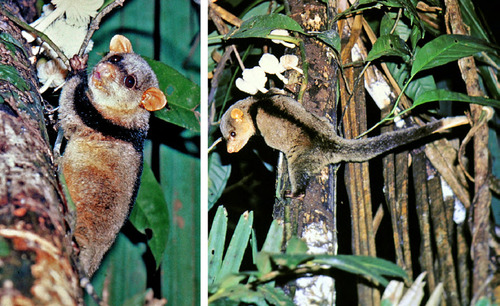
Where it lives
Recorded sightings
—
geo-referenced records in GBIF, from museums, herbaria and field observers.
Drag the globe to turn it. Dots are where records exist, not a range map; darker means more records.
In the stacks
Searching the stacks…
Every page naming Caluromysiops in the Biodiversity Heritage Library →
This page is assembled live from iNaturalist, GBIF, Wikipedia, the Source Library and the Internet Archive. It is not yet part of the hand-edited codex. iNaturalist taxon 42614.