- Plants
- ›Vascular Plants
- ›flowering plants
- ›Dicots
- ›Roses, Elms, Figs, and Allies
- ›rose family
- ›Amygdaloideae
- ›Maleae
- ›Malus
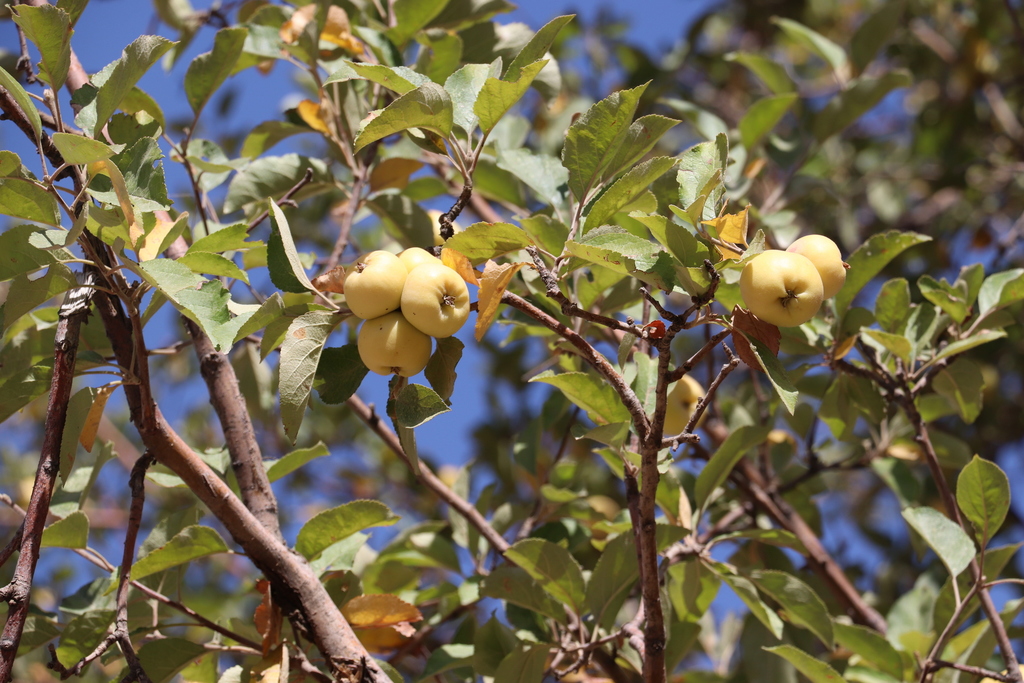
Malus sieversii
Malus sieversii is a wild apple. According to DNA analysis conducted in 2010 that sequenced the complete genome of the apple, it is the primary ancestor of M. domestica, the domesticated apple. Its scientific name is accredited to Johann August Carl Sievers.
Native to Central Asia, M. sieversii prefers warm and damp habitats. Its conservation status is vulnerable.
From the article Malus sieversii on Wikipedia (CC BY-SA), quoted section by section
Description
It is a deciduous tree growing 5 to 12 metres (16 to 39 ft), very similar in appearance to the domestic apple. Its pollen grains vary in size and are seen to be ovular when dry and spherical when swelled with water. Its fruit is the largest of any species of Malus except domestica, up to 7 cm in diameter, equal in size to many modern apple cultivars. Unlike domesticated varieties, its leaves go red in autumn: 62% of the trees in the wild do this compared to only 2.8% of the regular apple plant or the 2,170 English cultivated varieties. M. sieversii has the capability to reproduce vegetatively as they form root suckers, or basal shoots. The clonal individual grows from the adventitious bud on the root, with identical genetic materials to the mother plant. It was originally believed that wild apples produce root suckers only when upper plant parts are damaged, but further evidence suggests root-sucker growth occurs in healthy plants as a dispersal aid. For wild apples, proper development of root suckers requires certain humidity and aeration levels in the surface soil, where the mother root is located. Successful root-sucker growth also depends on shoot arrangement, time of growth and health conditions of the mother plant. Genetics of self-incompatibility, the system for preventing self-fertilization in angiosperms, have also been studied for M. sieversii. …
Range & habitat
Malus sieversii is distributed mainly within the Ili valley in southern Kazakhstan, where the damp climate suits its growth. It appears in many different habitats. Although the species prefers high temperatures and short winters, it is also found in the Tian Shan mountains which have long and harsh winters.
Wikipedia: “Distribution and habitat”
How it is grown
Malus sieversii has previously been identified as the main contributor to the genome of the cultivated apple (Malus domestica), on the basis of morphological, molecular, and historical evidence. Fruit traits including crispness, more flavour intensity and fruit weight have undergone differential selection by humans to produce Malus domestica as seen today. The dispersal of M. sieversii and its progeny throughout history can be attributed to the Silk Road. A DNA analysis in 2010 confirmed M. sieversii as the progenitor of the cultivated apple. It has a highly variable genetic diversity therefore it is the genetic source for abiotic and biotic stress tolerance, many disease resistance and unique fruit traits. Planting cultivated apple varieties close to wild groves causes crossbreeding.
Wikipedia: “Progenitor of cultivated apples”
In human culture
Almaty, the largest city in Kazakhstan, and formerly its capital, possibly derives its name from the Kazakh word alma 'apple', and it is often explained as meaning 'full of apples' (the region surrounding Almaty is home to forests of Malus sieversii).
Wikipedia: “In culture”
Where it lives
Recorded sightings
—
geo-referenced records in GBIF, from museums, herbaria and field observers.
Drag the globe to turn it. Dots are where records exist, not a range map; darker means more records.
In the stacks
Searching the stacks…
Every page naming Malus sieversii in the Biodiversity Heritage Library →
This page is assembled live from iNaturalist, GBIF, Wikipedia, the Source Library and the Internet Archive. It is not yet part of the hand-edited codex. iNaturalist taxon 425883.