- Plants
- ›Vascular Plants
- ›flowering plants
- ›Dicots
- ›pinks, cactuses, and allies
- ›Sundew Family
- ›Drosera
- ›Ergaleium
- ›Luniferae
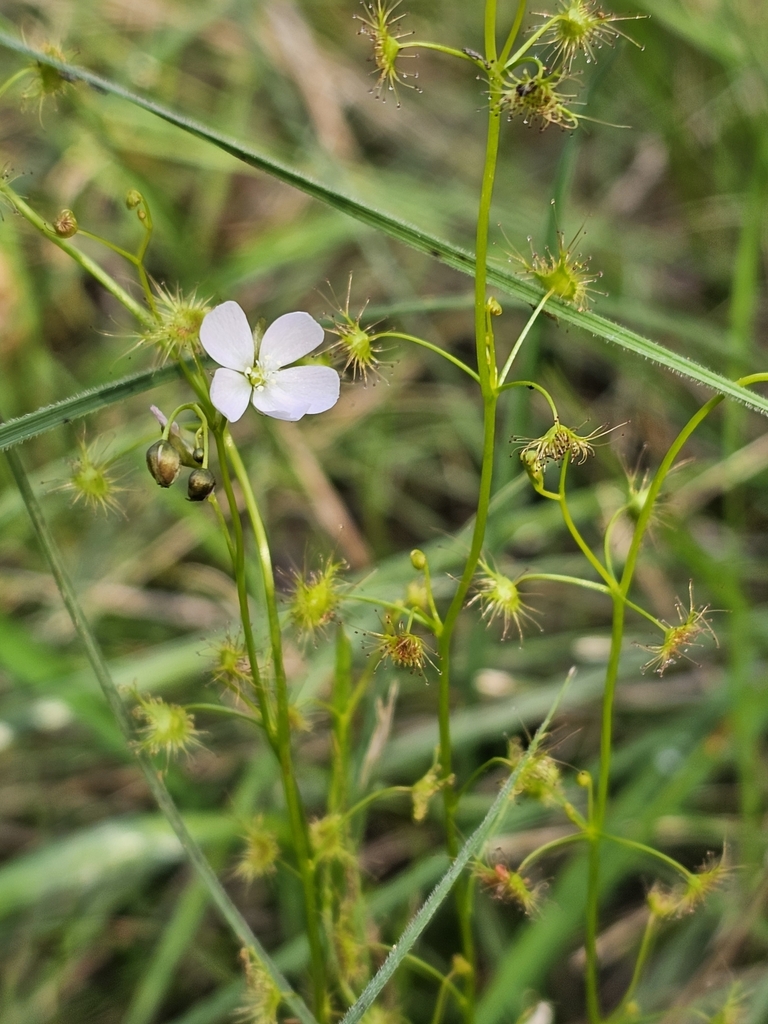
Tall sundew
Drosera auriculata
Drosera peltata, commonly called the shield sundew or pale sundew, is a climbing or scrambling perennial tuberous species in the carnivorous plant genus Drosera. Among the tuberous sundews, D. peltata has the largest distribution, which includes eastern and western Australia, New Zealand, India, and most of Southeast Asia including the Philippines. The specific epithet is Latin for "shield shaped", a reference to the shape of the cauline leaves. It is either a single extremely variable species, or a complex of several closely related species of uncertain taxonomic boundaries. In Australia at least four forms have had or still have specific taxonomic recognition: Drosera peltata subsp. peltata (an autonym), D. peltata subsp. auriculata, D. foliosa (also as D. peltata var. foliosa) and D. gracilis (also as D. peltata var. gracilis).
Tuberous sundews are species of the genus Drosera that have evolved to live in summer drought conditions and aestivate as a dormant underground tuber. While many tuberous sundews are ground-hugging rosettes, D. peltata is an upright species with a simple or branching inflorescence.
From the article Drosera peltata on Wikipedia (CC BY-SA), quoted section by section
Description
Drosera peltata is a perennial tuberous herb. Its underground tuber is generally found 4 – 6 cm under the soil surface, and its aerial parts range from 5 – 50 cm in height, with wide differentiation into several forms. The subspecies D. peltata subsp. auriculata is often the most robust, reaching up to 50 cm in height, whereas the form known informally as D. foliosa tends to be the shortest, often only 5–10 cm. Drosera peltata generally has an evident rosette of leaves at the soil surface, which is most pronounced in D. foliosa and in contrast often reduced to scales in mature plants of D. peltata subsp. auriculata. The aerial stem is simple or slightly branched in the nominal form of D. peltata, as well as in D. peltata subsp. auriculata, and the form informally known as D. gracilis. Flowers are variable in color, but generally white or light pink. The colour of the plants is also highly variable, with D. foliosa generally bright grass green even when growing in direct sunlight, D. peltata subsp. auriculata often tinged with variable amounts of red (or even solid red), and D. gracilis always orange or dark red colour.
Range & habitat
Drosera peltata is commonly found growing on frost free open flats with light scrub, in areas of regenerating forest, on grassy verges and roadside cuttings. The soil type these plants are found in is mainly soft fine clay or peaty, sand soils, which, while wet in winter, dry out over summer. This species has a large range and various forms occur naturally in southern, eastern and south-west Australia, Tasmania, New Zealand (in Northland) as well as south-east Asia and India.
Wikipedia: “Habitat and distribution”
How it is grown
Drosera peltata is one of the easiest tuberous Drosera to cultivate, a characteristic that is attributed to its forgiving nature when it comes to water and temperature. The tuberous Drosera typically require wet, cool winters, which is their active growing season, and warmer, nearly bone-dry summers or the dormant tubers will rot. Drosera peltata can withstand wetter summers.
Wikipedia: “Cultivation”
Where it lives
Recorded sightings
—
geo-referenced records in GBIF, from museums, herbaria and field observers.
Drag the globe to turn it. Dots are where records exist, not a range map; darker means more records.
In the stacks
Searching the stacks…
Every page naming Drosera auriculata in the Biodiversity Heritage Library →
This page is assembled live from iNaturalist, GBIF, Wikipedia, the Source Library and the Internet Archive. It is not yet part of the hand-edited codex. iNaturalist taxon 424565.