- Animals
- ›Chordates
- ›Vertebrates
- ›Mammals
- ›Therians
- ›Placental Mammals
- ›Ungulates, Carnivorans, and Allies
- ›Even-toed Ungulates and Cetaceans
- ›Ruminants
- ›Pronghorns
- ›Antilocapra
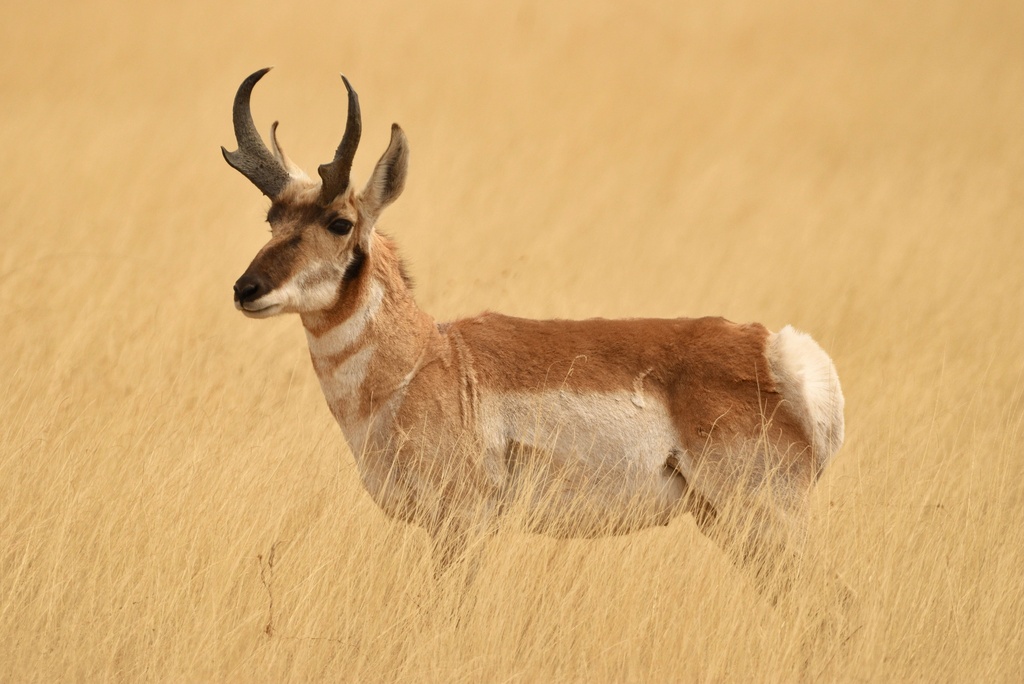
Pronghorn
Antilocapra americana
The pronghorn (UK: , US: ) (Antilocapra americana) is a species of artiodactyl (even-toed, hoofed) mammal indigenous to interior western and central North America. Though not an antelope, it is known colloquially in North America as the American antelope, prong buck, pronghorn antelope, and prairie antelope, because it closely resembles the antelopes of the Old World and fills a similar ecological niche due to parallel evolution. It is the only surviving member of the family Antilocapridae.
During the Pleistocene epoch, about 11 other antilocaprid species existed in North America, many with long or spectacularly twisted horns. Three other genera (Capromeryx, Stockoceros and Tetrameryx) existed when humans entered North America, but are now extinct.
From the article Pronghorn on Wikipedia (CC BY-SA), quoted section by section
Description
Pronghorns have distinct white fur on their rumps, sides, bellies, breasts, and across their throats. Adult males are 4.3–4.9 ft (1.3–1.5 m) long from nose to tail, stand 2.7–3.4 ft (82–104 cm) high at the shoulder, and weigh 88–143 lb (40–65 kg). The females are the same height as males, but weigh 75–106 lb (34–48 kg). The feet have two hooves, with no dewclaws. Their body temperature is 100 °F (38 °C).
Head. They have very large eyes with a 320° field of vision. Their orbits (eye sockets) are prominent and set high on the skull. Their teeth are hypsodont and their dental formula is 0.0.3.33.1.3.3. Unlike deer, pronghorns possess a gallbladder. Each horn of the pronghorn is composed of a slender, laterally flattened blade of bone, which is thought to grow from the frontal bones of the skull, or from the subcutaneous tissues of the scalp, forming a permanent core. As in the Giraffidae, skin covers the bony cores, but in the pronghorn, it develops into a keratinous sheath, which is shed and regrown annually. Males have a horn sheath about 4.9–17 in (12+1⁄2–43+1⁄4 cm) (average 9.8 in or 25 cm) long with a prong. …
Range & habitat
Prior to the arrival of Europeans, the pronghorn was particularly abundant in the regions west of the Mississippi River which is still its primary range today. The amount of wildlife was considered to be so vast at one time that the prehistoric American Prairie—and as recently as 200 to 300 years ago—has been dubbed the "American Serengeti", due to the once-millions-strong herds of bison, elk, and pronghorn, as well as many other now-extinct megafauna. The present-day range of the pronghorn is west of the Mississippi, extending from southern Saskatchewan and Alberta, Canada, south into the western United States, primarily in the states of Arizona, Colorado, Idaho, Kansas, Montana, Nebraska, Nevada, New Mexico, North Dakota, Oklahoma, Oregon, South Dakota, Texas, Utah, Washington, and Wyoming, and into Mexico. In extreme Northern California, pronghorns can be found in inland counties, ranging from neighboring Nevada and Oregon, as well as the central coastal grasslands, further south. In Mexico, the Sonoran pronghorn (A. a. sonoriensis) subspecies may be found from the state of Baja California Sur east through Sonora to San Luis Potosí, in north-central regions of the country, albeit in gradually diminishing populations. …
Wikipedia: “Range and ecology”
What it does
Pronghorns form mixed-sex herds in the winter. In early spring, the herds break up, with young males forming bachelor groups, females forming harems, and adult males living solitarily. Some female bands share the same summer range, and bachelor male bands form between spring and fall. Females form dominance hierarchies with few circular relationships. Dominant females aggressively displace other females from feeding sites. Adult males either defend a fixed territory that females may enter, or defend a harem of females. A pronghorn may change mating strategies depending on environmental or demographic conditions. Where precipitation is high, adult males tend to be territorial and maintain their territories with scent marking, vocalizing, and challenging intruders. In these systems, territorial males have access to better resources than bachelor males. Females also employ different mating strategies. "Sampling" females visit several males and remain with each for a short time before switching to the next male at an increasing rate as estrus approaches. "Inciting" females behave as samplers until estrus, and then incite conflicts between males, watching and then mating with the winners. Before fighting, males try to intimidate each other. If intimidation fails, they lock horns and try to injure each other. …
Wikipedia: “Social behavior and reproduction”
In human culture
The animal gets its name from its horn sheaths that branch and have a forward-pointing tine, unlike the horns of species from the ox family Bovidae.
Wikipedia: “Etymology”
Listen
Looking for field recordings…
Where it lives
Recorded sightings
—
geo-referenced records in GBIF, from museums, herbaria and field observers.
Drag the globe to turn it. Dots are where records exist, not a range map; darker means more records.
In the stacks
Searching the stacks…
Every page naming Antilocapra americana in the Biodiversity Heritage Library →
This page is assembled live from iNaturalist, GBIF, Wikipedia, the Source Library and the Internet Archive. It is not yet part of the hand-edited codex. iNaturalist taxon 42429.