- Plants
- ›Vascular Plants
- ›flowering plants
- ›Dicots
- ›Soapberries, Cashews, Mahoganies, and Allies
- ›Cashew Family
- ›cashews, sumacs, and allies
- ›Mangifera
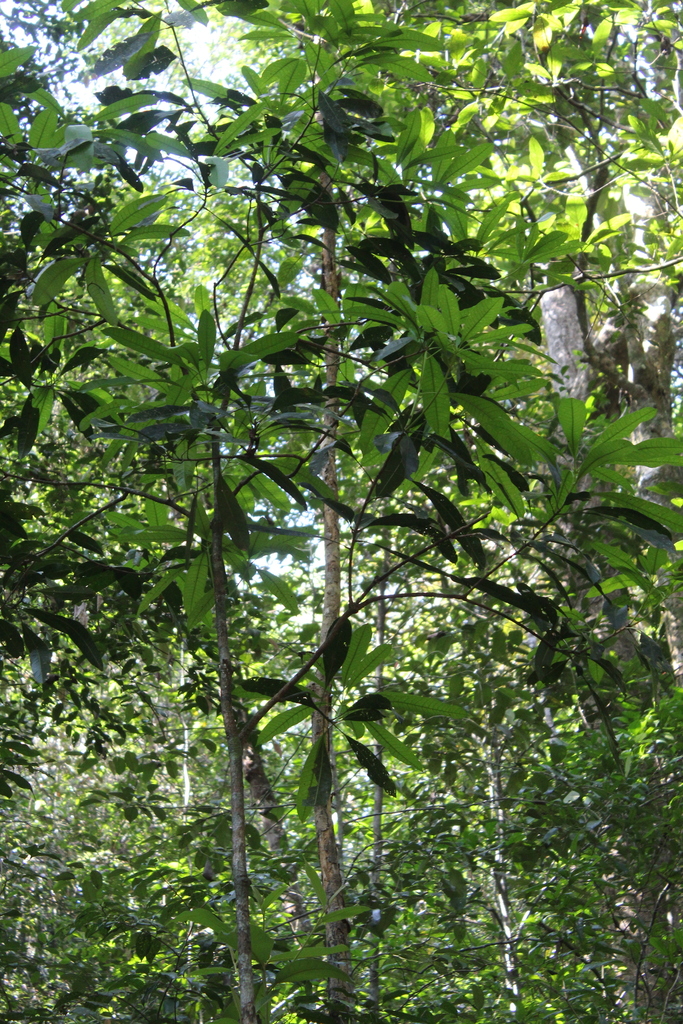
Mangifera zeylanica
Mangifera zeylanica, or Sri Lanka wild mango, is a wild species of mango relative endemic to Sri Lanka. This stately tree is the tallest member of the mango genus, Mangifera, and one of the two tallest trees in the family Anacardiaceae. The mango fruits are edible and have an excellent taste. It is called aetamba (ඇටඹ) or wal amba in Sinhala and kaddu-ma in Tamil.
The species was first described as Buchanania zeylanica by Carl Ludwig Blume in 1850. In 1876 the British botanist and explorer Joseph Dalton Hooker placed the species in genus Mangifera as M. zeylanica.
From the article Mangifera zeylanica on Wikipedia (CC BY-SA), quoted section by section
Description
Mangifera zeylanica is a large, slow growing, evergreen tree that can grow up to 35 m (115 ft) tall. The trunk is straight, up to 90 cm (35 in) in diameter, and is free of buttresses. Bark in older trees is rough, deeply fissured, with strips 2–3 cm (0.79–1.18 in) wide, and dark to light brown. The inner bark is orange brown. The wood is greyish white, soft, and coarsely grained. The dark green leaves are stiffly coriaceous, glabrous, and emit a mango aroma when damaged. The leaves are scattered, partly aggregating at the end of twigs. In shape they are spathulate or obovate-oblong or oblanceolate, up to 5 cm (2.0 in) wide and 16 cm (6.3 in) long, tapering towards the base, with a rounded apex in adult trees and with a pointed 7–13 cm (2.8–5.1 in) apex in saplings. The margins are slightly incurved and narrowly decurrent at the base along the petiole. The midrib is raised on both leaf surfaces. Lateral nerves 7 to 14 pairs. Petiole slender, 1–3 cm (0.39–1.18 in) long. Panicles glabrous, erect, up to 20 cm (7.9 in) long, terminal. Flowers whitish and cream yellow coloured, 5–merous, 4 mm (0.16 in) across, not glomerulate. Bracteoles lanceolate, minute, caducous. Pedicel slender, 1 mm (0.04 in). Petals twice as long as sepals. Sepals 5, ovate, acute, 2 mm × 1.5 mm (0.08 in × 0.06 in). Petals 5, elliptic, 3.5 x 2 mm. Disc large, cushion-like, with 5 globose lobes. …
Range & habitat
It mainly grows in forests of the intermediate and wet zones up to 800 m (2,600 ft), but can also be found in the Dry Zone along waterways and in moist valley areas. It occurs at low population densities, scattered here and there in forests, and, like many native plants, is declining in unprotected areas.
Wikipedia: “Distribution”
At the table
The fruit is eaten by villagers. The soft wood has been used for making tea cases and the like. The tree is not cultivated, but could be used for crossing and improving mango varieties and as a rootstock.
Wikipedia: “Uses”
Where it lives
Recorded sightings
—
geo-referenced records in GBIF, from museums, herbaria and field observers.
Drag the globe to turn it. Dots are where records exist, not a range map; darker means more records.
In the stacks
Searching the stacks…
Every page naming Mangifera zeylanica in the Biodiversity Heritage Library →
This page is assembled live from iNaturalist, GBIF, Wikipedia, the Source Library and the Internet Archive. It is not yet part of the hand-edited codex. iNaturalist taxon 424178.