- Animals
- ›Chordates
- ›Vertebrates
- ›Mammals
- ›Therians
- ›Placental Mammals
- ›Ungulates, Carnivorans, and Allies
- ›Even-toed Ungulates and Cetaceans
- ›Ruminants
- ›Bovids
- ›Bovines
- ›Cattle and Bison
- ›Bos
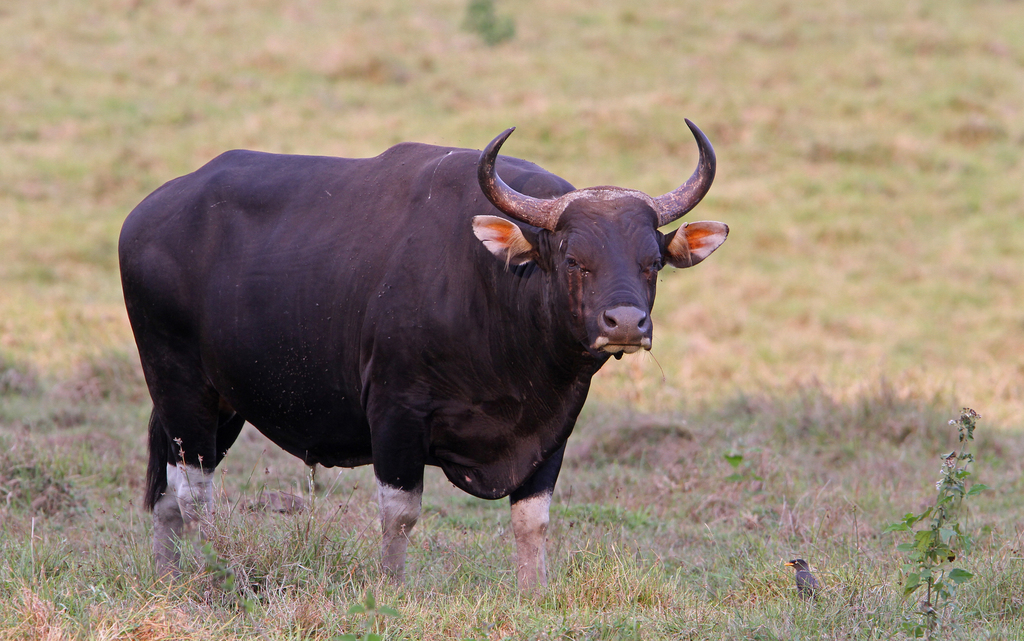
Banteng
Bos javanicus
The banteng (Bos javanicus; ), also known as the tembadau, is a species of wild bovine found in Southeast Asia, with domestic-wild hybrids present in parts of Northern Australia.
The head-and-body length is between 1.9 and 3.68 m (6.2 and 12.1 ft). Wild banteng are typically larger and heavier than their domesticated counterparts, but are otherwise similar in appearance. The banteng shows extensive sexual dimorphism; adult bulls are generally dark brown to black, larger and more sturdily built than adult cows, which are thinner and usually pale brown or chestnut red. There is a big white patch on the rump. Horns are present on both sexes, and are typically 60 to 95 cm (24 to 37 in) long. Three subspecies are generally recognised.
From the article Banteng on Wikipedia (CC BY-SA), quoted section by section
Description
The banteng is similar to taurine cattle, with head-and-body length between 1.9 and 2.25 m (6.2 and 7.4 ft). Wild banteng are typically larger and heavier than their domesticated counterparts, but are otherwise similar in appearance. The mean shoulder height of wild Javan and Indochinese banteng is 1.4 m (4.6 ft) for cows and 1.6 m (5.2 ft) for bulls; Bornean banteng, the smallest subspecies, are shorter. Domesticated banteng cows reach 1.2 m (3.9 ft) at the shoulder, while the bulls are 1.3–1.5 m (4.3–4.9 ft) tall. In the wild cows weigh around 590–670 kg (1,300–1,480 lb), while bulls weigh around 600–800 kg (1,300–1,800 lb). Weights of domesticated individuals range from 211 to 242 kg (465 to 534 lb) for females and from 335 to 363 kg (739 to 800 lb) for males. The largest bulls attain 3.3 and 3.7 m (11 and 12 ft) between pegs (nose to rump) with 0.9 and 0.95 m (3.0 and 3.1 ft) long tail, 1.76 and 1.91 m (5.8 and 6.3 ft) at the withers, and weigh 900 kg (2,000 lb) or more. The banteng shows extensive sexual dimorphism; adult bulls are generally dark brown to black, larger and more sturdily built than adult cows, that are thinner and usually pale brown or chestnut red. Females and juveniles additionally have a dark line running along their back. Some bulls may retain their brown colour, sometimes with white spots similar to those seen in deer. …
Wikipedia: “Characteristics”
Range & habitat
Banteng occur in a variety of habitats throughout their range, including open deciduous forests, semi-evergreen forests, lower montane forests, abandoned farms and grasslands. They occur up to an elevation of 2,100 m (6,900 ft) above the sea level. The largest populations of wild banteng occur in Cambodia, Java and possibly in Borneo, Viet Nam (Tay Nguyen) and Thailand. They are also known to occur in Kalimantan (Borneo) and Myanmar; their presence is uncertain in Bali, Sarawak, China, Laos and they are feared to have gone extinct in (if they were present in) Bangladesh, Brunei and India. Domesticated banteng occur in Bali and many eastern Indonesian islands (such as Sulawesi, Sumbawa, and Sumba), Australia, Malaysia and New Guinea. Feral populations are found in East Kalimantan, the Northern Territory in Australia, and possibly in Enggano and Sangihe in Indonesia. In the past banteng were widespread in the Southeast Asian mainland, including Yunnan Province (China) and extending to Borneo and Java through Peninsular Malaysia; northeastern India and Bali were probably part of the range. Some researchers have excluded Bali from the historical range in the absence of fossil evidence, considering banteng to be an introduced species. …
Wikipedia: “Habitat and distribution”
What it does
Banteng are active during the day as well as at night, though activity at night is more in areas frequented by humans. They typically form herds of two to forty individuals consisting of a single bull, cows and young. Older males form groups of two or three. Banteng are timid and reclusive, and tend to be highly alert, making approach difficult. Domestic individuals get stressed easily, and need to be handled with care. They rest and seek shelter for safety in dense forests. Banteng, particularly cows and calves, walk fast and manoeuvre easily through dense cover. Predators of adult banteng include the local populations of tigers and dholes (Asian wild dogs). Banteng use their strong sense of smell to detect predators and as a means of communication within a herd. Their hearing is also highly developed. Vocalisations such as roars and bellows might be common during the breeding season; calves within seven months may produce soft eng sounds. High-pitched cries are used to raise alarm.
Diet and foraging. Herbivores, banteng feed on vegetation such as grasses, sedges, shoots, leaves, flowers and fruits. They forage at night in open areas, taking breaks of two to three hours in between to ruminate and rest. They may move to forests at higher altitudes to forage during the rainy season. …
Wikipedia: “Ecology and behaviour”
At the table
The banteng was domesticated in Indonesian islands of Java or Bali probably around 3,500 BC. The domesticated population consists of mainly the Bali cattle in Indonesia. As of 2016, Bali cattle comprise nearly 25% of the Indonesian cattle population (2.45 million out of the total 9.8 million). Domesticated banteng are docile and can tolerate hot, humid weather. Moreover, they can thrive and maintain their normal body weights even on poor quality fodder. They are primarily used for their highly demanded meat, that has been described as lean and soft. They are also used as draught animals to a limited extent; banteng are reportedly less efficient than zebu in dragging carts on roads, though they are suitable for agricultural work. However, banteng produce little milk; they lactate for only six to ten months, and the daily produce is just 0.9–2.8 kg (2.0–6.2 lb). They are also vulnerable to diseases such as bovine malignant catarrhal fever. In 1964, an outbreak of an unidentified disease, locally known as "jembrana", wiped out 10–60% of domesticated banteng populations in several areas in Bali; similar but less intense outbreaks have continued in the following years. The disease was later determined to be caused by a lentivirus.
In Australia. …
Wikipedia: “Domestication and uses”
Listen
Looking for field recordings…
Where it lives
Recorded sightings
—
geo-referenced records in GBIF, from museums, herbaria and field observers.
Drag the globe to turn it. Dots are where records exist, not a range map; darker means more records.
In the stacks
Searching the stacks…
Every page naming Bos javanicus in the Biodiversity Heritage Library →
This page is assembled live from iNaturalist, GBIF, Wikipedia, the Source Library and the Internet Archive. It is not yet part of the hand-edited codex. iNaturalist taxon 42403.