- Animals
- ›Chordates
- ›Vertebrates
- ›Mammals
- ›Therians
- ›Placental Mammals
- ›Ungulates, Carnivorans, and Allies
- ›Even-toed Ungulates and Cetaceans
- ›Ruminants
- ›Bovids
- ›Bovines
- ›Cattle and Bison
- ›Bos
Kouprey
Bos sauveli
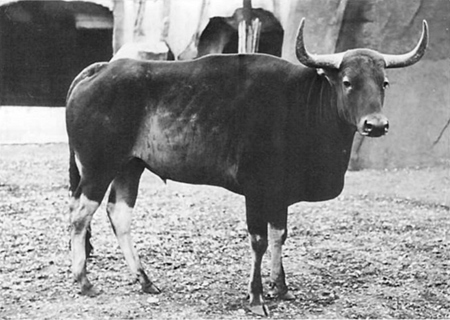
A kouprey (Bos sauveli, from Khmer: គោព្រៃ, Khmer pronunciation: , "forest ox"; also known as kouproh, "grey ox"), is a little-known, forest-dwelling, wild bovine species from Southeast Asia. A young male was sent to the Vincennes Zoo in 1937 where it was described by the French zoologist Achille Urbain and was declared the holotype. The kouprey has a tall, narrow body, long legs, a humped back and long horns.
From the article Kouprey on Wikipedia (CC BY-SA), quoted section by section
Description
The kouprey has a light and gracile build, in comparison to other wild cattle species. Both sexes have notched nostrils. It is 2.1–2.2 m (7–7.3 ft) long from nose to rear, 1.7–1.9 m (5.6–6.3 ft) tall at the shoulders and weighs 700–900 kg (1,500–2,000 lb). Calves have a reddish bay colour and turn grey at around 5 months of age. Their horns start appearing at the age of 6 months. The pelage of cows and bulls diverges as they mature; cows turn a mouse to brownish grey, while bulls become progressively darker, until individuals of 12 years or older are entirely dark brown. Both sexes have white stockings, with a dark strip down the front of each foreleg. Kouprey are a sexually dimorphic species and along with having different colour coats, males and females are distinguishable by the remarkably different shapes of their horns. Those of bulls are widely-set, similar to those of wild yaks, growing outwards before arching forwards and upwards, eventually fraying at the tips. While those of cows spiral upwards, growing into a shape reminiscent of a lyre. The horns of bulls reach up to 810 mm (32 in), and those of cows up to 410 mm (16 in). Bull kouprey develop large dewlaps as they age, with those of mature individuals reaching lengths of 16 inches (40 cm). In some cases, the dewlap is so pronounced that it drags along the ground.
Range & habitat
The range of the kouprey once stretched from eastern Thailand and southern Laos to the western edge of Vietnam and northern Cambodia. Archaeological evidence shows that it also occurred in northern Yunnan, China. The primary habitat of the kouprey is described as a mix of open grassland and dense open canopy forests featuring grassy glades, waterholes and salt licks.
Wikipedia: “Distribution and habitat”
What it does
Kouprey behaviour is described as similar to that of the banteng, with the two species often being found grazing alongside each other, though not intermixing. Herds, made up of cows, their calves, and periodically bulls, are always led by a mature cow. Kouprey are active, if nervous, animals, being quick to flee if approached. Bulls have been observed to plough up soil with their horns, especially around mineral licks and waterholes, which leads to the tips fraying. To avoid the hottest parts of the day, kouprey feed during the early morning and late afternoon, moving into denser forest for respite during midday. Little information is available on the animal's diet, though various grasses and some browse, supplemented with mineral soil, have been recorded. Kouprey come together to mate during the month of April, with bulls dispersing back into bachelor herds by the beginning of May. Gestation is between 8 and 9 months, with cows giving birth to a single calf between December and February. Female kouprey will isolate themselves to give birth, and remain away from the herd with their calf for the first month of its life. The total lifespan of a kouprey is thought to be around 20 years.
Wikipedia: “Behaviour and ecology”
In human culture
Potential depictions of kouprey in rock art have been documented in the Cardamon Mountains of Cambodia, and carvings in the temples of Angkor Wat have been found to resemble the animal as well.
The kouprey is the national animal of Cambodia, being designated as such by Norodom Sihanouk in 1960, its name is also the nickname of the country's national football team. Several statues depicting and dedicated to the kouprey have been established across Cambodia and Thailand, including in the country's capital city, Phnom Penh. During the 2022 Miss Grand Cambodia contest, model Pich Votey Saravody wore a costume depicting a kouprey, which stirred considerable controversy amongst viewers, many of whom felt the depiction disrespected the animal.
Wikipedia: “Cultural significance”
Listen
Looking for field recordings…
Where it lives
Recorded sightings
—
geo-referenced records in GBIF, from museums, herbaria and field observers.
Drag the globe to turn it. Dots are where records exist, not a range map; darker means more records.
In the stacks
Searching the stacks…
Every page naming Bos sauveli in the Biodiversity Heritage Library →
This page is assembled live from iNaturalist, GBIF, Wikipedia, the Source Library and the Internet Archive. It is not yet part of the hand-edited codex. iNaturalist taxon 42398.