- Animals
- ›Chordates
- ›Vertebrates
- ›Mammals
- ›Therians
- ›Placental Mammals
- ›Ungulates, Carnivorans, and Allies
- ›Even-toed Ungulates and Cetaceans
- ›Ruminants
- ›Bovids
- ›Antelopes, Goats, and Sheep
- ›Goats and Sheep
- ›Capra
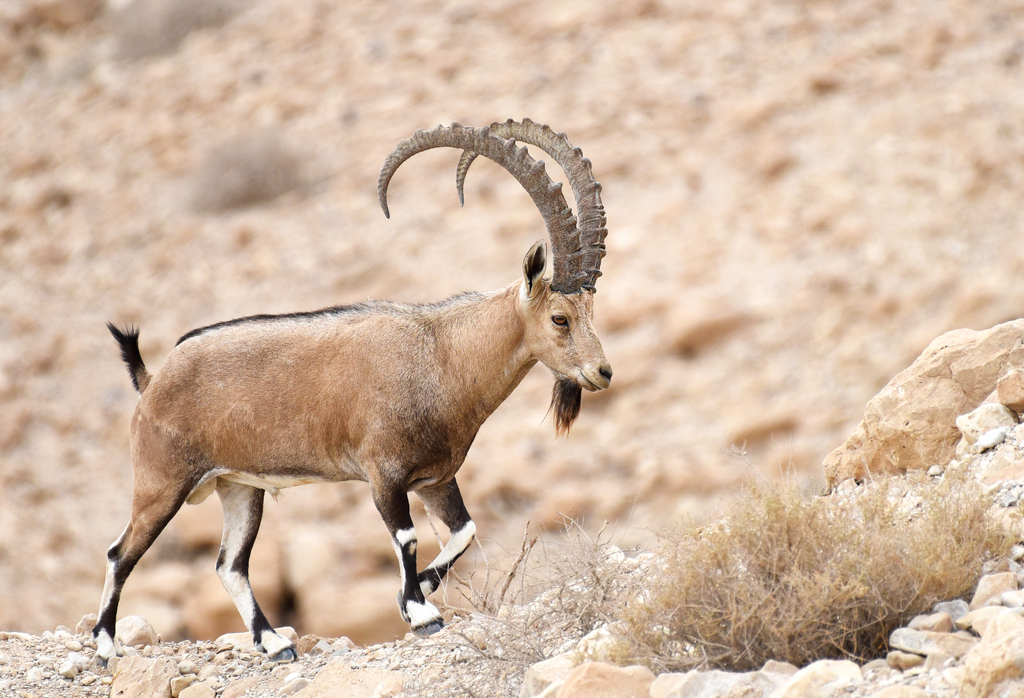
Nubian Ibex
Capra nubiana
The Nubian ibex (Capra nubiana) is a desert-dwelling species of goat (genus Capra) found in mountainous areas of northern and northeast Africa, and the Middle East. Historically considered a subspecies of the Alpine ibex (C. ibex), it is now recognized as a distinct species. The wild population is estimated at 4,500 mature individuals, and it is classified as vulnerable by the International Union for Conservation of Nature.
From the article Nubian ibex on Wikipedia (CC BY-SA), quoted section by section
Description
Nubian ibex are the smallest ibex species, following Bergmann's rule. They stand around 65–75 cm (26–30 in) tall at the shoulder. They are sexually dimorphic: males are significantly larger than females, with males averaging 52–74.7 kg (115–165 lb) and females 25.3–32.7 kg (56–72 lb).
They are a light tan color, with a white underbelly; males also have a dark brown mane down their backs. Their legs have a black and white pattern. They have a lighter rump with a dark brown tail. Males begin growing a beard at age 2 or 3, which continues to grow longer and darker as they age. During the autumn breeding season, mature males grow a "rutting fur" on their breast and sides which is very dark brown. It appears in October in 3–4-year-old males, but it may appear as early as July or August in older males age 6 and up. However, not all males develop rutting fur, even at a mature age. Nubian ibexes have long, thin horns that extend up and then backwards and down. In males, these reach around 1 m (3 ft 3 in) in length, while in females they are much smaller, reaching around 30 cm (12 in). Male horns are thicker than female horns, and grow large bulges which prevent the horns from sliding while the males are locked in combat. Male horn growth plateaus around age 7–8, where as female horn growth plateaus around age 4–6. …
Range & habitat
Historically, Nubian ibex were distributed across the Middle East and Northeastern Africa. Its range today is within Egypt, Jordan, Oman, Israel, Palestine, Saudi Arabia and Sudan. It was extirpated in Lebanon, though a captive breeding and reintroduction process is underway. It has been extirpated in Syria. Its presence is uncertain in Ethiopia, Eritrea and Yemen.
Wikipedia: “Distribution”
What it does
Nubian ibex live in rough, dry, mountainous terrain, where they eat mainly grasses and leaves, especially from Acacia trees (Genus Vachellia). They forage for food on the ground and may also rear up on their hind legs to reach leaves in trees. They can climb into trees while feeding. They reduce feeding on plants with strong defenses, such as tannins and thorns. Preferred plants vary depending on the amount of rain; rainy winters result in higher feeding preference for annual plants over perennials. Ibex preferentially feed in spaces that are close to cliffs where they can easily escape predators, demonstrating a Landscape of Fear: the farther from cliffs, the more vigilant ibex become. Ibex will also spend more time feeding in green patches with high nutritional quality and that are closer to water sources. Female Nubian ibex in Oman have been recorded consuming small bone fragments (osteophagy), a common behavior in mammals to supplement calcium and phosphorus in their diet.
Wikipedia: “Feeding”
In human culture
The earliest remains of the Nubian ibex in the Palestine region date back approximately 150,000 years to the Pleistocene, and it has been continually present in the region since then. In spite of the growing presence of livestock such as domesticated goats over the last 10,000 years, Nubian ibex have remained in the region throughout this time. However, its abundance has fluctuated in places like Ein Gedi, where it showed an increase in population in the late Holocene between approximately 5,165 and 950 years ago. Radiocarbon dated bones from archaeological excavations indicate that the Nubian ibex has been in a predator-prey relationship with the Arabian leopard throughout the Holocene.
Wikipedia: “Fossil history”
Listen
Looking for field recordings…
Where it lives
Recorded sightings
—
geo-referenced records in GBIF, from museums, herbaria and field observers.
Drag the globe to turn it. Dots are where records exist, not a range map; darker means more records.
In the stacks
Searching the stacks…
Every page naming Capra nubiana in the Biodiversity Heritage Library →
This page is assembled live from iNaturalist, GBIF, Wikipedia, the Source Library and the Internet Archive. It is not yet part of the hand-edited codex. iNaturalist taxon 42352.