- Animals
- ›Chordates
- ›Vertebrates
- ›Mammals
- ›Therians
- ›Placental Mammals
- ›Ungulates, Carnivorans, and Allies
- ›Even-toed Ungulates and Cetaceans
- ›Ruminants
- ›Bovids
- ›Antelopes, Goats, and Sheep
- ›Horse-like Antelopes
- ›Hippotragus
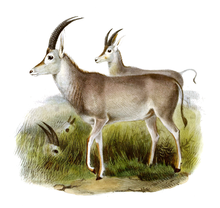
Bluebuck
Hippotragus leucophaeus
The bluebuck (Afrikaans: bloubok ) or blue antelope (Hippotragus leucophaeus) is an extinct species of antelope that lived in South Africa until around 1800. It was smaller than the other two species in its genus Hippotragus, the roan antelope and sable antelope. The bluebuck was sometimes considered a subspecies of the roan antelope, but a genetic study has confirmed it as a distinct species.
The largest mounted bluebuck specimen is 119 centimetres (47 in) tall at the withers. Its horns measure 56.5 centimetres (22.2 in) along the curve. The coat was a uniform bluish-grey, with a pale whitish belly. The forehead was brown, darker than the face. Its mane was not as developed as in the roan and sable antelopes; its ears were shorter and blunter, not tipped with black; and it had a darker tail tuft and smaller teeth. It also lacked the contrasting black and white patterns seen on the heads of its relatives. The bluebuck was a grazer, and may have calved where rainfall, and thus the availability of grasses, would peak. The bluebuck was confined to the southwestern Cape when encountered by Europeans, but fossil evidence and rock paintings show that it originally had a larger distribution.
From the article Bluebuck on Wikipedia (CC BY-SA), quoted section by section
Description
The adult male bluebuck in Leiden is 119 centimetres (47 in) tall at the withers, and is possibly the largest known specimen. According to Sclater and Thomas, the tallest specimen is the one in Paris, a male that stands 110 centimetres (45 in) at the shoulder; the specimen in Vienna, on the other hand, is the shortest, a 100-centimetre (40 in) tall female. The bluebuck was notably smaller than the roan and sable antelopes, and therefore the smallest member of its genus. The coat was a uniform bluish-grey, with a pale whitish belly, which was not contrasted on the flanks. The limbs had a faint dark line along their front surface. The forehead was brown, darker than the face, and the upper lip and patch in front of the eyes were lighter than the body. The neck-mane was directed forwards and not as developed as in the roan and sable antelopes, and the throat-mane was almost absent. Other differences between the bluebuck and its extant relatives included its shorter and blunter ears not tipped with black, a darker tail tuft (though little darker than its general colour), and smaller teeth. The bluebuck also lacked the contrasting black and white patterns seen on the heads of its relatives. As the old skins are presumably faded, it may be difficult to reconstruct the original colour of the bluebuck from them. …
Range & habitat
Endemic to South Africa, the bluebuck was confined to the southwestern Cape. A 2003 study estimated the expanse of the historic range of the bluebuck at 4,300 square kilometres (1,700 sq mi), mainly along the southern coast of South Africa; fossils, however, have been discovered in a broader area that includes the southern and western CFR and even the highlands of Lesotho. Historical records give a rough estimate of its range. On 20 January 1774, Swedish naturalist Carl Peter Thunberg recorded a sighting in Tigerhoek, Mpumalanga. In March or April 1783, Levaillant claimed to have witnessed two specimens in Soetemelksvlei, Western Cape. Based on these notes, a 2009 study by the South African zoologist Graham I. H. Kerley and colleagues estimated the range of the bluebuck to be limited within a triangular area in the Western Cape, bounded by Caledon to the west, Swellendam to the northeast and Bredasdorp to the south. Rock paintings in the Caledon river valley of the Free State province in eastern South Africa have been identified as bluebucks, which also confirms the once wider distribution of the species.
In 1974, Klein studied the fossils of Hippotragus species in South Africa. Most of these were found to represent the bluebuck and the roan antelope. …
Wikipedia: “Distribution and habitat”
What it does
The bluebuck, as Klein puts it, became extinct before "qualified scientists could make observations on live specimens". According to historical accounts, the bluebuck formed groups of up to 20 individuals. Similarities to the roan and the sable antelopes in terms of dental morphology make it highly probable that the bluebuck was predominantly a selective grazer, and fed mainly on grasses. The row of premolars was longer than in others of the genus, implying the presence of dicots in the diet. A 2013 study by the U.S. paleontologist J. Tyler Faith and colleagues noted the scarcity of morphological evidence to show that the bluebuck could have survived the summers in the western margin of the Cape Floristic Region (CFR), when the grasses are neither palatable nor nutritious. This might have induced a west-to-east migration, because the eastern margin receives rainfall throughout the year while precipitation in the western margin is limited to winter. An 18th-century account suggests that females might have left their newborn calves in isolation and returned regularly to suckle them until the calves were old enough to join herds, which is similar to the behaviour of roan and sable antelopes. Akin to other grazing antelopes, the bluebuck probably calved mainly where rainfall, and thus the availability of grasses, peaked. …
Wikipedia: “Behaviour and ecology”
In human culture
The bluebuck rock paintings from the Caledon river valley have been attributed to Bushmen. They show six antelopes facing a man, and were supposedly inspired by shamanic trance; they may depict a Bushman visiting the spirit-world through a tunnel. The Bushmen possibly believed that the bluebuck had a supernatural potency, like other animals in their environment. The animals in the paintings are similar in proportion to the reedbuck, but the large ears, horns, and lack of a mane rule out species other than the bluebuck. A South African fable, The Story of the Hare, mentions a bluebuck (referred to as inputi) that, among other animals, is appointed to guard a kraal. The bluebuck is also mentioned in French novelist Jules Verne's Five Weeks in a Balloon (1863); the animal is described as a "superb animal of a pale-bluish colour shading upon the gray, but with the belly and the insides of the legs as white as the driven snow".
Wikipedia: “Cultural significance”
Listen
Looking for field recordings…
Where it lives
Recorded sightings
—
geo-referenced records in GBIF, from museums, herbaria and field observers.
Drag the globe to turn it. Dots are where records exist, not a range map; darker means more records.
In the stacks
Searching the stacks…
Every page naming Hippotragus leucophaeus in the Biodiversity Heritage Library →
This page is assembled live from iNaturalist, GBIF, Wikipedia, the Source Library and the Internet Archive. It is not yet part of the hand-edited codex. iNaturalist taxon 42333.