- Animals
- ›Chordates
- ›Vertebrates
- ›Mammals
- ›Therians
- ›Placental Mammals
- ›Ungulates, Carnivorans, and Allies
- ›Even-toed Ungulates and Cetaceans
- ›Ruminants
- ›Bovids
- ›Antelopes, Goats, and Sheep
- ›Horse-like Antelopes
- ›Oryx
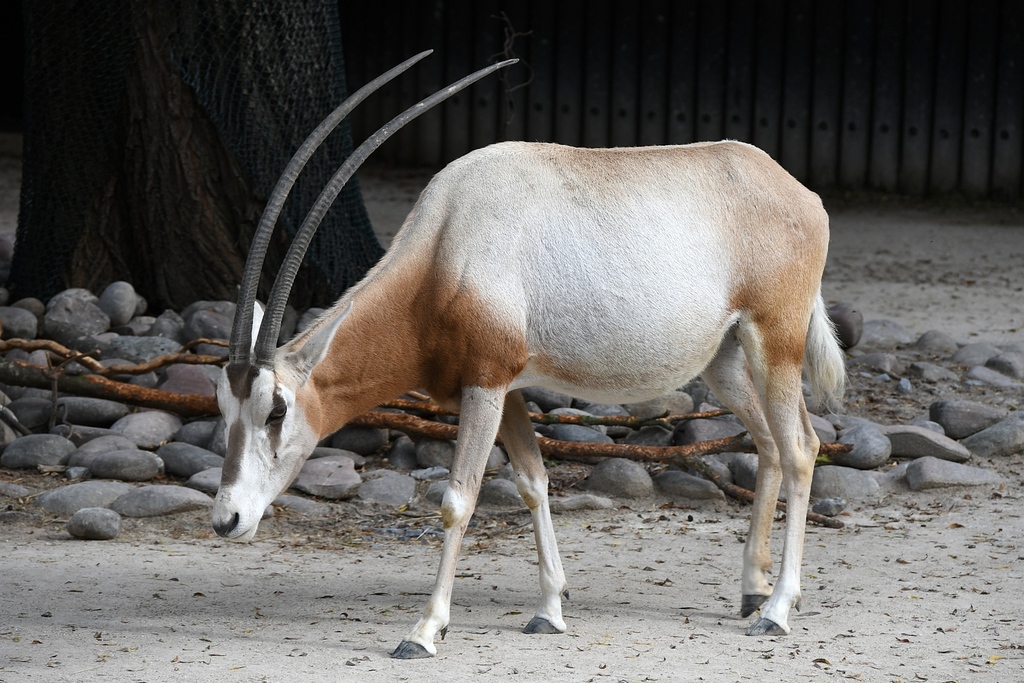
Scimitar-horned Oryx
Oryx dammah
The scimitar oryx (Oryx dammah), also known as the scimitar-horned oryx and the Sahara oryx, is an Oryx species that was once widespread across North Africa and parts of West and Central Africa. In 2000, it was declared extinct in the wild on the IUCN Red List, but in 2023, it was downlisted to endangered, with a reintroduced population in Chad. This particular oryx is adapted to harsh desert conditions and can survive for months without drinking water. A grazing animal, it derives most of its daily moisture intake from plants.
The decline of the scimitar oryx population began as a result of climate change during the Neolithic period, and later it was hunted extensively for its horns. Today, it is bred in captivity in special reserves in Tunisia, Morocco, and Senegal, and on private exotic animal ranches in the Texas Hill Country, United States. In 2016, a reintroduction program was launched, and currently a small herd has been successfully reintroduced in Chad.
From the article Scimitar oryx on Wikipedia (CC BY-SA), quoted section by section
Range & habitat
The scimitar oryx once inhabited grassy steppes, semideserts and deserts in a narrow strip of central north Africa (especially in Niger and Chad). It was widespread on the fringes of the Sahara, mainly in subdesert steppe, the grassy zone between the real desert and the Sahel, an area characterized by an annual rainfall of 75–150 mm (3.0–5.9 in). In 1936, a single herd of 10,000 scimitar oryxes was seen in the steppe area of Chad. By the mid-1970s, Chad was home to more than 95% of the world population of this species.
Wikipedia: “Habitat and distribution”
What it does
The scimitar oryx was a very sociable animal and traveled in herds of two to 40 individuals, generally, led by a dominant bull. This species once gathered in groups of several thousand for migration. During the wet season, they migrated north into the Sahara. Scimitar oryxes are diurnal. In the cool, early mornings and evenings, they rest under trees and shrubs, or if neither is available, they dig depressions in the soil with their hooves and rest there. Males fight often, but not for long and not violently. Predators, such as lions, leopards, hyenas, cheetahs, golden jackals, vultures, and Cape hunting dogs, mostly kill weak and young oryxes.
Adaptations. With a metabolism that functions at the high temperatures prevalent in their habitats, scimitar oryxes need less water for evaporation to help conduct heat away from the body, enabling them to go for long periods without water. They can allow their body temperatures to rise to almost 46.5 °C (115.7 °F) before beginning to perspire. In times of ample supply, oryxes can use fluid loss through urination and feces to lower their body temperatures to below 36 °C (97 °F) at night, giving more time before reaching maximum body temperature the following day. They can tolerate high temperatures that would be lethal to most mammals. …
Wikipedia: “Ecology and behavior”
Listen
Looking for field recordings…
Where it lives
Recorded sightings
—
geo-referenced records in GBIF, from museums, herbaria and field observers.
Drag the globe to turn it. Dots are where records exist, not a range map; darker means more records.
In the stacks
Searching the stacks…
Every page naming Oryx dammah in the Biodiversity Heritage Library →
This page is assembled live from iNaturalist, GBIF, Wikipedia, the Source Library and the Internet Archive. It is not yet part of the hand-edited codex. iNaturalist taxon 42310.