- Animals
- ›Chordates
- ›Vertebrates
- ›Mammals
- ›Therians
- ›Placental Mammals
- ›Ungulates, Carnivorans, and Allies
- ›Even-toed Ungulates and Cetaceans
- ›Ruminants
- ›Bovids
- ›Antelopes, Goats, and Sheep
- ›Reduncines
- ›Redunca
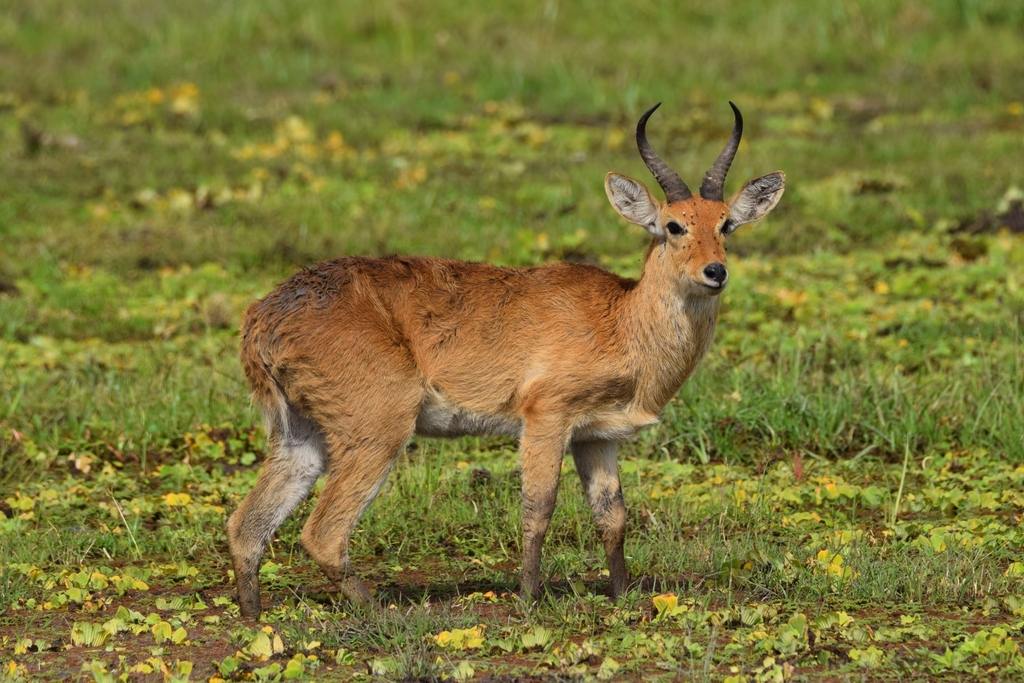
Bohor Reedbuck
Redunca redunca
The bohor reedbuck (Redunca redunca) is an antelope native to central Africa. The animal is placed under the genus Redunca and in the family Bovidae. It was first described by German zoologist and botanist Peter Simon Pallas in 1767. The bohor reedbuck has five subspecies. The head-and-body length of this medium-sized antelope is typically between 100–135 cm (39–53 in). Males reach approximately 75–89 cm (30–35 in) at the shoulder, while females reach 69–76 cm (27–30 in). Males typically weigh 43–65 kg (95–143 lb) and females 35–45 kg (77–99 lb). This sturdily built antelope has a yellow to grayish brown coat. Only the males possess horns which measure about 25–35 cm (9.8–13.8 in) long.
A herbivore, the bohor reedbuck prefers grasses and tender reed shoots with high protein and low fiber content. This reedbuck is dependent on water, though green pastures can fulfill its water requirement. The social structure of the bohor reedbuck is highly flexible. Large aggregations are observed during the dry season, when hundreds of bohor reedbuck assemble near a river. Males become sexually mature at the age of three to four years, while females can conceive at just one year of age, reproducing every nine to fourteen months. Though there is no fixed breeding season, mating peaks in the rainy season. The gestation period is seven and a half months long, after which a single calf is born. The calves are weaned at eight to nine months of age.
From the article Bohor reedbuck on Wikipedia (CC BY-SA), quoted section by section
Range & habitat
The bohor reedbuck inhabits moist grasslands and swamplands as well as woodlands. It is found in two kinds of habitat in northern Cameroon: the seasonally flooded grasslands rich in grasses like Vetiveria nigritana and Echinochloa pyramidalis (in the Sahelo-Sudan region) and Isoberlina woodlands (in the Sudano-Guinean region). Often found on grasslands susceptible to floods and droughts, the bohor reedbuck can adapt remarkably well to radical seasonal changes and calamities. It is not so widespread as the bushbuck due to its habitat requirements. In some margins of its range, the bohor reedbuck shares its habitat with the mountain reedbuck. The ranges of the bohor reedbuck and southern reedbuck extensively overlap in Tanzania. Endemic to Africa, the bohor reedbuck is native to Benin, Burkina Faso, Burundi, Cameroon, Central African Republic, Chad, Democratic Republic of the Congo, Ethiopia, the Gambia, Ghana, Guinea, Guinea-Bissau, Kenya, Mali, Mauritania, Niger, Nigeria, Rwanda, Senegal, Sudan, Tanzania and Togo. The animal is possibly extinct in Ivory Coast and Uganda. Formerly widespread in western, central and eastern Africa, its present range extends from Senegal in the west to Ethiopia in the east. Among the three reedbuck species, bohor reedbuck is the most widespread in Tanzania. …
Wikipedia: “Habitat and distribution”
What it does
Bohor reedbuck are active throughout the day, seeking cover during the daytime and grazing in the night. A large proportion of the whole day is spent on feeding and vigilance. They can easily camouflage in grasses and reeds, and hide themselves rather than running from danger. When threatened, they usually remain motionless or retreat slowly into cover for defense, but if the threat is close, they flee, whistling shrilly to alert the others. It hides from predators rather than forming herds in defense. Many predators, including lions, cheetahs, leopards, hyenas, wild dogs and crocodiles prey on the reedbuck. If shade is available, females remain solitary; otherwise, they, along with their offspring, congregate to form herds of ten animals. Female home ranges span over 15–40 hectares (37–99 acres; 0.058–0.154 sq mi), while the larger territories of males cover 25–60 hectares (62–148 acres; 0.097–0.232 sq mi). These home ranges keep overlapping. As the daughters grow up, they distance themselves from their mothers' home ranges. Territorial males are much tolerant; they may even associate with up to 19 bachelor males in the absence of females. As many as five females may be found in a male's territory. Territorial bulls drive out their sons when they start developing horns (when they are about a year-and-a-half old). …
Wikipedia: “Ecology and behavior”
Listen
Looking for field recordings…
Where it lives
Recorded sightings
—
geo-referenced records in GBIF, from museums, herbaria and field observers.
Drag the globe to turn it. Dots are where records exist, not a range map; darker means more records.
In the stacks
Searching the stacks…
Every page naming Redunca redunca in the Biodiversity Heritage Library →
This page is assembled live from iNaturalist, GBIF, Wikipedia, the Source Library and the Internet Archive. It is not yet part of the hand-edited codex. iNaturalist taxon 42304.