- Animals
- ›Chordates
- ›Vertebrates
- ›Mammals
- ›Therians
- ›Placental Mammals
- ›Ungulates, Carnivorans, and Allies
- ›Even-toed Ungulates and Cetaceans
- ›Ruminants
- ›Bovids
- ›Antelopes, Goats, and Sheep
- ›Alcelaphines
- ›Connochaetes
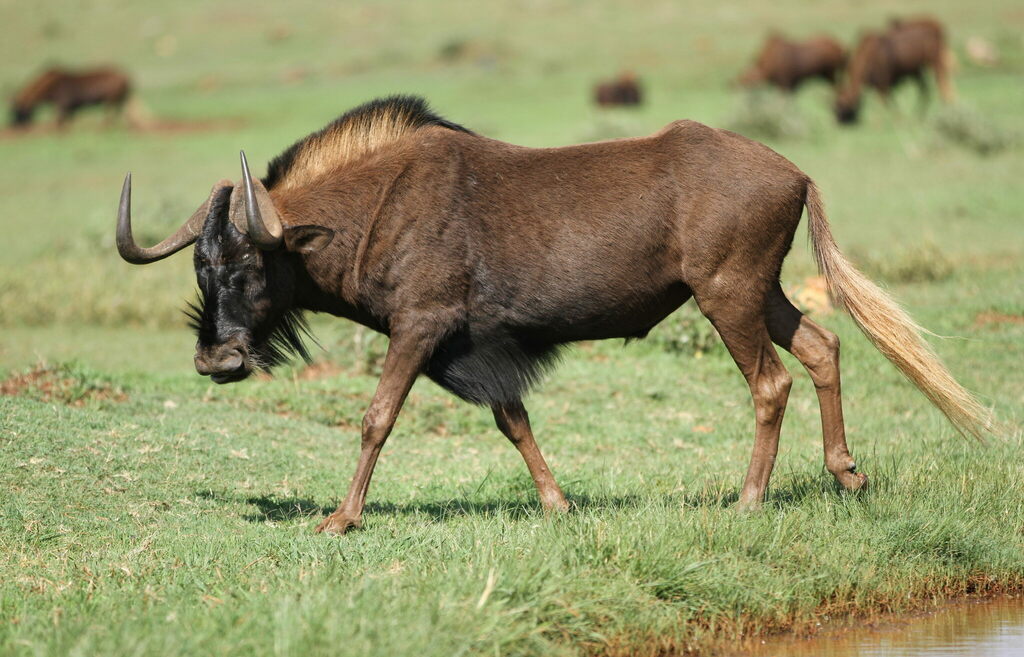
Black Wildebeest
Connochaetes gnou
The black wildebeest or white-tailed gnu (Connochaetes gnou) is one of the two closely related wildebeest species. It is a member of the genus Connochaetes and family Bovidae. It was first described in 1780 by Eberhard August Wilhelm von Zimmermann. The black wildebeest is typically 1.7–2.2 m (5 ft 7 in – 7 ft 3 in) in head-and-body length, and the typical weight is 110–180 kg (240–400 lb). Males stand about 1.11–1.21 m (3 ft 8 in – 4 ft 0 in) at the shoulder, while the height of the females is 1.06–1.16 m (3 ft 6 in – 3 ft 10 in). The black wildebeest is characterised by its white, long, horse-like tail. It also has a dark brown to black coat and long, dark-coloured hair between its forelegs and under its belly.
The black wildebeest is an herbivore, and almost the whole diet consists of grasses. Water is an essential requirement. The three distinct social groups are the female herds, the bachelor herds, and the territorial bulls. They are fast runners and communicate using a variety of visual and vocal communications. The primary breeding season for the black wildebeest is from February to April. A single calf is usually born after a gestational period of about 8.5 months. The calf remains with its mother until her next calf is born a year later. The black wildebeest inhabits open plains, grasslands, and karoo shrublands.
From the article Black wildebeest on Wikipedia (CC BY-SA), quoted section by section
Description
Black wildebeest are sexually dimorphic, with females being shorter and slenderer than males. The head-and-body length is typically between 1.7 and 2.2 m (5 ft 7 in and 7 ft 3 in). Bulls reach about 1.11 to 1.21 m (3 ft 8 in to 4 ft 0 in) at the shoulder, while cows reach 1.06 to 1.16 m (3 ft 6 in to 3 ft 10 in). Bulls typically weigh 140 to 157 kg (309 to 346 lb) and cows 110 to 122 kg (243 to 269 lb). A distinguishing feature in both sexes is the tail, which is long and similar to that of a horse. Its bright-white colour gives this animal the vernacular name of "white-tailed gnu", and also distinguishes it from the blue wildebeest, which has a black tail. The length of the tail ranges from 80 to 100 cm (2.6 to 3.3 ft). The black wildebeest has a dark brown or black coat, which is slightly paler in summer and coarser and shaggier in the winter. Calves are born with shaggy, fawn-coloured fur. Males are darker than females. They have bushy and dark-tipped manes that, as in the blue wildebeest, stick up from the back of the neck. The hairs that compose this are white or cream-coloured with dark tips. On its muzzle and under its jaw, it has black bristly hair. It also has long, dark-coloured hair between its forelegs and under its belly. …
Range & habitat
The black wildebeest is native to southern Africa. Its historical range included South Africa, Eswatini, and Lesotho, but in the latter two countries, it was hunted to extinction in the 19th century. It has now been reintroduced there and also introduced to Namibia, where it has become well established. The black wildebeest inhabits open plains, grasslands, and karoo shrublands in both steep, mountainous regions and lower, undulating hills. The altitudes in these areas vary from 1,350–2,150 m (4,430–7,050 ft). The herds are often migratory or nomadic, otherwise they may have regular home ranges of 1 km2 (0.39 sq mi). Female herds roam in home ranges around 250 acres (100 ha; 0.39 sq mi) in size. In the past, black wildebeest occurred on temperate grasslands in highveld during the dry winter season and the arid karoo region during the rains. However, as a result of massive hunting of the animal for its hide, they vanished from their historical range, and are now largely limited to game farms and protected reserves in southern Africa. In most reserves, the black wildebeest shares its habitat with the blesbok and the springbok.
Wikipedia: “Distribution and habitat”
What it does
Black wildebeest are mainly active during the early morning and late afternoon, preferring to rest during the hottest part of the day. The animals can run at speeds of 80 km/h (50 mph). When a person approaches a herd to within a few hundred metres, the wildebeest snort and run a short distance before stopping and looking back, repeating this behaviour if further approached. They communicate with each other using pheromones detected by flehmen and several forms of vocal communication. One of these is a metallic snort or an echoing "hick", that can be heard up to 1.5 km (1 mi) away. They are preyed on by the lion, spotted hyena, Cape hunting dog, leopard, cheetah, and Nile crocodile. Of these, the calves are targeted mainly by the hyenas, while lions attack the adults. The black wildebeest is a gregarious animal with a complex social structure comprising three distinct groups, the female herds consisting of adult females and their young, the bachelor herds consisting only of yearlings and older males, and territorial bulls. The number of females per herd is variable, generally ranging from 14 to 32, but is highest in the densest populations and also increases with forage density. A strong attachment exists among members of the female herd, many of which are related to each other. Large herds often get divided into smaller groups. …
Wikipedia: “Ecology and behavior”
At the table
The black wildebeest is depicted on the coat of arms of the Province of Natal in South Africa. Over the years, the South African authorities have issued stamps displaying the animal and the South African Mint has struck a 5-rand coin with a prancing black wildebeest. Though they are not present in their natural habitat in such large numbers today, black wildebeest were at one time the main herbivores in the ecosystem and the main prey item for large predators such as the lion. Now, they are economically important for human beings, as they are a major tourist attraction, and provide animal products such as leather and meat. The hide makes good-quality leather, and the flesh is coarse, dry, and rather tough. Wildebeest meat is dried to make biltong, an important part of South African cuisine. The meat of females is more tender than that of males, and is at its best during the autumn season. The wildebeest can provide 10 times as much meat as a Thomson's gazelle. The silky, flowing tail is used to make fly-whisks or chowries. However, black wildebeest can also affect human beings negatively. Wild individuals can be competitors of commercial livestock and can transmit fatal diseases such as rinderpest, and cause epidemics among animals, particularly domestic cattle. They can also spread ticks, lungworms, tapeworms, flies, and paramphistome flukes.
Wikipedia: “Uses and interaction with humans”
Listen
Looking for field recordings…
Where it lives
Recorded sightings
—
geo-referenced records in GBIF, from museums, herbaria and field observers.
Drag the globe to turn it. Dots are where records exist, not a range map; darker means more records.
In the stacks
Searching the stacks…
Every page naming Connochaetes gnou in the Biodiversity Heritage Library →
This page is assembled live from iNaturalist, GBIF, Wikipedia, the Source Library and the Internet Archive. It is not yet part of the hand-edited codex. iNaturalist taxon 42281.