- Animals
- ›Chordates
- ›Vertebrates
- ›Mammals
- ›Therians
- ›Placental Mammals
- ›Ungulates, Carnivorans, and Allies
- ›Even-toed Ungulates and Cetaceans
- ›Ruminants
- ›Bovids
- ›Antelopes, Goats, and Sheep
- ›Typical Antelopes
- ›Dorcatragus
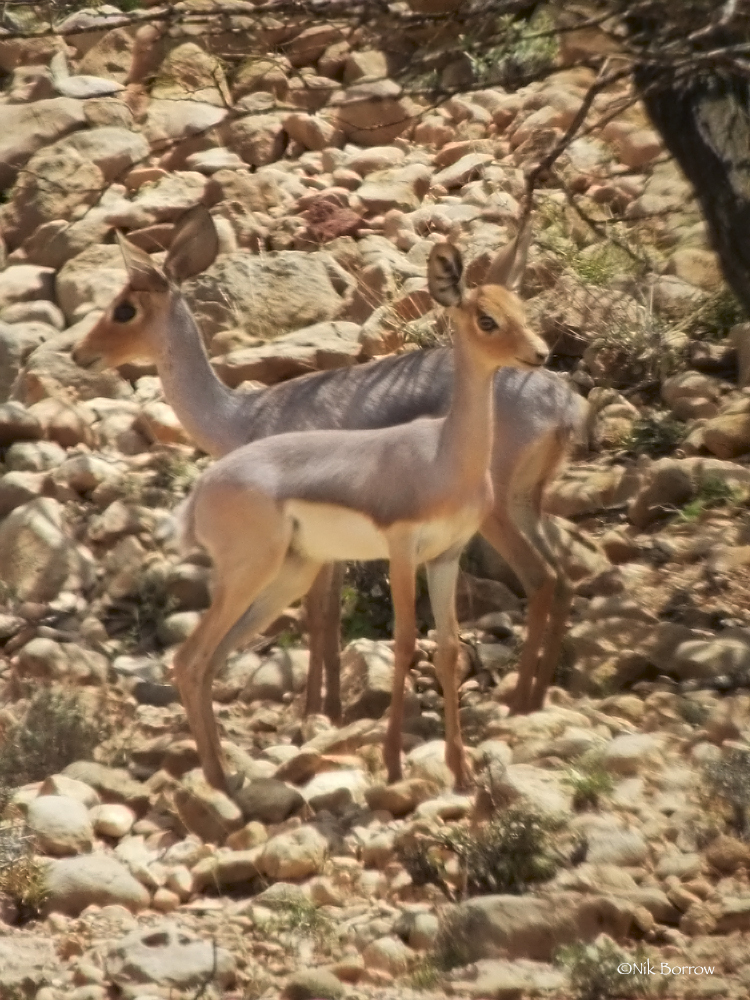
Beira
Dorcatragus megalotis
The beira (Dorcatragus megalotis) is a small antelope that inhabits arid regions of the Horn of Africa. It is the only current species in the genus Dorcatragus.
From the article Beira (antelope) on Wikipedia (CC BY-SA), quoted section by section
Description
The beira has a bushy tail and a coarse coat which is reddish grey on the back separated from the white underparts by a dark band which extends along each side from the elbow to the rear leg. Its long, slender legs are fawn-coloured and the head is yellowish red with black eyelids and white eye rings. The beira has disproportionately large ears, which are 15 cm (5.9 in) long and 7.5 cm (3.0 in) across with white fur on their interiors. Only the males have horns which are 7.5–10 cm (3.0–3.9 in) long, straight spikes which grow out vertically from near the sides of the ears. The length of the animal is 80–86 cm (31–34 in), it stands 50–60 cm (20–24 in) at the shoulder and weighs between 9–11.5 kg (20–25 lb).
Range & habitat
The beira is endemic to northeast Africa, it occurs in the far south of Djibouti southwards across Somaliland and northern Somalia, and into extreme northeastern Ethiopia. The main part of its range is in Somaliland, from the frontier with Djibouti, east into Puntland in northern Somalia and the Nogaal Valley. Its occurrence in Djibouti was confirmed in only 1993.
Wikipedia: “Distribution”
Listen
Looking for field recordings…
Where it lives
Recorded sightings
—
geo-referenced records in GBIF, from museums, herbaria and field observers.
Drag the globe to turn it. Dots are where records exist, not a range map; darker means more records.
In the stacks
Searching the stacks…
Every page naming Dorcatragus megalotis in the Biodiversity Heritage Library →
This page is assembled live from iNaturalist, GBIF, Wikipedia, the Source Library and the Internet Archive. It is not yet part of the hand-edited codex. iNaturalist taxon 42270.