- Animals
- ›Chordates
- ›Vertebrates
- ›Mammals
- ›Therians
- ›Placental Mammals
- ›Ungulates, Carnivorans, and Allies
- ›Even-toed Ungulates and Cetaceans
- ›Ruminants
- ›Musk Deer

Musk Deer
Moschus
Musk deer can refer to any one, or all seven, of the species that make up Moschus, the only extant genus of the family Moschidae. Despite being commonly called deer, they are not true deer belonging to the family Cervidae, but rather their family is closely related to Bovidae, the group that contains antelopes, bovines, sheep, and goats. The musk deer family differs from cervids, or true deer, by lacking antlers and preorbital glands also, possessing only a single pair of teats, a gallbladder, a caudal gland, a pair of canine tusks and—of particular economic importance to humans—a musk gland.
Musk deer live mainly in forested and alpine scrub habitats in the mountains of East Asia, the Himalayas, and Siberia. They are entirely Asian in their present distribution, being extinct in Europe where the earliest musk deer are known to have existed from Oligocene deposits.
7 branches of this genus, most-observed first · about 7 known species

Siberian Musk Deer
speciesMoschus moschiferus

Alpine Musk Deer
speciesMoschus chrysogaster
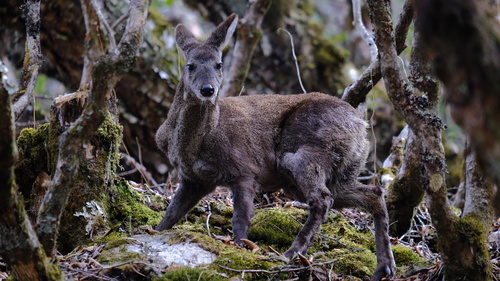
Himalayan Musk Deer
speciesMoschus leucogaster

Chinese Forest Musk Deer
speciesMoschus berezovskii

Kashmir Musk Deer
speciesMoschus cupreus

Anhui Musk Deer
speciesMoschus anhuiensis

Dusky Musk Deer
speciesMoschus fuscus
Where it lives
Recorded sightings
—
geo-referenced records in GBIF, from museums, herbaria and field observers.
Drag the globe to turn it. Dots are where records exist, not a range map; darker means more records.
In the old herbals & bestiaries


In the stacks
Searching the stacks…
Every page naming Moschus in the Biodiversity Heritage Library →
This page is assembled live from iNaturalist, GBIF, Wikipedia, the Source Library and the Internet Archive. It is not yet part of the hand-edited codex. iNaturalist taxon 42141.