- Animals
- ›Chordates
- ›Vertebrates
- ›Mammals
- ›Therians
- ›Placental Mammals
- ›Ungulates, Carnivorans, and Allies
- ›Even-toed Ungulates and Cetaceans
- ›Suids and Peccaries
- ›Peccaries
- ›Pecari
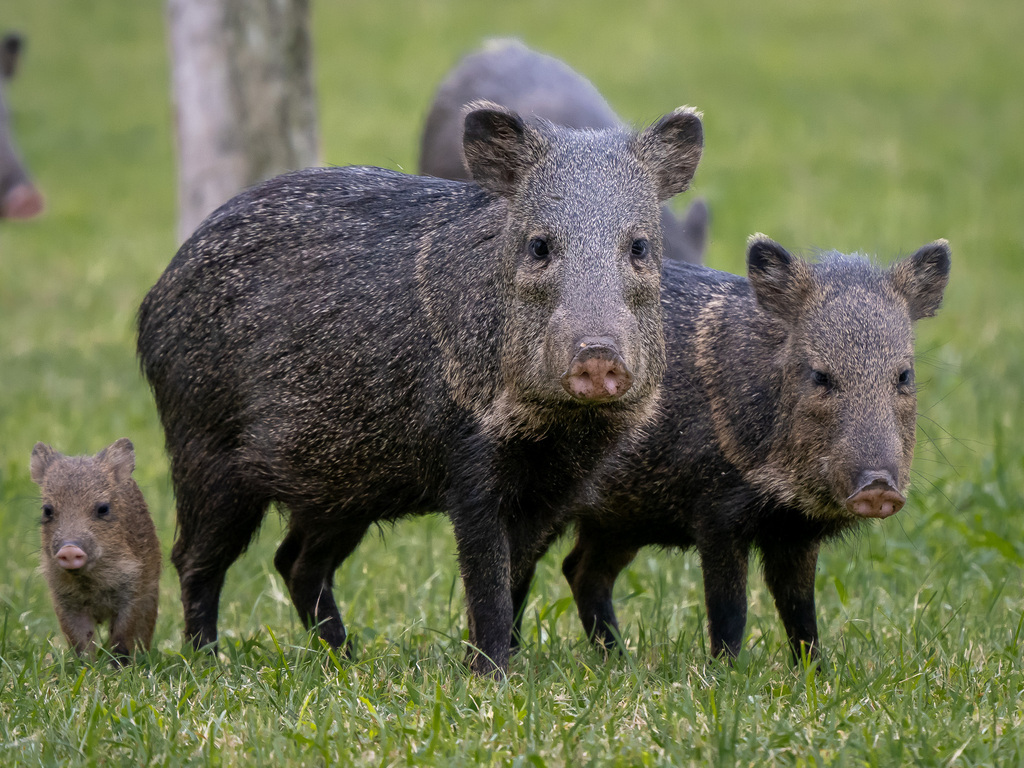
Collared Peccary
Pecari tajacu
The collared peccary (Dicotyles tajacu) is a peccary, a species of artiodactyl (even-toed) mammal in the family Tayassuidae. It is the only extant member of the genus Dicotyles. They are commonly referred to as javelina, saíno, taitetu, or báquiro, although these terms are also used to describe other species in the family. The species is also known as the musk hog. In Trinidad, it is colloquially known as quenk.
The species is found in the tropical and subtropical Americas. In the Miocene, the first Tayassuids appeared, which would give rise to the modern collared peccary, with these species belonging to the same genus and often being larger than it. It is believed that many of its ancestors initially appeared in North America, later migrating to South America and eventually giving rise to the modern Tayassu (Tayassu tajacu).
From the article Collared peccary on Wikipedia (CC BY-SA), quoted section by section
Description
The collared peccary stands around 51–61 cm (20–24 in) tall at the shoulder and is about 1.0–1.5 m (3 ft 3 in – 4 ft 11 in) long. It weighs between 16 and 27 kg (35 and 60 lb). The dental formula is: 2/3,1/1,3/3,3/3. The collared peccary has small tusks that point toward the ground when the animal is upright. It has slender legs with a robust or stocky body. The tail is often hidden in the coarse fur of the peccary. The animal has a musk gland on its back, several inches above the tail. This automatically discharges a skunklike scent when its hairs are raised in alarm, alerting other members of its herd. Peccary will also rub their scent onto rocks and tree stumps to mark their territory, and rub the scent on each other to help with identification. Collared peccaries are diurnal creatures that live in groups of up to 50 individuals, averaging between six and nine animals. They sleep in burrows (often under bushes or larger systems of tree roots), but sometimes can be found in caves, abandoned mines, old desert tunnels, or among logs, felled trees and abandoned timber. However, collared peccaries are not completely diurnal. In central Arizona, they are often more active at night, and less so in the heat of the daytime.
Range & habitat
The collared peccary is widespread throughout much of the tropical and subtropical Americas, ranging from the Southwestern United States to northern Argentina. They were reintroduced to Uruguay in 2017, after 100 years of extirpation there. The only Caribbean island where it is native, however, is Trinidad. Until fairly recently, it was also present on the nearby island of Tobago, but is now exceedingly rare (if not extirpated) due to overhunting by humans. An adaptable species, it inhabits deserts, xeric shrublands, tropical and subtropical grasslands, savannas, shrublands, flooded grasslands and savannas, tropical and subtropical dry broadleaf forests, and several other habitats; it is also present in habitats shared by humans, merely requiring sufficient cover. Peccaries can be found in cities and agricultural land throughout their range, where they consume garden plants. Notable populations are known to exist in the suburbs of Phoenix and Tucson, Arizona.
Fossil record. Due to the lack of fossil material or even specimens from archeological sites, it was assumed that javelinas only recently crossed into the US from further south by way of Mexico, being previously excluded from the region by competition with the now-extinct flat-headed peccary (Platygonus compressus) and long-nosed peccary (Mylohyus nasutus). …
Wikipedia: “Distribution and habitat”
What it does
Collared peccaries are often classified as herbivores. They normally feed on cactus, mesquite beans, honey, fruits, berries, seeds, roots, tubers, bulbs, palm nuts, grasses, other green vegetation, fungi, and insects. However, they will also eat eggs, snakes, caterpillars, fish, frogs, lizards, dead birds, and rodents if the opportunity presents itself. Despite all this supplementary diet, the main dietary components of this species are agaves and prickly pears. In areas inhabited by humans, they also consume cultivated crops and ornamental plants, such as tulip bulbs. The collared peccary's main predators are cougars (Puma concolor), wolves (Canis lupus), coyotes (Canis latrans), jaguars (Panthera onca) and possibly American crocodiles (Crocodylus acutus) and ocelots (Leopardus pardalis). Although they usually ignore humans and tend to flee to safety, if wounded or cornered a peccary will defend itself with its tusks. If alarmed, a collared peccary can release its skunklike musk or give a sharp bark. Amazonian peoples (including the Shipibos) sometimes raise and tame juvenile collared peccaries, if they are encountered.
Wikipedia: “Ecology”
At the table
The meat is relatively dry but can be cooked, though opinions differ about its flavor.
Wikipedia: “Uses”
Listen
Looking for field recordings…
Where it lives
Recorded sightings
—
geo-referenced records in GBIF, from museums, herbaria and field observers.
Drag the globe to turn it. Dots are where records exist, not a range map; darker means more records.
In the stacks
Searching the stacks…
Every page naming Pecari tajacu in the Biodiversity Heritage Library →
This page is assembled live from iNaturalist, GBIF, Wikipedia, the Source Library and the Internet Archive. It is not yet part of the hand-edited codex. iNaturalist taxon 42113.