- Plants
- ›Vascular Plants
- ›flowering plants
- ›Dicots
- ›pinks, cactuses, and allies
- ›Stone plants
- ›Aizooideae
- ›Tetragonioideae
- ›Tetragonia
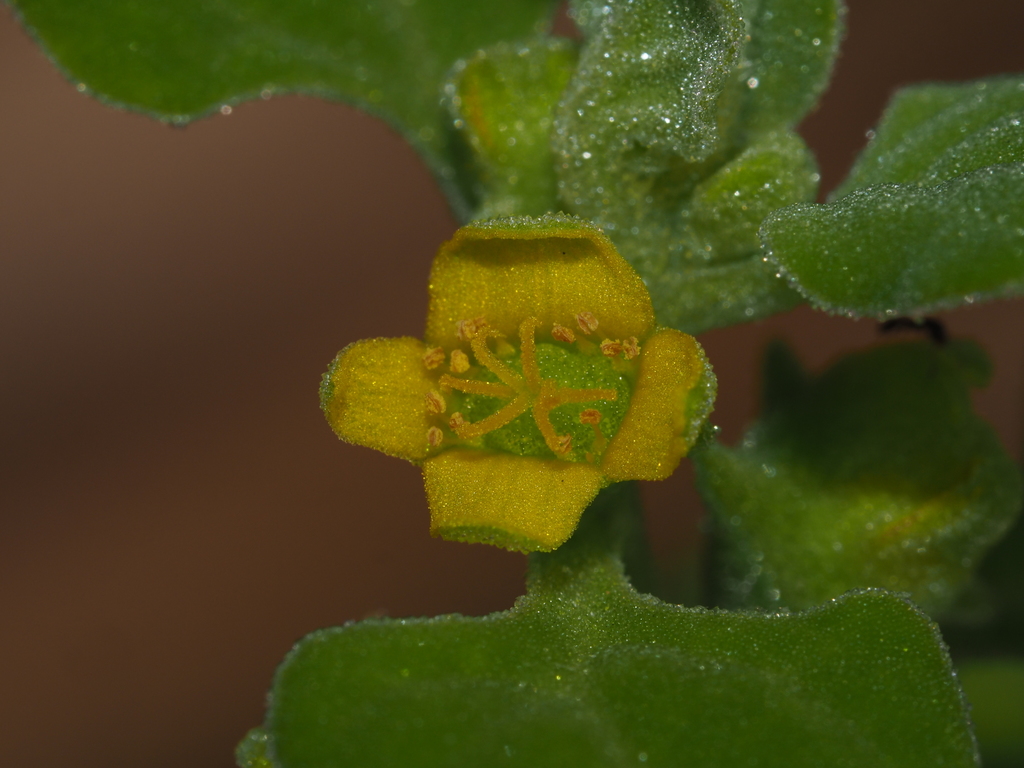
New Zealand Spinach
Tetragonia tetragonoides
Tetragonia tetragonioides, commonly called New Zealand spinach, warrigal greens or by its Māori name of Kōkihi, is a flowering plant in the fig-marigold family (Aizoaceae). It is often cultivated as a leafy vegetable.
It is a widespread species, native to eastern Asia, Australia, and New Zealand. It has been introduced and is an invasive species in many parts of Africa, Europe, North America, and South America. Its natural habitat is sandy shorelines and bluffs, often in disturbed areas. It is a halophyte and grows well in saline ground.
From the article Tetragonia tetragonioides on Wikipedia (CC BY-SA), quoted section by section
Description
The plant has a trailing habit, and will form a thick carpet on the ground or climb through other vegetation and hang downwards. It can have erect growth when young. The leaves of the plant are 3–15 cm (1.2–5.9 in) long, triangular in shape, and bright green. The leaves are thick, and covered with tiny papillae that look like waterdrops on the top and bottom of the leaves. The flowers of the plant are yellow, and the fruit are small, hard capsules each with 4–10 horned seeds. Sphaeraphides are found in at least the leaves, calyx and ovary.
At the table
The species, rarely used by indigenous people as a leaf vegetable, was first documented by Captain Cook. It was immediately picked, cooked, and pickled to help fight scurvy, and taken with the crew of the Endeavour. It spread when the explorer and botanist Joseph Banks took seeds back to Kew Gardens during the latter half of the 18th century. For two centuries, T. tetragonioides was the only cultivated vegetable to have originated from Australia and New Zealand. There are some indications that Māori did eat kōkihi perhaps more regularly. According to Murdoch Riley, "to counteract the bitterness of the older leaves of this herb, the Māori boiled it with the roots of the convolvulus (pōhue)", in reference to species of Convolvulaceae now classified as Calystegia. The tips of the spinach can be pinched off and eaten raw or cooked.
Wikipedia: “As food”
How it is grown
It is grown for the edible leaves, and can be used as food or an ornamental plant for ground cover. It can be an annual or perennial. As some of its names signify, it has similar flavour and texture properties to spinach, and is cooked like spinach. Like spinach, it contains oxalates; its medium to low levels of oxalates need to be removed by blanching the leaves in hot water for one minute, then rinsing in cold water before cooking. It thrives in hot weather, and is considered an heirloom vegetable. Few insects consume it, and even slugs and snails do not seem to feed on it. The thick, irregularly-shaped seeds should be planted just after the last spring frost. Before planting, the seeds should be soaked for 12 hours in cold water, or 3 hours in warm water. Seeds should be planted 5–10 mm (0.2–0.4 in) deep, and spaced 15–30 cm (5.9–11.8 in) apart. The seedlings will emerge in 10–20 days, and it will continue to produce greens through the summer. Mature plant will self-seed. Seeds will overwinter up to USDA zone 5.
Wikipedia: “Cultivation”
Where it lives
Recorded sightings
—
geo-referenced records in GBIF, from museums, herbaria and field observers.
Drag the globe to turn it. Dots are where records exist, not a range map; darker means more records.
In the stacks
Searching the stacks…
Every page naming Tetragonia tetragonoides in the Biodiversity Heritage Library →
This page is assembled live from iNaturalist, GBIF, Wikipedia, the Source Library and the Internet Archive. It is not yet part of the hand-edited codex. iNaturalist taxon 418653.