- Plants
- ›Vascular Plants
- ›flowering plants
- ›Dicots
- ›proteas, lotuses, planes, and allies
- ›Protea family
- ›Paired Proteas
- ›Embothrieae
- ›Hakeinae
- ›Grevillea
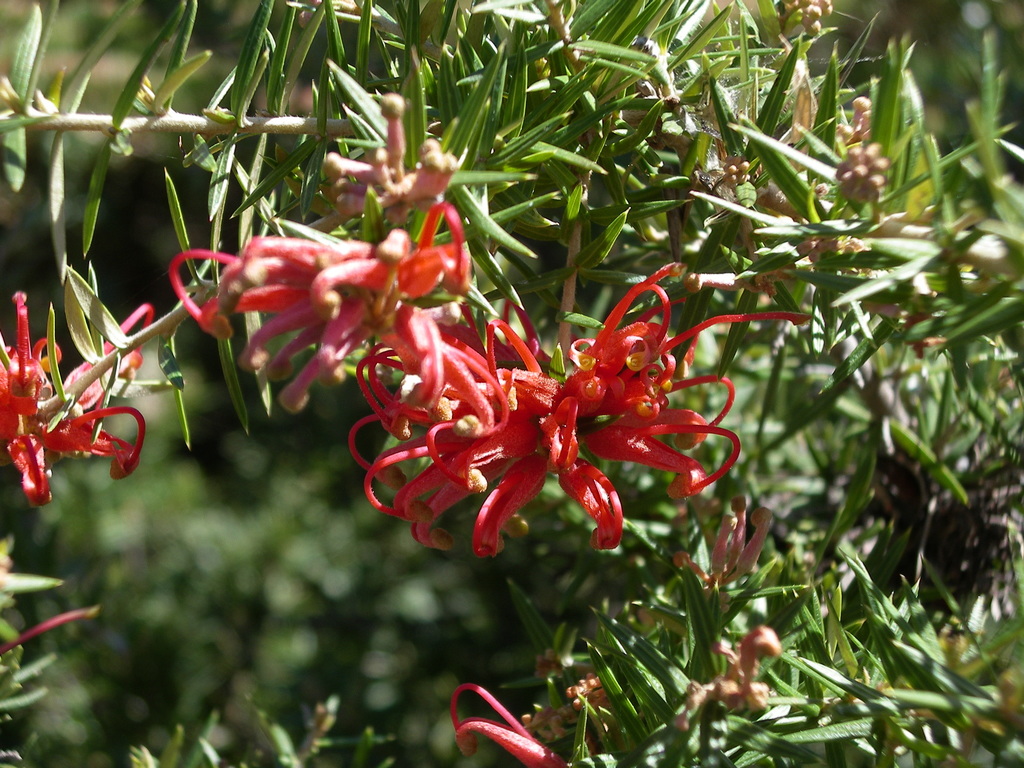
juniper-leaf grevillea
Grevillea juniperina
Grevillea juniperina, commonly known as juniper- or juniper-leaf grevillea or prickly spider-flower, is a plant of the family Proteaceae native to eastern New South Wales and southeastern Queensland in Australia. Scottish botanist Robert Brown described the species in 1810, and seven subspecies are recognised. One subspecies, G. j. juniperina, is restricted to Western Sydney and environs and is threatened by loss of habitat and housing development.
A small, prickly-leaved shrub between 0.2–3 m (0.66–9.84 ft) high, G. juniperina generally grows on clay-based or alluvial soils in eucalypt woodland. The flower heads, known as inflorescences, appear from winter to early summer and are red, orange or yellow. Birds visit and pollinate the flowers. Grevillea juniperina plants are killed by bushfire, regenerating afterwards from seed. Grevillea juniperina adapts readily to cultivation and has been important in horticulture as it is the parent of many popular garden hybrids.
From the article Grevillea juniperina on Wikipedia (CC BY-SA), quoted section by section
Description
Grevillea juniperina has a spreading or erect habit (growth form) and it grows to between 0.2–3 m (0.66–9.84 ft) in height. The branchlets are thick and sturdy. The prickly leaves are generally stiff and are 0.5–3.5 cm (1⁄4–1+3⁄8 in) long and 0.5–6 mm (1⁄32–1⁄4 in) wide. They are crowded along the stems. Flowering occurs throughout the year, peaking between midwinter and early summer, though it varies between the different subspecies. Subspecies allojohnsonii flowers from September to February, subspecies trinervis flowers from August to December, and subspecies juniperina, amphitricha, sulphurea, villosa and fortis flower in August and September. The spider-flower arrangement of the inflorescence has several individual flowers emerging from a central rounded flower head—reminiscent of the legs of a spider. The flowers are red, pink, orange, yellow or greenish, and are mostly terminal—arising on the ends of stems—though they occasionally arise from axillary buds. They are 2.5–3.5 cm (1–1+3⁄8 in) long. The perianth is finely furred on the outside, while the pistil is smooth; it is 1.5–2.7 cm (5⁄8–1+1⁄8 in) long. Flowering is followed by the development of seed pods, each capsule is 10–18 mm (3⁄8–3⁄4 in) long, and releases one or two seeds when ripe. The narrow oval seed is 7.5–12 mm (1⁄4–1⁄2 in) and 2.2–3.3 mm (1⁄16–1⁄8 in) wide, with a swelling at the apex and a short wing. …
Range & habitat
Subspecies allojohnsonii is found on the Northern Tablelands and North West Slopes in northern New South Wales, from Walcha north to Tenterfield and Stanhope and Girraween National Park in southern Queensland. Subspecies amphitricha grows in woodland and grassland on slopes and ridges between Braidwood and Nerriga in the Shoalhaven River catchment on the Southern Tablelands. Subspecies fortis grows in forest, woodland and shrubland and is found on rocky hills and slopes near watercourses, specifically along Ginninderra Creek, the lower reaches of the Molonglo and Cotter Rivers, and the Murrumbidgee River from Pine Island downstream to where it is joined by the Molonglo River—mostly within the Australian Capital Territory. Subspecies juniperina grows in forest or woodland and is found in Cumberland Plain and Castlereagh Woodland communities on clay-loam soils, growing alongside such species as forest redgum (Eucalyptus tereticornis), mugga ironbark (E. sideroxylon), thin-leaved stringybark (E. eugenioides), broad-leaved red ironbark (E. fibrosa), grey box (E. moluccana), white feather honeymyrtle (Melaleuca decora), boxthorn (Bursaria spinosa), sickle wattle (Acacia falcata) and Dillwynia tenuifolia. The annual rainfall in regions where G. …
Wikipedia: “Distribution and habitat”
What it does
Killed by bushfire, Grevillea juniperina regenerates afterwards by seeds that germinate after lying dormant in the soil, stimulated by exposure to heat and smoke. Plants over 1 m (3.3 ft) high produce more seed. Intervals of 10 to 15 years between fires are thought to be most beneficial for the species' survival, as this allows seed numbers to build up in the soil over time. Grevillea juniperina can also colonise disturbed areas, though overgrowth of Bursaria spinosa can negatively impact its spread. Grevillea juniperina is pollinated by birds, with bees also recorded visiting flowers. The leaves are food for caterpillars of the cyprotus blue butterfly (Candalides cyprotus). A springtail species of Australian origin—Calvatomina superba—was found on Grevillea juniperina cultivated at the Lost Gardens of Heligan in Cornwall.
Wikipedia: “Ecology”
How it is grown
Allan Cunningham sent seed of G. juniperina to England in 1820; it was grown there the following year. Baron Charles von Hügel grew the species in Vienna in 1831. It has been grown outdoors in southern England, particularly G. juniperina subspecies sulphurea. Grevillea juniperina adapts easily to cultivation and grows in a wide range of soils and aspects in locations with good drainage. Long-flowering, it attracts birds such as honeyeaters with its nectar. The prickly dense foliage is also a good nesting site and shelter, particularly for smaller birds, such as finches. Many forms and hybrids have been commercially propagated and sold, some having more horticultural appeal than others. Low winter temperatures promote more prolific flowering and pruning promotes dense foliage. Plants are readily propagated by cuttings or seed, although propagation by cuttings is required to ensure the new plants have the same characteristics of the parent. Direct contact with the plant may cause a skin rash. Many cultivars have been selected for horticultural use, either selected forms or hybrids with other Grevillea species. One prominent early breeder was Leo Hodge of W Tree, Victoria. Hodge became interested in breeding grevilleas after finding seedlings in his garden. His first trials involved crossing G. juniperina with G. victoriae, producing G. …
Wikipedia: “Use in horticulture”
Where it lives
Recorded sightings
—
geo-referenced records in GBIF, from museums, herbaria and field observers.
Drag the globe to turn it. Dots are where records exist, not a range map; darker means more records.
In the stacks
Searching the stacks…
Every page naming Grevillea juniperina in the Biodiversity Heritage Library →
This page is assembled live from iNaturalist, GBIF, Wikipedia, the Source Library and the Internet Archive. It is not yet part of the hand-edited codex. iNaturalist taxon 418054.