- Plants
- ›Vascular Plants
- ›flowering plants
- ›monocots
- ›grasses, sedges, cattails, and allies
- ›grasses
- ›Oatgrasses, Pampasgrasses, and allies
- ›Oatgrasses, Pampasgrasses, and allies
- ›Rytidosperma
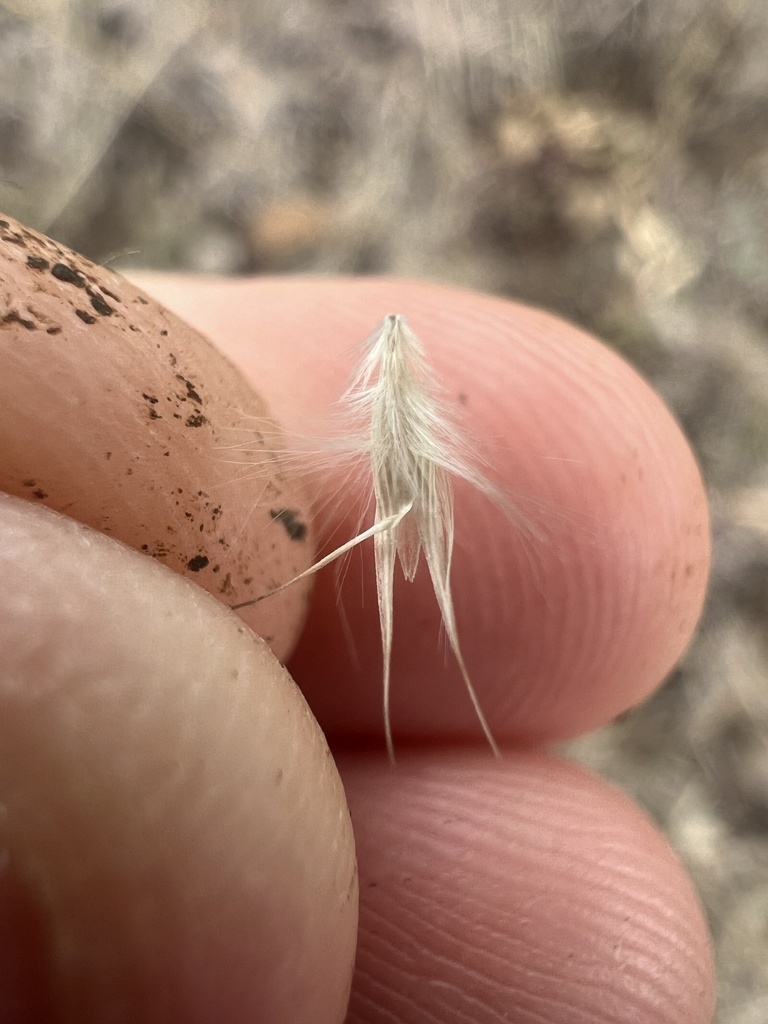
Leafy Wallaby-grass
Rytidosperma bipartitum
Rytidosperma bipartitum, the leafy wallaby grass, is a perennial species of grass found in south eastern Australia. Usually found on the heavier clay or on loamy soils in open eucalyptus woodland. The habit is somewhat variable, erect and densely tufted. The grass may grow up to 0.7 m (2 ft 4 in) tall.
From the article Rytidosperma bipartitum on Wikipedia (CC BY-SA), quoted section by section
Description
Rytidosperma bipartitum is an erect, tufted perennial up to 0.7 m (2+1⁄4 ft) high. Stem bearing the inflorescence, or culm, is smooth, slender and generally 4-noded. The lower part of the leaf containing the sheath usually smooth, with small membranous appendage on the top of the sheath (ligule) having short hairs. Leaf blade is 20 to 30 cm (7+7⁄8 to 11+3⁄4 in) long and 1 to 2.5 mm (1⁄16 to 1⁄8 in) wide, flat to loosely or closely rolled inwards, usually slightly hairy, bearing coarse and rough hairs. Inflorescence with a few to numerous spikelets, lanceolate or ovate in shape, 4 to 12 cm (1+5⁄8 to 4+3⁄4 in) long. Inflorescence can be spreading or contracted. Spikelets are 4 to 6-flowered, pale-greenish to straw in colour. Spikelet florets, which are each flower together with lemma and palea that enclose it, are shorter than the glumes (bracts at the base of the grass spikelet) except for the awns (fine bristle-like appendage). Glumes with membranous margins, 7 to 13 mm (1⁄4 to 1⁄2 in) long. …
What it does
R. bipartitum is a host of Sphaerodothella danthoniae, a sac fungus that produces black, shiny leaf spots that occasionally coalesce into straight to irregular lines in the leaf surface of several species of Rytidosperma.
Wikipedia: “Ecology”
Where it lives
Recorded sightings
—
geo-referenced records in GBIF, from museums, herbaria and field observers.
Drag the globe to turn it. Dots are where records exist, not a range map; darker means more records.
In the stacks
Searching the stacks…
Every page naming Rytidosperma bipartitum in the Biodiversity Heritage Library →
This page is assembled live from iNaturalist, GBIF, Wikipedia, the Source Library and the Internet Archive. It is not yet part of the hand-edited codex. iNaturalist taxon 417796.