- Plants
- ›Vascular Plants
- ›flowering plants
- ›monocots
- ›Agaves, Orchids, Irises, and Allies
- ›Orchids
- ›Orchidoid Orchids
- ›Diurideae
- ›Caladeniinae
- ›Cyanicula
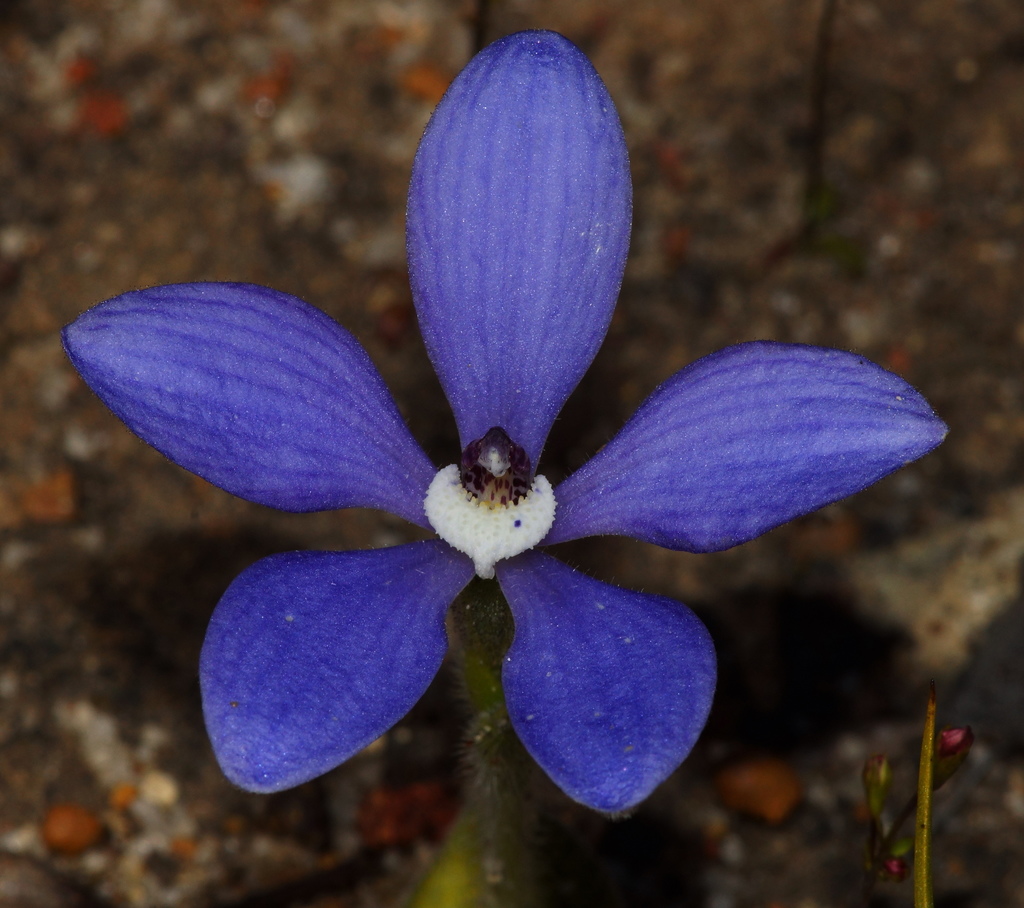
Blue China Orchid
Cyanicula gemmata
Cyanicula gemmata, commonly known as the blue china orchid, is a plant in the orchid family Orchidaceae and is endemic to the south-west of Western Australia. It has a small, oval leaf and up to three intense blue to mauve flowers. It is the most common and widespread of the West Australian china orchids, sometimes appearing in large numbers after summer fires.
From the article Cyanicula gemmata on Wikipedia (CC BY-SA), quoted section by section
Description
Cyanicula gemmata is a terrestrial, perennial, deciduous, herb with an underground tuber. It has a single dark green, shiny leaf, 20–40 mm (0.8–2 in) long, 10–20 mm (0.4–0.8 in) wide and purplish underneath. Up to three intense blue to purplish flowers 20–50 mm (0.8–2 in) long and wide are borne on a stalk 40–150 mm (2–6 in) tall. The dorsal sepal is erect, 20–30 mm (0.8–1 in) long and 5–10 mm (0.2–0.4 in) wide. The lateral sepals and petals have about the same dimensions as the dorsal sepal. The labellum is 5–8 mm (0.2–0.3 in) long, 5–7 mm (0.2–0.3 in) wide, purple and blue and curves downward near its tip. There are many scattered small, bead-like calli covering the labellum. Flowering occurs from August to early November.
Range & habitat
Cyanicula gemmata is a common and widespread china orchid found between Kalbarri in the north and Israelite Bay in the east, growing in a range of habitats from heath to forest. Plants growing in wetter areas tend to flower more profusely after summer fires.
Wikipedia: “Distribution and habitat”
Where it lives
Recorded sightings
—
geo-referenced records in GBIF, from museums, herbaria and field observers.
Drag the globe to turn it. Dots are where records exist, not a range map; darker means more records.
In the stacks
Searching the stacks…
Every page naming Cyanicula gemmata in the Biodiversity Heritage Library →
This page is assembled live from iNaturalist, GBIF, Wikipedia, the Source Library and the Internet Archive. It is not yet part of the hand-edited codex. iNaturalist taxon 416794.