- Plants
- ›Vascular Plants
- ›flowering plants
- ›Dicots
- ›proteas, lotuses, planes, and allies
- ›Protea family
- ›Paired Proteas
- ›Banksieae
- ›Banksiinae
- ›Banksia
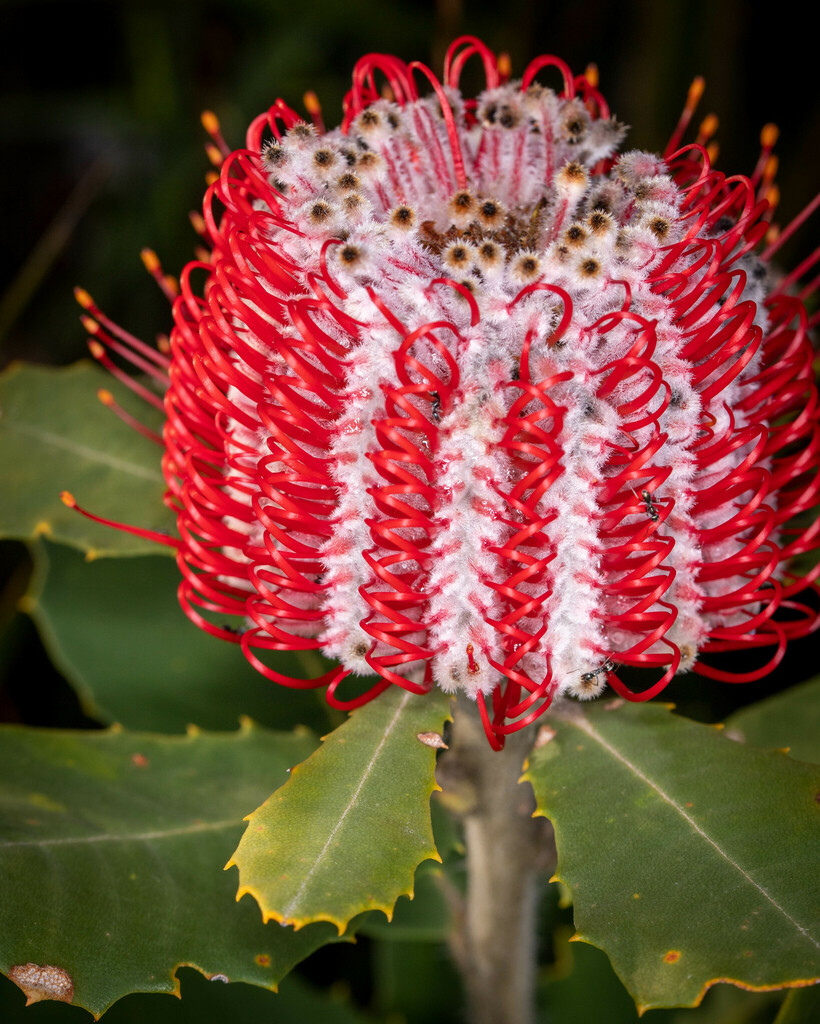
Scarlet Banksia
Banksia coccinea
Banksia coccinea, commonly known as the scarlet banksia, waratah banksia or Albany banksia, is an erect shrub or small tree in the family Proteaceae. Its distribution in the wild is along the southwest coast of Western Australia, from Denmark to the Stokes National Park, and north to the Stirling Range, growing on white or grey sand in shrubland, heath, or open woodland. Reaching up to 8 m (26 ft) in height, it is a single-stemmed plant that has oblong leaves, which are 3–9 cm (1.2–3.5 in) long and 2–7 cm (0.8–2.8 in) wide. The prominent red and white flower spikes appear mainly in the spring. As they age, they develop small follicles that store seeds until opened by fire. Though widely occurring, it is highly sensitive to dieback, and large populations of plants have succumbed to the disease.
Collected and described by Robert Brown in the early 19th century, Banksia coccinea appears to be most closely related to Banksia speciosa and B. baxteri. Banksia coccinea plants are killed by bushfire and regenerate from seed. The flowers attract nectar- and insect-feeding birds, particularly honeyeaters, and various insects. Widely considered one of the most attractive Banksia species, B. coccinea is a popular garden plant and one of the most important Banksia species for the cut flower industry; it is grown commercially in several countries, including Australia, South Africa, Canada, the United States, New Zealand, and Israel. In cultivation, B. coccinea grows well in a sunny location on well-drained soil, but it cannot survive in areas with humid or wet summers.
From the article Banksia coccinea on Wikipedia (CC BY-SA), quoted section by section
Description
The scarlet banksia grows as an erect shrub or small tree, generally around 2–4 m (6.6–13.1 ft) tall, with little lateral spread. However, it can reach 8 metres (26 ft) in height, particularly in the vicinity of Albany. The trunk is generally single at the base before branching, covered with smooth grey bark that is 2–5 mm (0.08–0.20 in) thick and lacking in lenticels. Peaking in the summer months, the pinkish-brown new growth is densely hairy. The oblong, cordate or obcordate leaves are 3–9 cm (1.2–3.5 in) long and 2–7 cm (0.8–2.8 in) wide, with 3–5 mm (0.12–0.20 in) long petioles. Truncate at the apex, they have dentate margins with small (1–3 mm long) teeth 3–18 mm (0.12–0.71 in) apart, separated by shallow u- or v-shaped sinuses. The upper surface is covered in fine fur when young and becomes smooth with age, while the undersurface is covered with white fur, particularly along the midrib. The flowering process takes 9–12 months; the stems begin developing microscopically in spring, with no visible evidence of flower spike development for around five months before the buds actually appear. Flower spikes bloom from May to December or January, peaking between July and October. The distinctive inflorescences arise from the ends of one-year-old branchlets. Squat and roughly cylindrical, they are 3–6 cm (1.2–2.4 in) high and 8–10 cm (3.1–3.9 in) wide. …
Range & habitat
Banksia coccinea occurs close to the south coast of Western Australia, from the Hay River northeast of Denmark, Albany in the west, east to Stokes National Park southeast of Munglinup, and inland to the Stirling Range and the northern border of Fitzgerald River National Park. Around 47% of plants are protected in conservation areas, while 13% are on road verges. It prefers deep white or grey sand, among tall shrubland, heath, mallee-heath, associated with such species as B. baxteri, B. speciosa, B. attenuata, and Lambertia inermis, or low open woodland in the Stirling Range and near Albany, where it is found with Eucalyptus marginata, Banksia attenuata, and B. ilicifolia. Most of its range has a gently undulating topography, but it also occurs on a steep rocky slope at Ellen Peak in the Stirling Ranges. The annual rainfall is 400–800 mm (16–31 in).
Wikipedia: “Distribution and habitat”
What it does
A field study conducted around Albany found the honey possum (Tarsipes rostratus) sometimes visits Banksia coccinea, as do the New Holland honeyeater (Phylidonyris novaehollandiae), white-cheeked honeyeater (P. nigra), and western spinebill (Acanthorhynchus superciliosus). Banksia coccinea flowers are visited by colletid bees Hylaeus alcyoneus and H. sanguinipictus. The short-billed black cockatoo breaks off old cones with follicles to eat the seed, often doing so before the seed is ripe. B. coccinea is killed by fire and regenerates from seed released from burnt follicles. It has some degree of serotiny, that is, it has an aerial seed bank in its canopy in the form of the follicles of the old flower spikes. However, seed numbers are less than other co-occurring banksia species on the southern plains and peak several years after a fire. Unusually for banksias, B. coccinea can release seed with resulting seedlings growing in the absence of a bushfire trigger. Plants flower and fruit three years after germination and are shorter-lived than other banksias, appearing in poor health or dying before 20 years of age. …
Wikipedia: “Ecology”
How it is grown
Widely considered one of the most attractive Banksia species, B. coccinea is a popular garden plant and one of the most important Banksia species for the cut flower industry; it is grown commercially in Australia, South Africa, Canada, the United States, New Zealand, Israel, and trialled in France, Spain, and South America. Its striking terminal inflorescences and furry new growth are its main horticultural attributes. However, it is highly sensitive to dieback and succumbs readily when exposed. It is difficult to keep alive in areas of heavy soils, summer rainfall, or humidity, such as the Australian east coast. Furthermore, flowering may be sparse or not occur when cultivated in warmer climates such as Perth. Pruning promotes branching, which leads to more flower spikes being produced. Propagation is by seed, though these can be difficult to extract from the follicles. Seeds do not require any treatment before sowing, and germination takes 12 to 48 days. Cultivars require propagation by cutting for progeny to grow true. Cuttings are slow to strike. Attempts to graft B. …
Wikipedia: “Cultivation”
Where it lives
Recorded sightings
—
geo-referenced records in GBIF, from museums, herbaria and field observers.
Drag the globe to turn it. Dots are where records exist, not a range map; darker means more records.
In the stacks
Searching the stacks…
Every page naming Banksia coccinea in the Biodiversity Heritage Library →
This page is assembled live from iNaturalist, GBIF, Wikipedia, the Source Library and the Internet Archive. It is not yet part of the hand-edited codex. iNaturalist taxon 416532.