- Animals
- ›Chordates
- ›Vertebrates
- ›Mammals
- ›Therians
- ›Placental Mammals
- ›Ungulates, Carnivorans, and Allies
- ›Even-toed Ungulates and Cetaceans
- ›Cetaceans and Hippopotamuses
- ›Cetaceans
- ›Baleen Whales
- ›Bowhead and Right Whales
- ›Eubalaena
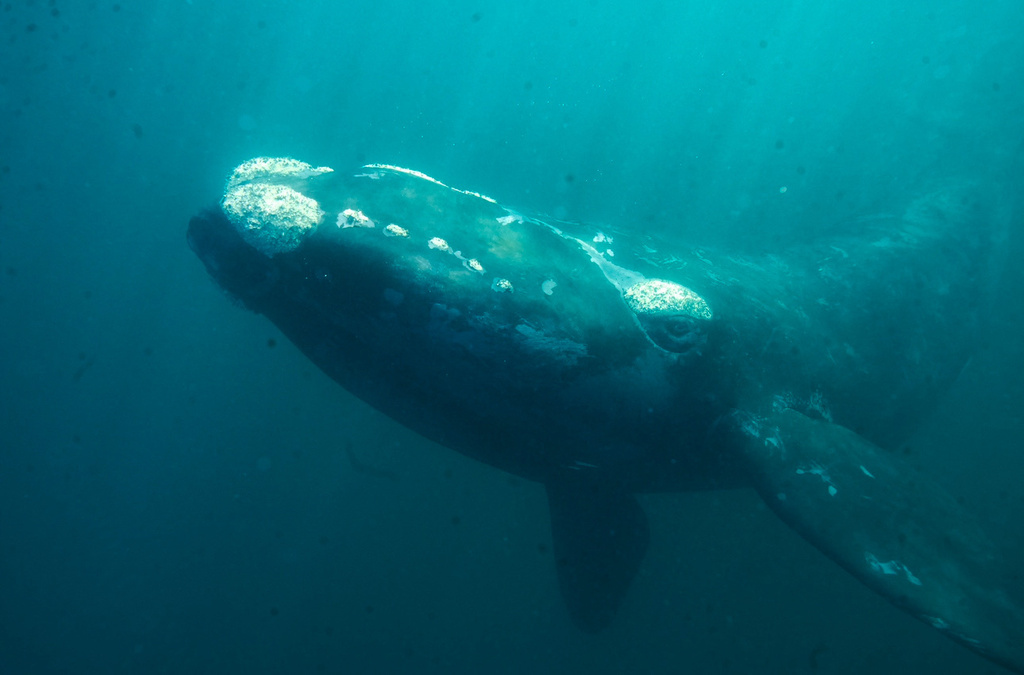
Southern Right Whale
Eubalaena australis
The southern right whale (Eubalaena australis) is a large baleen whale and one of three species of right whale belonging to the genus Eubalaena. Found throughout the Southern Hemisphere, it inhabits oceans between the latitudes of 20° and 60° south. Like its northern relatives, the southern right whale is noted by its broad back without a dorsal fin, a long, arching mouth, and white growths on its head known as callosities. Previously hunted for hundreds of years, almost to extinction, the species is now protected and its global population was estimated to be around 13,600 (2009).
Each year, the southern right whale migrates. During the summer months, it feeds on zooplankton and krill in the cold waters of the Southern Ocean, often near Antarctica. In the winter, it travels northward to the warmer coastal waters off Argentina, Australia, Brazil, South Africa, and New Zealand to breed and calve. The whales are known for their active behavior at the surface, which includes breaching and a unique practice called "tail sailing," where they use their flukes to catch the wind.
From the article Southern right whale on Wikipedia (CC BY-SA), quoted section by section
Description
Like other right whales, the southern right whale is readily distinguished from others by the callosities on its head, a broad back without a dorsal fin, and a long arching mouth that begins above the eye. Its skin is very dark grey or black, occasionally with some white patches on the belly. The right whale's callosities appear white due to large colonies of cyamids (whale lice). It is almost indistinguishable from the closely related North Atlantic and the North Pacific right whales, displaying only minor skull differences. It may have fewer callosities on its head than North Atlantic and more on its lower lips than the two northern species. The biological functions of callosities are unclear, with proposed purposes including protection, identification, and use in mating. An adult female is 15 m (49 ft) and can weigh up to 47 tonnes (46 long tons; 52 short tons), with the larger records of 17–18 m (56–59 ft) in length and up to 80 tonnes (79 long tons; 88 short tons) in weight, making them slightly smaller than other right whales in the Northern Hemisphere. On each side of the upper jaw are 200–270 baleen plates. These are narrow and approximately 3 m (9.8 ft) long, and are covered in very thin hairs. The pectoral fin is 1.7 m (5.6 ft) long. The testicles of right whales are likely to be the largest of any animal, each weighing around 500 kg (1,100 lb). …
Range & habitat
The global population of southern right whales was estimated at 13,611 in 2009. An estimate published by National Geographic in October 2008 put the southern whale population at 10,000. A population estimate of 7,000 followed a March 1998 IWC workshop. Researchers used population data from three surveys of adult females in the 1990s (Argentina, South Africa and Australia). They extrapolated to include the population of unsurveyed areas, and used known male-to-female and adult-to-calf ratios to estimate and include numbers of males and calves. Recovery of the overall population size of the species is predicted to be at less than 50% of its pre-whaling state by 2100 due to heavier impacts of whaling and slower recovery rates. Since hunting ceased, the population is estimated to have grown by 7% a year. The southern right whale spends summer in the far Southern Ocean feeding, probably close to Antarctica. If the opportunity arises, feeding can occur even in temperate waters such as along Buenos Aires. It migrates north in winter for breeding and can be seen by the coasts of Argentina, Australia, Brazil, Chile, Namibia, Mozambique, Peru, Tristan de Cunha, Uruguay, Madagascar, New Zealand and South Africa; whales have also been known to winter in sub-Antarctic regions. …
Wikipedia: “Population and distribution”
What it does
Like other right whales, they are rather active on the water surface and curious towards human vessels. Southern rights appear to be more active and tend to interact with humans more than the other two northern species. One behaviour unique to the southern right whale, known as tail sailing, is that of using their elevated flukes to catch the wind, remaining in the same position for a considerable amount of time. It appears to be a form of play and is most commonly seen off the coast of Argentina and South Africa. Some other species such as humpback whales are also known to display. Right whales are often seen interacting with other cetaceans, especially humpback whales and dolphins. There have been records of southern rights and humpbacks thought to be involved in mating activities off Mozambique, and along Bahia, Brazil. A female southern right whale was spotted off the coast of Western Australia accompanying a lone humpback whale calf, although the actual relationship of this pair is unclear.
Reproduction. Southern right whales display strong maternal fidelity to their calving grounds. Calving females are known to return to calving grounds at 3-year intervals. The most commonly observed calving interval is 3 years, but intervals can range from 2 to 21 years. …
Wikipedia: “Behaviour”
In human culture
The species was featured on a 70p commemorative stamp issued by Tristan da Cunha in 2019 as part of a set celebrating different species of whale.
Wikipedia: “Popular culture”
Listen
Looking for field recordings…
Where it lives
Recorded sightings
—
geo-referenced records in GBIF, from museums, herbaria and field observers.
Drag the globe to turn it. Dots are where records exist, not a range map; darker means more records.
In the stacks
Searching the stacks…
Every page naming Eubalaena australis in the Biodiversity Heritage Library →
This page is assembled live from iNaturalist, GBIF, Wikipedia, the Source Library and the Internet Archive. It is not yet part of the hand-edited codex. iNaturalist taxon 41571.