- Animals
- ›Chordates
- ›Vertebrates
- ›Mammals
- ›Therians
- ›Placental Mammals
- ›Ungulates, Carnivorans, and Allies
- ›Even-toed Ungulates and Cetaceans
- ›Cetaceans and Hippopotamuses
- ›Cetaceans
- ›Baleen Whales
- ›Bowhead and Right Whales
- ›Eubalaena
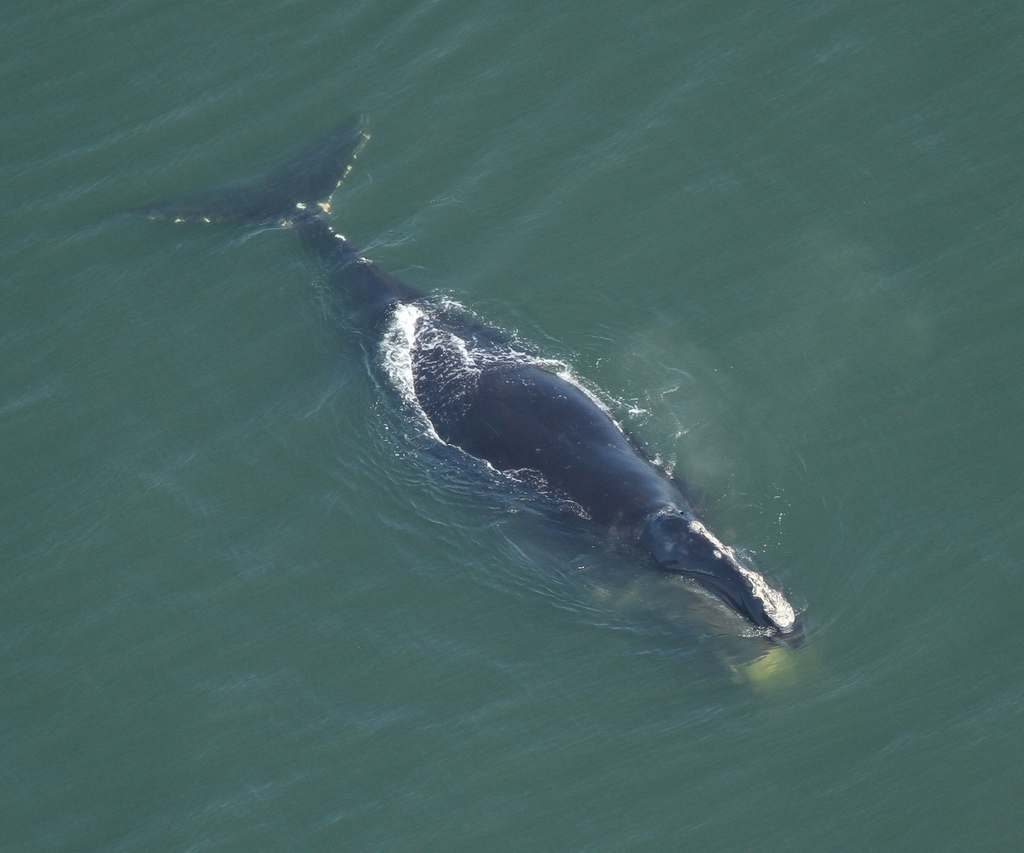
North Atlantic Right Whale
Eubalaena glacialis
The North Atlantic right whale (Eubalaena glacialis) is a baleen whale, one of three right whale species belonging to the genus Eubalaena, all of which were formerly classified as a single species. Because of their docile nature, their slow surface-skimming feeding behaviors, their tendencies to stay close to the coast, and their high blubber content (which makes them float when they are killed, and which produces high yields of whale oil), right whales were once a preferred target for whalers. At present, they are among the most endangered whales in the world, and they are protected under the U.S. Endangered Species Act and Marine Mammal Protection Act and Canada's Species at Risk Act. As of 2026, there are an estimated 380 individuals, including 70 breeding females. They migrate between feeding grounds in the Labrador Sea and their winter calving areas off Georgia and Florida, an ocean area with heavy shipping traffic. In the eastern North Atlantic, on the other hand—with a total population reaching into the low teens at most—scientists believe that they may become functionally extinct in the next two decades. Vessel strikes and entanglement in fixed fishing gear, which together account for nearly half of all North Atlantic right whale mortality since 1970, are their two greatest threats to recovery.
From the article North Atlantic right whale on Wikipedia (CC BY-SA), quoted section by section
Description
Like other right whales, the North Atlantic right whale, also known as the northern right whale or black right whale, is readily distinguished from other cetaceans by the absence of a dorsal fin on its broad back, short, paddle-like pectoral flippers and a long arching mouth that begins above the eye. Its coloration is dark grey to black, with some individuals occasionally having white patches on their stomachs or throats. Other unique features include a large head, which makes up a quarter of its total body length, narrow tail stock in comparison to its wide fluke, and v-shaped blowhole which produces a heart-shaped blow. The most distinguishing feature for right whales is their callosities: rough, white patches of keratinized skin found on their heads. The right whale's callosities provide habitat for large colonies of cyamids or whale lice, which feed on the right whale's skin as these small crustaceans cannot survive in open water. The relationship between cyamids and right whales is symbiotic in nature but is poorly understood by scientists. Callosities are not caused by the external environment and are present on fetuses before birth. …
Range & habitat
It is not known how many populations of North Atlantic right whales existed prior to whaling, but the majority of studies usually consider that there were historically two populations, one each in the eastern and western North Atlantic. There are however two other hypotheses which claim, respectively, one super-population among the entire North Atlantic (with mixing of eastern and western migratory routes occurring at locations in relatively high latitudes such as in the Denmark Strait), and three sub-populations of eastern, western, and central Atlantic right whales (with the central stock ranging from Greenland's Cape Farewell in summer to the Azores, Bermuda, and Bahamas in winter, although recent study indicates that the Azores had probably been a migratory corridor rather than a wintering ground). Recent studies revealed that modern counterparts of the eastern and western populations are genetically much closer to each other than previously thought. Right whales' habitat can be affected dramatically by climate changes along with Bowhead whales.
Western population. In spring, summer and autumn, the western North Atlantic population feeds in a range stretching from Massachusetts to Newfoundland. Particularly popular feeding areas are the Bay of Fundy, the Gulf of Maine and Cape Cod Bay. In winter, they head south towards Georgia and Florida to give birth. …
Wikipedia: “Population and distribution”
What it does
North Atlantic right whales are promiscuous breeders. They first give birth at age nine or ten after a year-long gestation; the interval between births seems to have increased since the 1990s, and now averages three to six years. Calves are 13–15 feet (4.0–4.6 m) long at birth and weigh approximately 3,000 pounds (1,400 kg). The North Atlantic right whale's penis can reach at least 1.8 m (5 ft 11 in) in length.
Wikipedia: “Reproduction”
Listen
Looking for field recordings…
Where it lives
Recorded sightings
—
geo-referenced records in GBIF, from museums, herbaria and field observers.
Drag the globe to turn it. Dots are where records exist, not a range map; darker means more records.
In the stacks
Searching the stacks…
Every page naming Eubalaena glacialis in the Biodiversity Heritage Library →
This page is assembled live from iNaturalist, GBIF, Wikipedia, the Source Library and the Internet Archive. It is not yet part of the hand-edited codex. iNaturalist taxon 41570.