- Animals
- ›Chordates
- ›Vertebrates
- ›Mammals
- ›Therians
- ›Placental Mammals
- ›Ungulates, Carnivorans, and Allies
- ›Even-toed Ungulates and Cetaceans
- ›Cetaceans and Hippopotamuses
- ›Cetaceans
- ›Baleen Whales
- ›Rorquals
- ›Balaenoptera
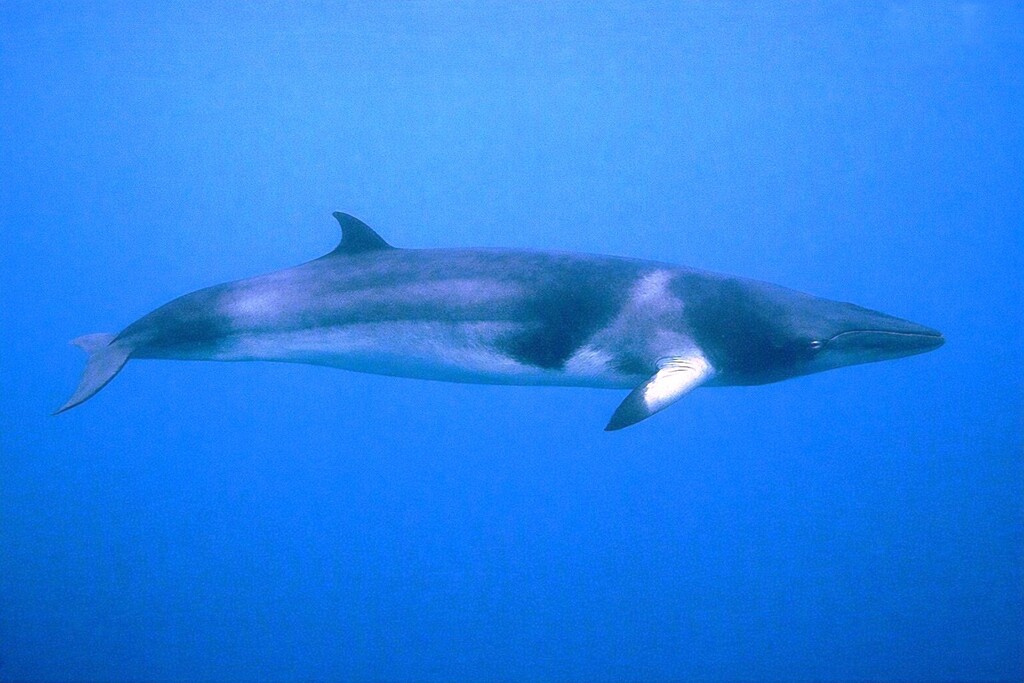
Common Minke Whale
Balaenoptera acutorostrata
The common minke whale or northern minke whale (Balaenoptera acutorostrata) is a species of minke whale within the suborder of baleen whales.
It is the smallest species of the rorquals and the second smallest species of baleen whale. Although first ignored by whalers due to its small size and low oil yield, it began to be exploited by various countries beginning in the early 20th century. As other species declined, larger numbers of common minke whales were caught, largely for their meat. It is now one of the primary targets of the whaling industry. There is a dwarf form in the Southern Hemisphere.
From the article Common minke whale on Wikipedia (CC BY-SA), quoted section by section
Range & habitat
There are approximately 209,800 common minke whales worldwide. They have a disjointed distribution. In the North Atlantic, they occur as far north as Baffin Bay, Svalbard, Franz Josef Land, and Novaya Zemlya and as far south as 40°N (New Jersey) and the Hebrides and central North Sea during summer. There are a few records from Hudson Bay (James Bay in 1986 and Button Bay in 1990), and they have also been observed occasionally in Hudson Strait and Ungava Bay. They have been recorded off Madeira and occur year-round off the Canary Islands. There are occasional sightings and strandings off Spain and Portugal, western Sahara, Mauritania, and Senegal. It is rare off the Azores and a vagrant in the Gulf of Mexico and the Mediterranean Sea, with a few records from the Black Sea (1880 and 1926). During the winter it has been recorded off Bermuda, the Bahamas, the Antilles, the east coast of the United States south of 40°N, and in the southeastern North Atlantic between 10°40'N and 19°35'N and 22°W and 20°05'W. In the western and central North Pacific, they range from Hawaii, the Mariana Islands, the East China Sea, the Yellow Sea and the Sea of Japan in the south to the Sea of Okhotsk and Bering and Chukchi Seas in the north. In the eastern North Pacific, they occur in the Gulf of Alaska south along the entire west coast of North America (including the U.S. …
Wikipedia: “Distribution”
What it does
Common minke whales are sexually mature at about six to eight years of age for females and about six to seven years for males. Females are promiscuous. After a gestation period of 10 months, a single 2.6 m (8 ft 6 in) calf is born – only one out of 79 mature females during a study of minke whales off Iceland had twin fetuses, an 8.7 m (29 ft) female caught in July 2006 which had a 34 cm (13 in) male and a 32 cm (13 in) female. The calf is weaned after a period of six months. Peak conception is February in the North Atlantic, late February to mid-March for the "O stock", which migrates along the eastern coast of Japan to the Okhotsk Sea), and between October and November for the "J stock" (which occurs in the Yellow Sea, East China Sea, and Sea of Japan, and migrates to the southern Okhotsk Sea in the spring, where it mixes with the O stock. Peak calving is December in the North Atlantic, December to January in the North Pacific, and May to July for the J stock. The calving interval is only a year, so females are often simultaneously pregnant and lactating. Females reach physical maturity perhaps as early as 13 years of age; another study suggested that growth ceases for both sexes when they have 15 to 20 growth layers in their tympanic bullae, which may correspond to about 15 to 20 years of age. …
Wikipedia: “Reproduction”
In human culture
Otto Fabricius, in his Fauna Groenlandica (1780), was the first to describe the minke, noting its small size and white baleen – but he described it erroneously under the name Balaena rostrata (the taxonomic designation for the beaked whale). In 1804, Baron de Lacepede named it Balaenoptera acuto-rostrata, basing his description partly on the stranding of a 4.26 m (14.0 ft) juvenile female near Cherbourg, France in 1791. In 1872, the American whaleman and naturalist Charles Melville Scammon described and named Balaenoptera davidsoni, after an 8.3 m (27 ft) pregnant female that was found dead on the north shore of Admiralty Inlet in October 1870 in then Washington Territory (now Washington state) and towed into Port Townsend Bay by Italian fisherman, who flensed it on the beach. Scammon mentioned its "dwarfish size", "pointed head", "falcated dorsal fin", and the "white band" on its "inordinately small, pointed pectorals". In 1877, the Italian geologist and paleontologist Giovanni Capellini described and named Sibbaldius mondini from a juvenile specimen that was captured off Italy in 1771. Both were later synonymized with B. …
Wikipedia: “History”
Listen
Looking for field recordings…
Where it lives
Recorded sightings
—
geo-referenced records in GBIF, from museums, herbaria and field observers.
Drag the globe to turn it. Dots are where records exist, not a range map; darker means more records.
In the stacks
Searching the stacks…
Every page naming Balaenoptera acutorostrata in the Biodiversity Heritage Library →
This page is assembled live from iNaturalist, GBIF, Wikipedia, the Source Library and the Internet Archive. It is not yet part of the hand-edited codex. iNaturalist taxon 41550.