- Plants
- ›Vascular Plants
- ›flowering plants
- ›Dicots
- ›saxifrages, stonecrops, and allies
- ›daphniphyllum family
- ›Daphniphyllum
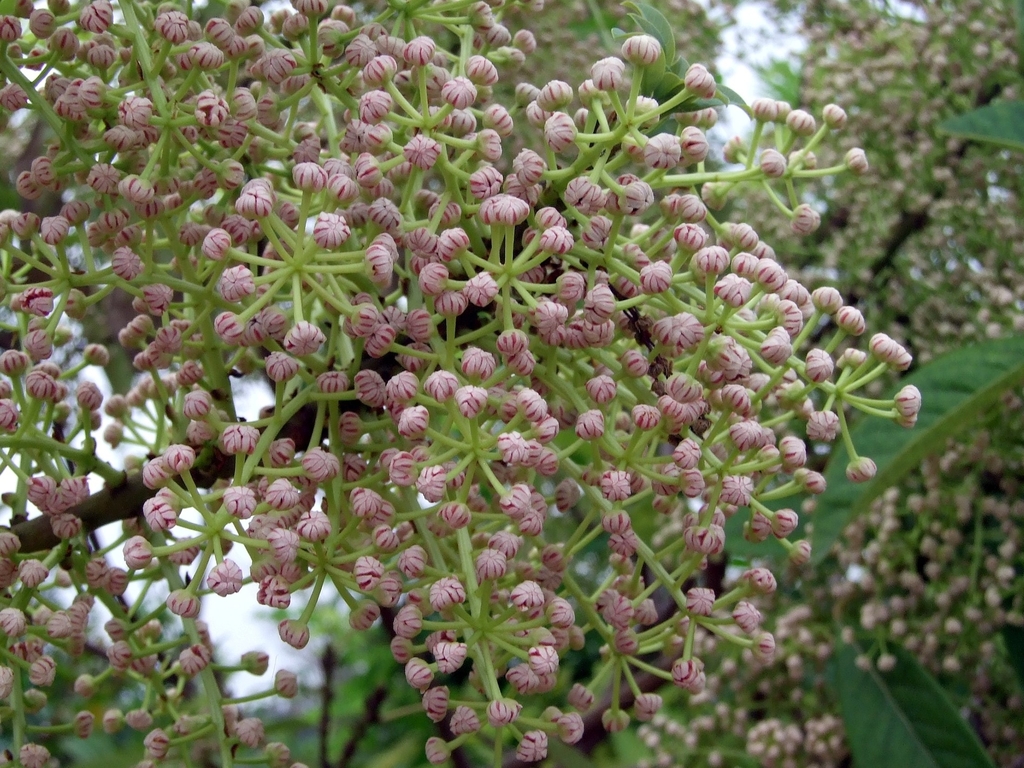
Calyx-shaped Tigernanmu
Daphniphyllum calycinum
Daphniphyllum calycinum is a species of shrubby plant in the family Daphniphyllaceae. It is found in northern Vietnam and Southeastern Zhōngguó/China. It is used in biodiesel and in lubrication, soap-making and Chinese medicine.
From the article Daphniphyllum calycinum on Wikipedia (CC BY-SA), quoted section by section
Description
This species grows as a shrub some 1-5-4m tall. The grayish-brown branches are sparsely lenticillate. The petioles are some 4 to 8 cm long. The obovate to obovate-elliptic leaf blades are 12–16 by 4–9 cm in size, they are chartaceous, glaucous/hairy and are inconspicuously papillate on lower surface; broadly cuneate leaf base, slightly reflexed margins and obtuse to rounded apex, mucronate; 8-11 pairs of later veins are visible on upper surface, prominent on lower. Male flowers have an 8–10 cm pedicel and a discoid calyx with 3 or 4 broadly triangular lobes, 9 or 10 stamens some 3 mm long with very short filaments, oblong laterally-compressed anthers, connective exserted. Female flowers have a 5–6 mm pedicel, broadly-triangular calyx-loves about 1.5mm in size, ellipsoidal ovary 1.5–2 mm in size, very short style, 2 recurved stigmas. The Infructescence/fruiting head is some 4–5 cm in size, densely arranged with ovoid-ellipsoidal, tubercalate, glaucous drupes some 7 by 4 mm in size, with persistent calyx and style branches. Flowering occurs from April to June, while fruiting is from August to November. Distinguishing characteristics of this species are: the size (9–16 by 4–9 cm) and shape (obovate to obovate-elliptic) of the leaf blade, the obtuse to rounded apex; and size (about 7 mm), dense arrangement and glaucousness of the fruit.
Range & habitat
The plant is native to an area from northern Vietnam to southeastern China (Fujian, Guangdong, Guangxi, Hong Kong, south Hunan, south Jiangxi).
Wikipedia: “Distribution”
What it does
The shrub grows in forests and thickets at altitudes of occasionally below 100 m (330 ft) but mainly 200–700 m (660–2,300 ft). Daphniphyllum calycinum is present on the degraded hillside shrublands of Hong Kong, it is common there in scrubland and forest edges. Birds disperse the dry-season fruiting seeds. The follicular micromycete, or sac-fungi, Mycosphaerella fasciculata, in the Mycosphaerellaceae family, uses this species as a host.
Wikipedia: “Habitat and ecology”
At the table
The seeds provide abundant oil that was used in lubrication and to make refined soap, however recently because of its toxicity it is only used in biodiesel. Roots and leaves are used within Chinese medicine. The plant has many alkaloids and other active ingredients, see for example Wu et al., 2013.
== References ==
Wikipedia: “Uses”
Where it lives
Recorded sightings
—
geo-referenced records in GBIF, from museums, herbaria and field observers.
Drag the globe to turn it. Dots are where records exist, not a range map; darker means more records.
In the stacks
Searching the stacks…
Every page naming Daphniphyllum calycinum in the Biodiversity Heritage Library →
This page is assembled live from iNaturalist, GBIF, Wikipedia, the Source Library and the Internet Archive. It is not yet part of the hand-edited codex. iNaturalist taxon 415460.