- Animals
- ›Chordates
- ›Vertebrates
- ›Mammals
- ›Therians
- ›Placental Mammals
- ›Ungulates, Carnivorans, and Allies
- ›Even-toed Ungulates and Cetaceans
- ›Cetaceans and Hippopotamuses
- ›Cetaceans
- ›Toothed Whales
- ›Oceanic Dolphins and Porpoises
- ›Porpoises
- ›Phocoena
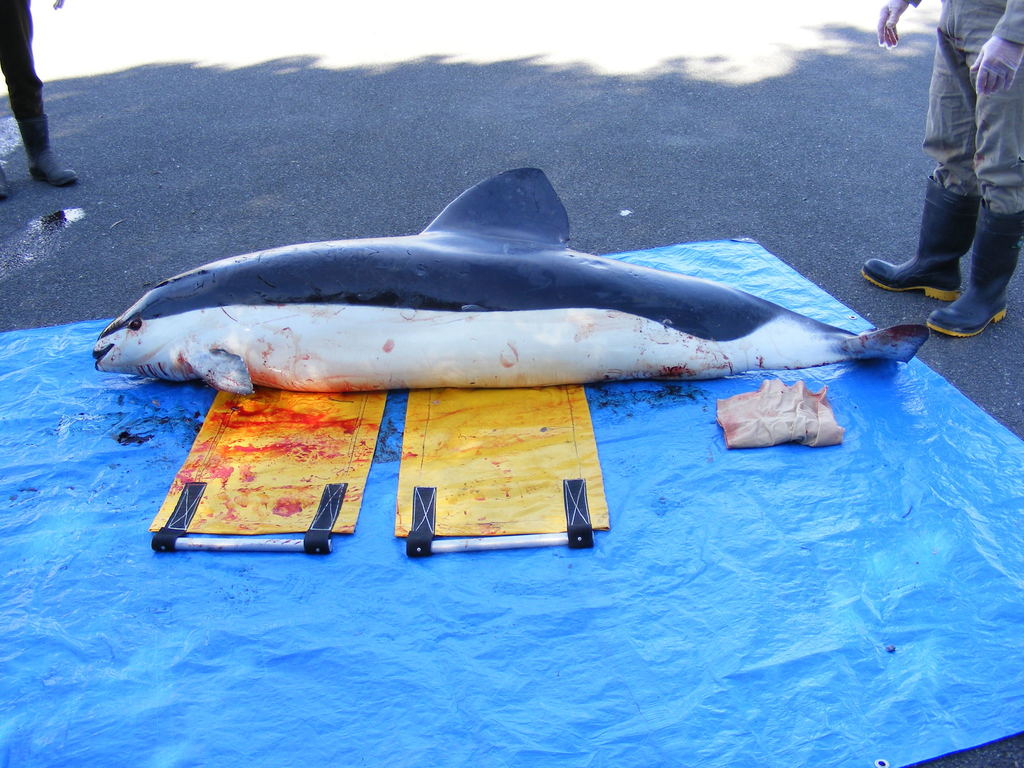
Spectacled Porpoise
Phocoena dioptrica
The spectacled porpoise (Phocoena dioptrica) is a small to midsize porpoise indigenous to the Southern Ocean. It is one of the most poorly studied cetaceans, partly due to its remote range in the Southern Ocean. What little is known about this porpoise species has been gathered mainly from stranded individuals, and a few observations of living animals made at sea.
The species was first described in 1912 by Fernando Lahille.
From the article Spectacled porpoise on Wikipedia (CC BY-SA), quoted section by section
Description
As with other porpoise species, the spectacled porpoise has no beak. It has small pectoral fins with rounded tips positioned far forward on the body, and a triangular dorsal fin. This porpoise species shows obvious sexual dimorphism between adult males and females, as the dorsal fins in males are much larger and more rounded than those of females. Records for female length range up to 204 centimetres (80 in), while males may reach 224 centimetres (88 in), which represents the largest specimen documented thus far. The maximum weight for a female was 85 kilograms (187 lb), while a male has been recorded at 110 kilograms (240 lb). The spectacled porpoise has a distinctive coloration. As an adult it is countershaded, with a black dorsal region which is sharply delineated from a white belly. In some individuals, this line can be feathered. An obvious dark eye patch is present in both juveniles and adults. A pale 'saddle-patch' around the dorsal fin and a dark line around the blowhole have also been documented. Females are described as lighter in coloration, while young animals may have a dorsal area that is grey rather than black, with a lighter grey on the belly, a clearly demarked line connecting the mouth and flipper.
Range & habitat
The distribution of the spectacled porpoise is thought to be circumpolar, and it is considered a predominately oceanic species, however occasional sightings and specimens are documented in coastal regions. Evidence from sightings and strandings suggest that the species can be found within cool temperate, sub-Antarctic and Antarctic waters, where water temperatures range between 0.9 and 10.3 °C (33.6 and 50.5 °F). Stranded individuals have been found across the southern hemisphere. In the south-western Atlantic records have been made at Santa Catarina in Southern Brazil, Uruguay, from Buenos Aires to Tierra del Fuego, and the Falkland Islands and South Georgia. Records exist from the south-western South Pacific (Auckland and Maquarie Islands) to the southern Indian Ocean (Heard and Kerguelen), and also from New Zealand, Burney Island, Tasmania and South Australia. This widespread distribution is evidence of a circumpolar range, and possible association with the Falkland Current and Antarctic Circumpolar Current (ACC) which transports cold water along the Atlantic coast of South America, and around Antarctica respectively. Sightings of spectacled porpoise at sea are similarly widespread, and include waters off Patagonia, South Georgia, Kerguelen, south of New Zealand, Tasmania and Heard Island. Nine sightings have been made south of 64°, in Antarctic waters.
Wikipedia: “Geographic distribution”
What it does
Little is known about the reproduction of the spectacled porpoise. In the Tierra del Fuego region, studies estimate that young porpoises are born at 100 centimetres (39 in) long in late spring or summer (November to February). No information is available on gestation, lactation, or inter-birth intervals.
Wikipedia: “Reproduction”
Listen
Looking for field recordings…
Where it lives
Recorded sightings
—
geo-referenced records in GBIF, from museums, herbaria and field observers.
Drag the globe to turn it. Dots are where records exist, not a range map; darker means more records.
In the stacks
Searching the stacks…
Every page naming Phocoena dioptrica in the Biodiversity Heritage Library →
This page is assembled live from iNaturalist, GBIF, Wikipedia, the Source Library and the Internet Archive. It is not yet part of the hand-edited codex. iNaturalist taxon 41444.