- Animals
- ›Chordates
- ›Vertebrates
- ›Mammals
- ›Therians
- ›Placental Mammals
- ›Ungulates, Carnivorans, and Allies
- ›Even-toed Ungulates and Cetaceans
- ›Cetaceans and Hippopotamuses
- ›Cetaceans
- ›Toothed Whales
- ›Oceanic Dolphins and Porpoises
- ›Porpoises
- ›Phocoena
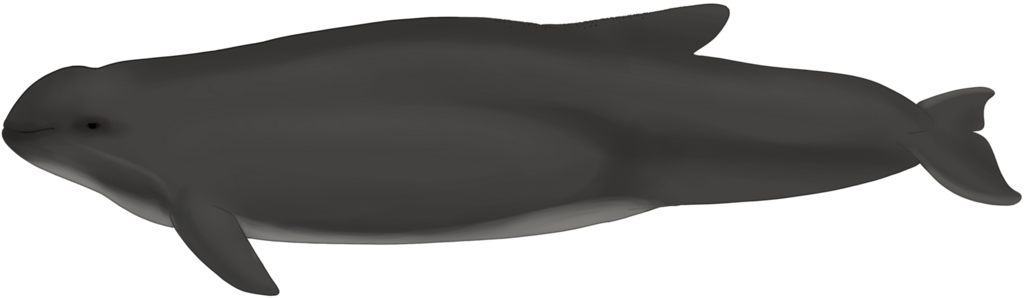
Burmeister's Porpoise
Phocoena spinipinnis
Burmeister's porpoise (Phocoena spinipinnis) is a species of porpoise endemic to the coast of South America. It was first described by Hermann Burmeister, for whom the species is named, in 1865. Locally it is known as marsopa espinosa (thorny porpoise) and chancho marino (sea pig).
From the article Burmeister's porpoise on Wikipedia (CC BY-SA), quoted section by section
Description
Most photographs of Burmeister's porpoises are taken of dead specimens and show the animal to be coloured black. This phenomenon gave rise to the earlier common name, black porpoise. However live individuals are typically a dark grey color. They turn black in just a few minutes after death. The underside varies in colour but is usually a lighter grey. Burmeister's are about 150 cm (59 in) long when fully mature and weigh 50–75 kg (110–165 lb). The maximum recorded weight is that of a female at 105 kg (231 lb). They have a shallow indentation at their blowhole set just in front of the eyes. The shape and placement of the dorsal fin is unusual for a cetacean—it is triangular rather than curved and points backwards more than upwards. It is located about three quarters of the way along the back—further back than any other dolphin or porpoise. These features are sufficient to distinguish the porpoise from the similar-sized Chilean dolphin which is found in the porpoise's Pacific range.
Range & habitat
While Burmeister's porpoise seems to be relatively common in its range, little work has been done to survey the species. The total population is at least in the tens of thousands. Its range appears to be continuous in coastal waters from northern Peru in the Pacific Ocean round Tierra del Fuego and up to southern Brazil in the Atlantic Ocean. Burmeister's porpoises frequent inshore bays, channels, and fjords, but individuals have been spotted as far as 50 km (31 mi) from the shore and in the freshwater Valdivia River in southern Chile. Though normally found in continental shelf waters, they have been found as deep as 1,000 m (3,300 ft)
Wikipedia: “Population and distribution”
What it does
Burmeister's porpoise is difficult to observe. It appears to be shy, shows little of its body when surfacing and will move quickly away from approaching boats. They are typically seen alone or in pairs with occasional larger groups. One report from Chile saw a group of 70 in number. The porpoise feeds on various pelagic fish such as anchovies, hake and mackerel.
Wikipedia: “Behaviour”
Listen
Looking for field recordings…
Where it lives
Recorded sightings
—
geo-referenced records in GBIF, from museums, herbaria and field observers.
Drag the globe to turn it. Dots are where records exist, not a range map; darker means more records.
In the stacks
Searching the stacks…
Every page naming Phocoena spinipinnis in the Biodiversity Heritage Library →
This page is assembled live from iNaturalist, GBIF, Wikipedia, the Source Library and the Internet Archive. It is not yet part of the hand-edited codex. iNaturalist taxon 41439.